Modernization
During the Korean War USAF personnel in the field realized that they needed additional boats and the 85 ft. boat was the most desirable model. However, it had not been updated since WWII and they wanted to update the electronics, heating system, and some medical items. They submitted their requests but nothing happened. The problem was that the requests wound up in the HQ USAF Deputy Chief of Staff for Operations office and they had no idea as to what the boats did or why the boats were needed. Further they had no idea as to what they would cost or how to go about finding out. Nor could anyone else in the HQ Air Staff offices offer any more expertise or help.
All crash boats in USAF inventory had been purchased by the Army or Navy during WWII and turned over to the Air Force to use. The Air Force had no one to develop and defend a budget for new boat construction before Congress. To go unprepared was considered career suicide. When the USAF was split from the Army, Military Occupational Specialty numbers were converted to AF Specialty Classifications and all officer authorizations in marine careers had been eliminated by the Air Force. So, the Air Force had to ask the Army to go through their files to find an officer with a marine MOS who might have transferred to the Air Force in 1947. The Army came up with Lt. Col. William Bodenstein, who had served on rescue boats in the Southwest Pacific during WW II and was still in the Air Force Reserve. He agreed to take on the task of the budget and more.
He informed his superiors that in order to prepare a budget he needed some basic information: What was the mission of the boats? What size boats were needed? Where? How many? He then asked what capability did the USAF have for design, engineering, procurement, etc. for these boats. The answer to all questions was a short but not so sweet: None!
Once he learned how the boats were being used, he realized they were never intended for live-aboard crews for extended periods, nor for the severe winter weather. None of them had what became common pleasure craft technology of the 1950’s, radar, depth sounder, SSB radio, electric heating systems, or electric blankets. The 63s were even more primitive, as described earlier.
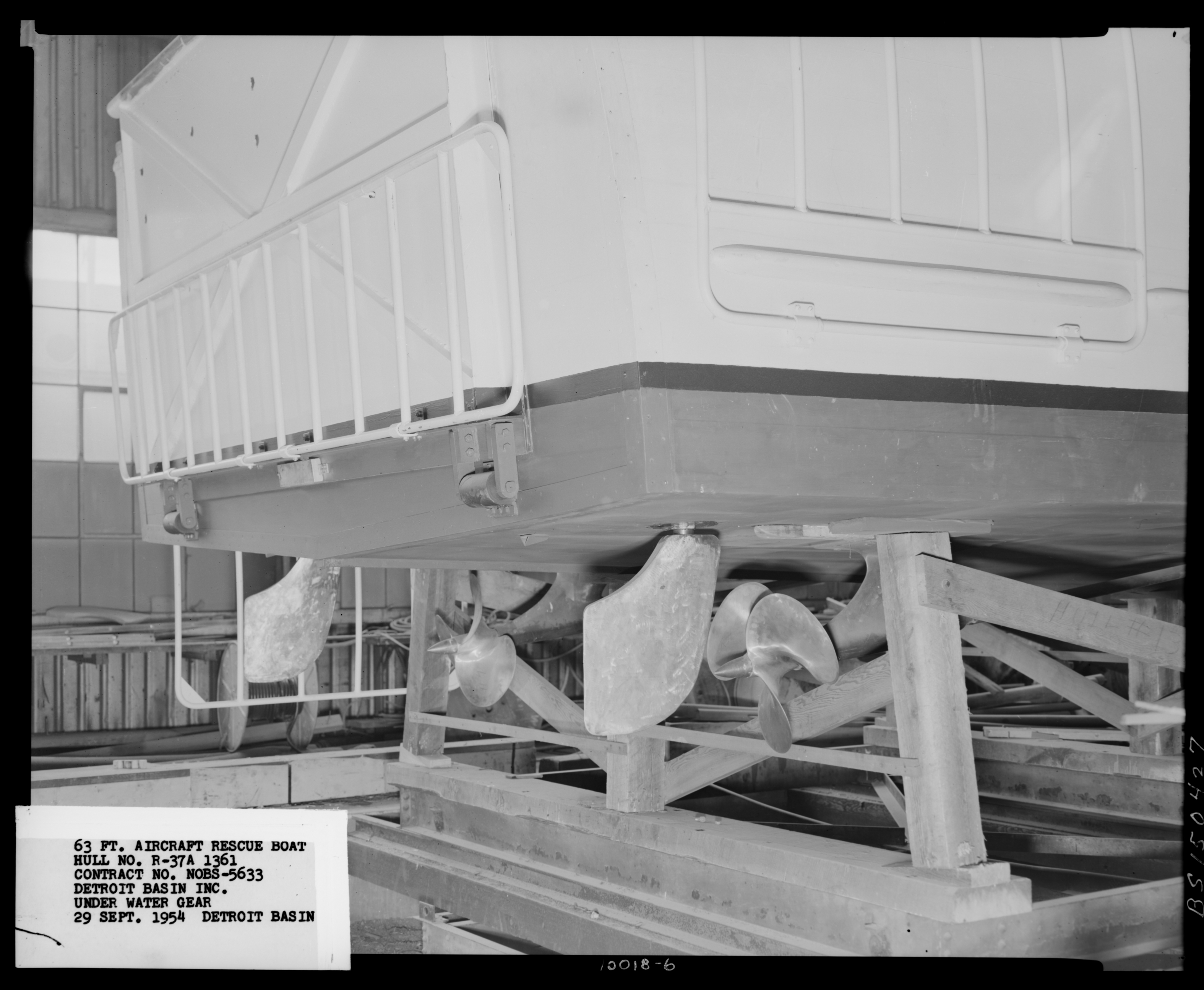
File:CB\63|\Construction\Leg Guards
One of the basic upgrades was the addition of deployable guards to keep arms and legs away from the propellors.
Bodenstein contacted the Navy and they could and would pull the Mk2 specs on the 63 ft. boats and offered to incorporate the improvements he wanted, except the heating system which would require major changes to the design. The boats built to original specs were Mk2s but those built later, incorporating the upgrades, would be Mk3s. When Bodenstein took his data back to the USAF bosses, they went ballistic, higher than their missiles! They argued over design, materials, and other matters about which they were totally unqualified to judge since they had no experience building boats.
The Air Force agreed to procure a limited number of the Mk2 (the Navy referred to them as Mk3s) boats as a makeshift measure to get something to Korea quickly without the requested updates from Communications, Supply, or Maintenance. The situation in Korea was critical and the one thing the USAF did not have was time. Communications succeeded in eliminating the depth finders and most of the other electronics upgrades except the surface search radar.
If the 63 footers seemed difficult, they were a walk on the beach compared to getting 85s into the field. Again these were WWII designs, procured by the Army Quartermaster Corps. Contrary to some reports, the Army quickly gave the Air Force copies of the original plans and specs but they were no longer in the boat buying business, per the DOD reorganization of 1947, so they could offer no further help. The Navy was responsible for watercraft procurement for all service branches. The Navy was willing to procure more of the boats and handle contracting of the job as long as the Air Force had the funds. However, it would not accept responsibility for updating the plans or specs, nor would it accept responsibility for performance after delivery. In addition, the Air Force would have to be responsible for supplying the builders all of the government furnished items needed, such as aircraft radios, engines, IFF units, or any other Air Force specified special items. The Navy had no engineering or historical data on these boats, thus they were a completely new and foreign design to the Navy engineers and architects. The Navy attitude was that they had not designed the boat, nor had they contracted the original purchase, so they would not be responsible for the final product.
Then there was the issue of engines. While Packard was not out of business; they produced their last car in 1958, by 1954 its financial condition was deteriorating, and the Navy no longer used the 4M-2500 engines as the PT boats had been discontinued. The Air Force Depot had been barely able to get by with spare parts purchased from used parts dealers all over the country for this out of production engine. There was no reliable outside source for overhaul of the engines; it would have to be done “in-house”. The power plant closest to the Packard that was in production was a 1,000-hp. cast iron Caterpillar diesel the Navy used in their minesweepers, but that was 500 hp. less than the aluminum Packard and its size and weight were nearly twice that of a Packard. The engine room of the 85 was too small to accommodate two of the engines and the hull framing would not support the weight.
94 ft. Crash Boat
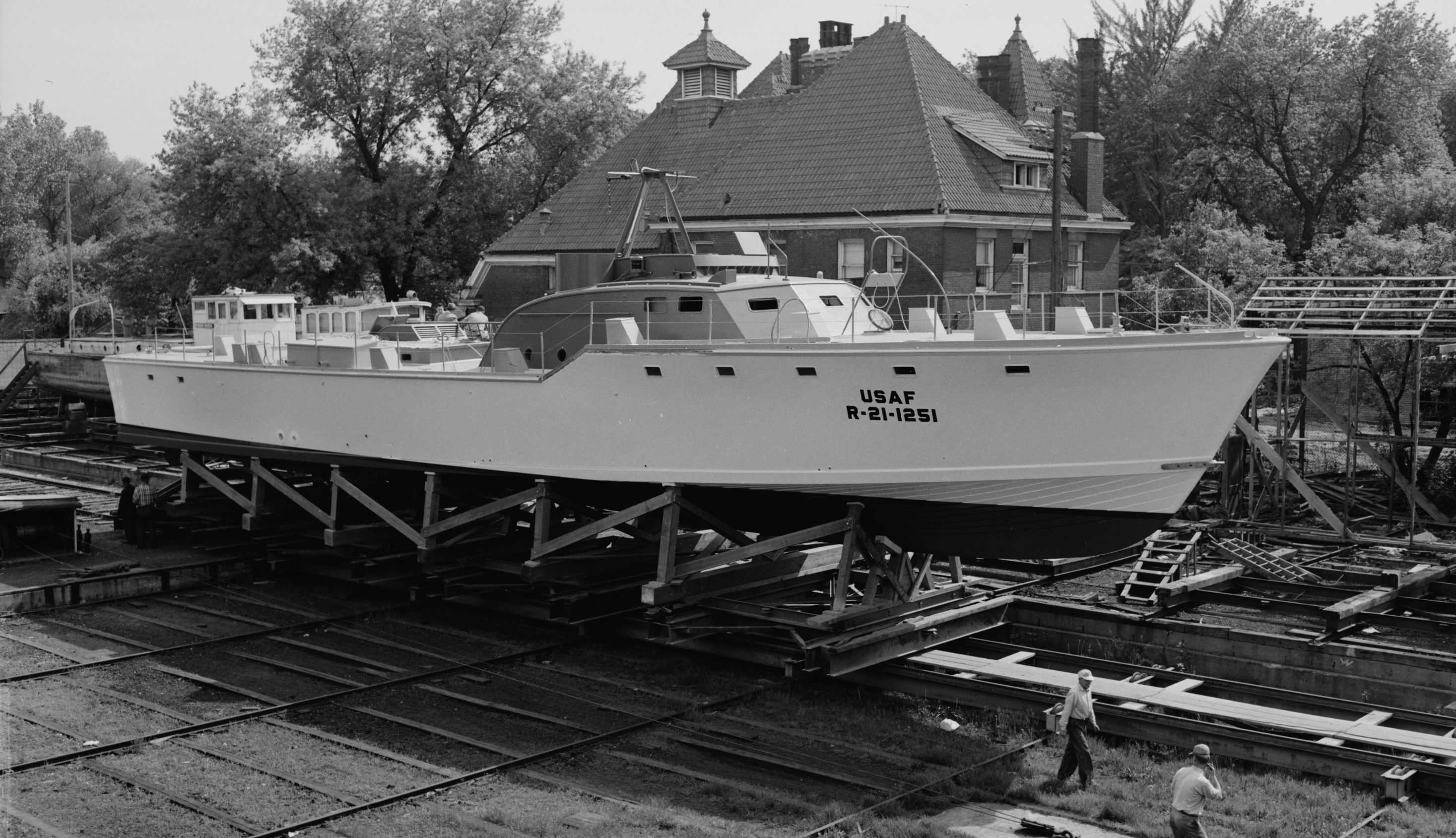
Lt. Col. William Bodenstein eventually persuaded the Air Staff that the only sensible path forward was to stop trying to modernize obsolete World War II hulls and instead commission a completely new rescue boat, built around three of the modern diesels then available. His plan was modest and logical: design the boat first, then build one prototype for testing before committing to production. The Air Force, however, decided to build two—perhaps to satisfy political interests, or simply because no one wanted to appear timid.
After the usual rounds of inter‑service negotiations and bureaucratic self‑protection, the Army—whose involvement remains something of a mystery—agreed to contract the design work to the famed naval architect John Hacker. Hacker was tasked with creating a boat that incorporated the Air Force’s entire “wish list.” Once the design was approved, the Navy would handle procurement, provided the Air Force supplied the funding. But the Navy made its position clear: it would guarantee only that the boats were built to specification. Any design flaw, performance issue, or operational failure would be the Air Force’s problem alone.
50 t0 55 ft. Crash Boats
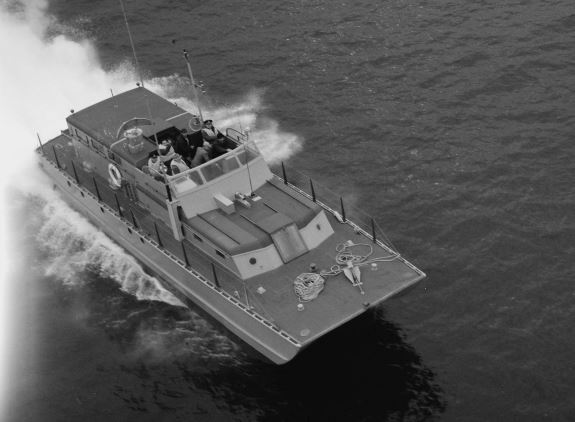
Documentation on the next experimental boat is far thinner, but a handful of photographs preserved in the National Archives—and reproduced in the Photos & Missions section—confirm that the Air Force tested a very unusual craft in the mid‑1950s: R‑22‑1325, a 55‑foot experimental crash boat with a 16‑foot beam, built by the Grebe Boatyard in Chicago around 1953–54. Seen from the air, she was unmistakable—unlike any other crash boat in the inventory.
Trials in 1954 revealed just how radical she was. With two post‑war Packard engines producing roughly 2,000 brake horsepower each—likely highly supercharged 4M‑2500s or the extremely rare 1M‑3300s—she reached an astonishing 70 miles per hour. At that speed she behaved less like a rescue craft and more like an offshore racing boat, complete with a towering rooster tail. When fitted with two 750‑hp Packard 1D‑2270 diesels, she still managed 47 mph, and with two Hall‑Scott engines she ran at 40 mph. But 70 mph was simply too fast; the boat spent as much time airborne as in the water.
40 to 45 ft. Crash Boats
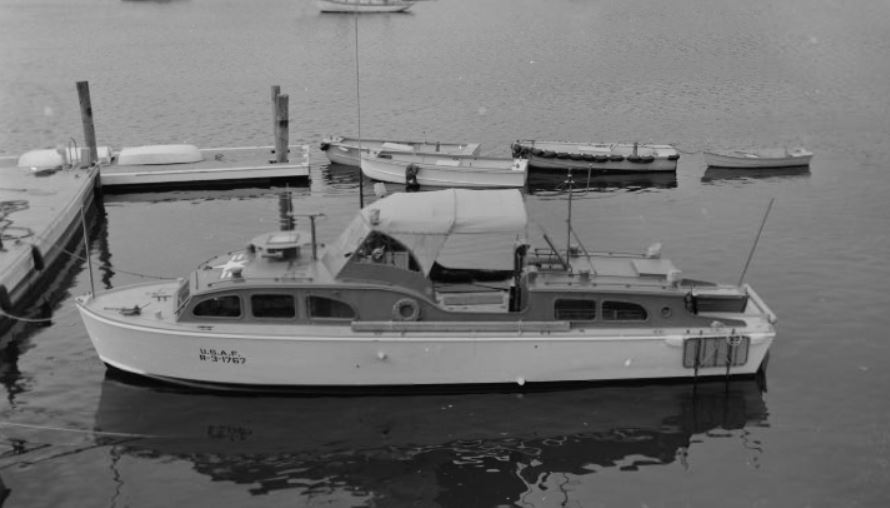
By the early 1950s, the Air Force knew its aging 42‑foot Owens rescue boats—veterans of World War II—were overdue for replacement. What the service wanted was a modern craft in the 40‑ to 45‑foot range. The historical record, however, is confusing. Some documents refer to a new 45‑foot rescue boat, while photographs from the National Archives clearly label a 40‑footer. It is highly unlikely that the Air Force was simultaneously developing two nearly identical designs at a time when helicopters were already being viewed as the future of rescue work. Far more plausible is that one source or the other misidentified the prototype.
As more photographs and documents surfaced, a clearer picture emerged. The boat under development was commonly called a 40‑footer, likely referring to its waterline length, but its actual overall length was 43 feet, 3½ inches. Meanwhile, the Navy’s Bureau of Ships was having very similar boats built for both the Navy and the Coast Guard. Rather than wait for the Air Force’s new design to complete testing and evaluation, the USAF decided to procure the Navy’s version as an interim solution.