Class Three - 63 Ft. Crash Boats
File: 63\ BS-135343
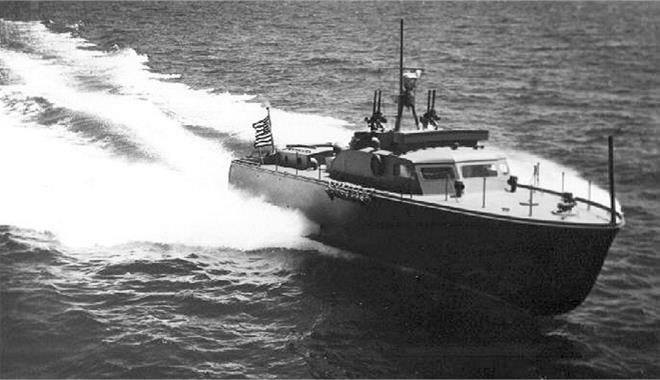
The 63-foot Aircraft Rescue Vessels—designated AVRs—formed one of the most remarkable classes of high-speed rescue craft built during World War II. The Miami Shipbuilding Corporation, founded in 1939 and formerly known as Fogel Boat Yard, received the first US Navy contract for the construction of small, fast and lightly armed "Crash Boats" in its first year of existence. Most of the information in this section comes indirectly from Jean E. Buhler (1917-2012), Chief Technical Officer of Miami Shipbuilding Corporation. His older brothers, Theod130 Miami Shipbuilding Corporation (MSC) learned that the Union of South Africa was interested in purchasing rescue boats that the builder would guarantee to make 42 knots. The most powerful engine on the market was the 1250 horsepower Packard 4M-2500-W8, but the U.S. Navy had restricted their use to PT-Boats. The 630 hp Hall-Scott “Defender” engine was attractive but the production was sold out to the British for the next year. The third most powerful engine was the Kermath 500 hp “Sea Raider” and it was available.
Miami Shipbuilding decided to use four Sea Raiders to get 2000 hp and then rework the Stevens tank data to determine the largest boat that could be built to get 43 knots. The result was the 63-foot Aircraft Rescue Boat. With all its variants, it was the most popular crash boat, with 740 built, including 2 that the Australians built.
Though Miami Shipbuilding also produced two prototype PTs, production contracts were passed to more experienced builders. However, the yard received a large contract for building crash boats for lend/lease to Russia, and ended up producing 50 of the type by the end of 1943. Further orders followed from allied navies, and by the end of the war Miami Shipbuilding had sent over 200 crash boats down its ways for the Russian, British, Australian Dutch and South African armed forces, a large part of the 329 boats MSC built during the war.
The US Army Air Forces used only 63 foot models 314 and 416, described further on, during WW II. The model 314 boats were acquired through Navy contracts. MSC Built 146 of the model 314 but model 416 was built to Army specifications. Collectively all 63s were often referred to as "Class III" Boats. During WWII these boats were painted gray but there were a few painted black in the Philippines for special operations. During peace time the hulls were white, decks yellow, and the sides of the superstructure orange. This paint scheme was also used by 63 ft. boats during the Korean War as they were in South Korean waters where they were not likely to come under hostile fire.
Typically, the 63 ft. boat carried a crew of 8 to 10 men consisting of one Master; two Engineers; one Medical Tech; one Radio Operator, one Cook; and two or three A/B Seamen.
The designation “AVR” stood for Auxiliary Vessel, Rescue (or Aircraft Vessel, Rescue, depending on the source). Some naval references suggested that the “V” identified the craft as aviation-related, echoing the terminology of aircraft carriers. Whatever the meaning, these boats were part of a unique fleet dedicated to rescuing pilots from downed aircraft, often in treacherous coastal and offshore waters.
Though designed for the U.S. Navy, many AVRs were transferred to the U.S. Army Air Forces, their production funded by Army allocations. Early batches were supplied to Allied nations under the Lend-Lease program. Designed by Dair N. Long just before World War II, the AVRs were smaller and more lightly armed than the famous PT boats. Each carried only four .50-caliber machine guns mounted in two twin “tubs,” relying on speed and agility rather than heavy firepower. Typically crewed by eight men and capable of transporting six stretcher-bound casualties, these boats became the lifeline for downed airmen across the Atlantic, Pacific, and Mediterranean theaters.
While primarily used for rescue, the Navy occasionally assigned AVRs to patrol and antisubmarine duties. In these roles, crews often added depth-charge racks to the stern, and some sources mention installations of 20mm Oerlikon cannons—though this appears to have applied only to the Model 293 and not to the standard 63-footers, where space constraints made such armament impractical. In the South Pacific, some crews improvised by mounting an additional .50-caliber gun on the bow, providing better forward coverage against attacking aircraft and helping the vessel get on plane faster due to the added weight forward.
The robust design of the 63-footers was documented in a series of Bureau of Ships drawings, standard across models, since all shared identical hull dimensions. Variations among the models were chiefly in the superstructure and interior arrangements rather than in the hull form itself.
The following is a partial list of BuShips drawing numbers for the Mark 3 63 ft. rescue boat but all 63 ft. rescue boats seem to share the same hull dimensions so these drawings should serve for all the hulls. The variations appear in the superstructure from one series to the next. I do not have these drawings but they may be available from the N.A.R.A. in College Park, MD or the Navy Yard in Washington, DC.
- S8203(5) -63-1387683 - Lines and Offsets
- S8203(5) -63-1387684 - Outboard Profile
- S8203(5) -63-1387685 - Inboard Profile and Arrangement Plan
- S8203(5) -63-1387686 - Deck Plan
- S8203(5) -63-1387688 - Framing Plan & Profile
- S8203(5) -63-1387689 -Shipping Cradle & Lifting Sling
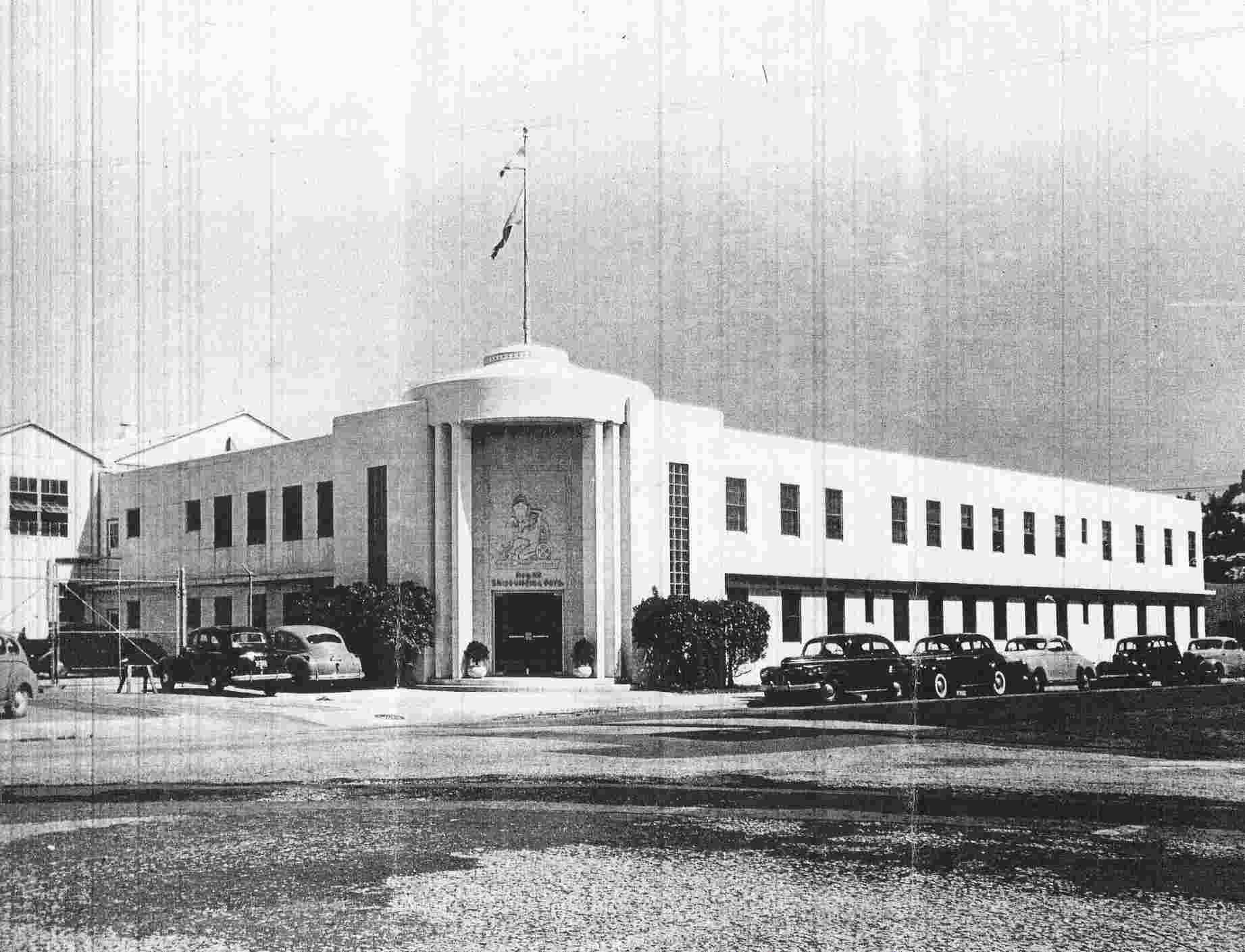
During World War II, Miami Shipbuilding was the second largest employer in Miami-Dade County, employing about 1,800 people on both sides of the Miami River. After the war MSC worked with the US Navy on several hydrofoil development projects. MSC's participation in projects wound down in 1960 and shortly thereafter the company ceased operation.
The MSC Building was used as Police Headquarters in the 1980s TV series Miami Vice and the building was demolished in the 1990s. File: 63\MSB Office
Model 127 - The South African R-Boats (Production Run of 8)
The story of the 63-foot AVRs began with the Model 127, which originated from a proposal Miami Shipbuilding Corporation submitted to the Union of South Africa through the British Purchasing Commission. The company was awarded a U.S. Navy contract to build eight boats—designated R-1 through R-8—at a cost of roughly $125,000 each, an impressive sum in 1941.
These early boats were built to exceptionally high standards. All fittings were bronze, structural fixtures such as door frames and portholes were aluminum, and even galley ware and utensils were stainless steel. Each boat came fully appointed, with linens, blankets, and pillows, and included a nine-foot sailing dinghy designed by Dair Long. Notably, these early 63-footers lacked a flying bridge and featured a long trunk cabin aft of the pilothouse.
Speed trials for R-1 commenced on March 3, 1941, along Miami’s County (now MacArthur) Causeway, where the Army Corps of Engineers had laid out a one-mile testing course. Every boat exceeded its guaranteed 42-knot speed, impressing onlookers and frequently bringing traffic on the causeway to a standstill. Powered by four 500-horsepower Kermath “Sea Raider” engines, these vessels delivered agility and speed unmatched by anything of their size.
When it came time for delivery, practical challenges arose. With no cranes in Miami capable of hoisting a 50,000-pound boat, the ships had to be towed 25 miles north to Port Everglades for loading aboard the freighter SS Lancaster, which carried them to South Africa in April 1941.
During these trials, Miami Shipbuilding engineers found themselves competing informally with newly arrived PT boats of Navy Squadron 2. The lighter, more nimble 63-footers reportedly outpaced and outmaneuvered the PTs on a 30-mile run to Hillsboro Light—a testament to their superb design.
Model 152 – The British “Miami” Rescue Boats (Production Run of 82)
The success of the South African R-boats soon attracted British interest. At the outset of the war, Britain ordered additional 63-footers and diverted fourteen Hall-Scott “Defender” V12 engines from other builds to power them. These twin-engine boats produced 1,260 horsepower and could reach 36 knots (about 42 mph).
Although the basic hull remained unchanged, the internal layout was redesigned. The engine compartment was relocated aft and coupled with new V-drive transmissions, freeing cabin space and redistributing fuel tanks beneath the aft berths. The Model 152 introduced the first flying bridge, gun tubs, and mast—features that became standards in later versions. For operational and logistical reasons, British crews came to call all Miami Shipbuilding 63-foot rescue boats “Miamis,” regardless of model. Production of the Model 152 ended prematurely when Watson-Flagg, the supplier of the V-drive units, could not keep up with
Model 168 – The Packard-Powered “Special Operations” Boats (Production Run of 16)
In 1942, the U.S. Navy Bureau of Aeronautics became interested in a high-performance version of the 63-footer. The resulting Model 168 was powered by two 1,250-horsepower Packard 4M-2500 engines—the same type used in PT boats—giving these craft blistering speeds of up to 48 knots (55 mph).
The hull form and general arrangement were similar to the Model 152, but the extra horsepower required stronger V-drives, additional fuel storage, and a redesigned steering system. These boats were likely used for special operations. Their exhaust typically exited through the hull sides just above the waterline, though some export versions, such as the Belgian boat BENGA, had transom exhausts.
The trial runs of the Model 168 confirmed its exceptional speed but revealed challenges with hydraulic steering due to both propellers turning right-handed, which caused a strong bias to starboard. Constant manual compensation was required from the helmsman. The issue was later resolved with a mechanical steering system designed by Selden L. Stewart, who succeeded Dair Long as chief engineer at Miami Shipbuilding after Long departed to develop the 85-foot rescue boat for the Army Transportation Corps.
Despite their quirks, the Model 168s represented the pinnacle of the 63-foot line’s speed and innovation—a final expression of Dair Long’s design vision for compact, fast, and versatile rescue craft.
The evolution of the 63-foot Aircraft Rescue Vessel reached a high point with the series of models that followed the early wartime designs. Each new version reflected changes in available materials, shifting priorities, and battlefield demands. The story of the later models—252, 293, 314, and 440—reveals how a combination of ingenuity, improvisation, and wartime necessity shaped some of the most versatile small craft ever built for the U.S. military and its allies.
Model 252 – Production Run of 11
The Model 252 represented a bridge between the earlier experimental designs and the wartime production standards. Only eleven of these boats were built, all destined for service with the Union of South Africa. They were powered by two pairs of Kermath “Sea Raider” 550-horsepower engines, mounted nose-to-nose on each of two shafts—four engines in total. This configuration created a combined 2,200 horsepower and eliminated the need for the more complex V-drive systems, which were increasingly scarce.
Structurally, the Model 252 resembled the earlier Model 152, essentially a straight-drive adaptation but incorporating the flying bridge introduced on the Model 168. Although fitted with gun tubs, there is no evidence that any were armed. The exhaust system was repositioned to exit cleanly through the transom. These boats performed well in their role and stood as a testament to Miami Shipbuilding’s ability to adapt proven designs to meet Allied needs under difficult supply conditions.
Model 293 – The “Sub Chaser” Variant, Production Run of 76
The Model 293 was a direct outgrowth of the wartime shift toward more offensive coastal operations. With a total production run of 76, these flush-decked craft were engineered as small submarine chasers, effectively transforming the standard rescue vessel into a multi-role combat platform.
Built by various shipyards, including Trumpy and Miami Shipbuilding, the 293 featured Hall-Scott “Defender” 650-horsepower straight-drive engines mounted amidships. The elimination of the aft cockpit created room for four depth charge racks on each side near the stern on Trumpy-built boats, while Miami Shipbuilding fitted three per side and two across the stern, maintaining the same total of eight.
The most visible difference in this model was the addition of a 20mm Oerlikon cannon aft, which gave the boat a true combat capability. Some of these vessels were delivered to Russia under Lend-Lease, designated as Russian Patrol Craft (RPC), while others served as PTC or SC (Small Sub Chasers) in the U.S. Navy. Their aft sections were reconfigured to make room for extra fuel, ammunition, and ordnance rather than rescue facilities.
Because of the overlapping production runs and frequent reallocation between Allied fleets, tracking the individual fates of the Model 293 boats remains notoriously difficult. Even the meticulous “Builders, Boats & Dates” database contains unavoidable inconsistencies due to these wartime shuffles.
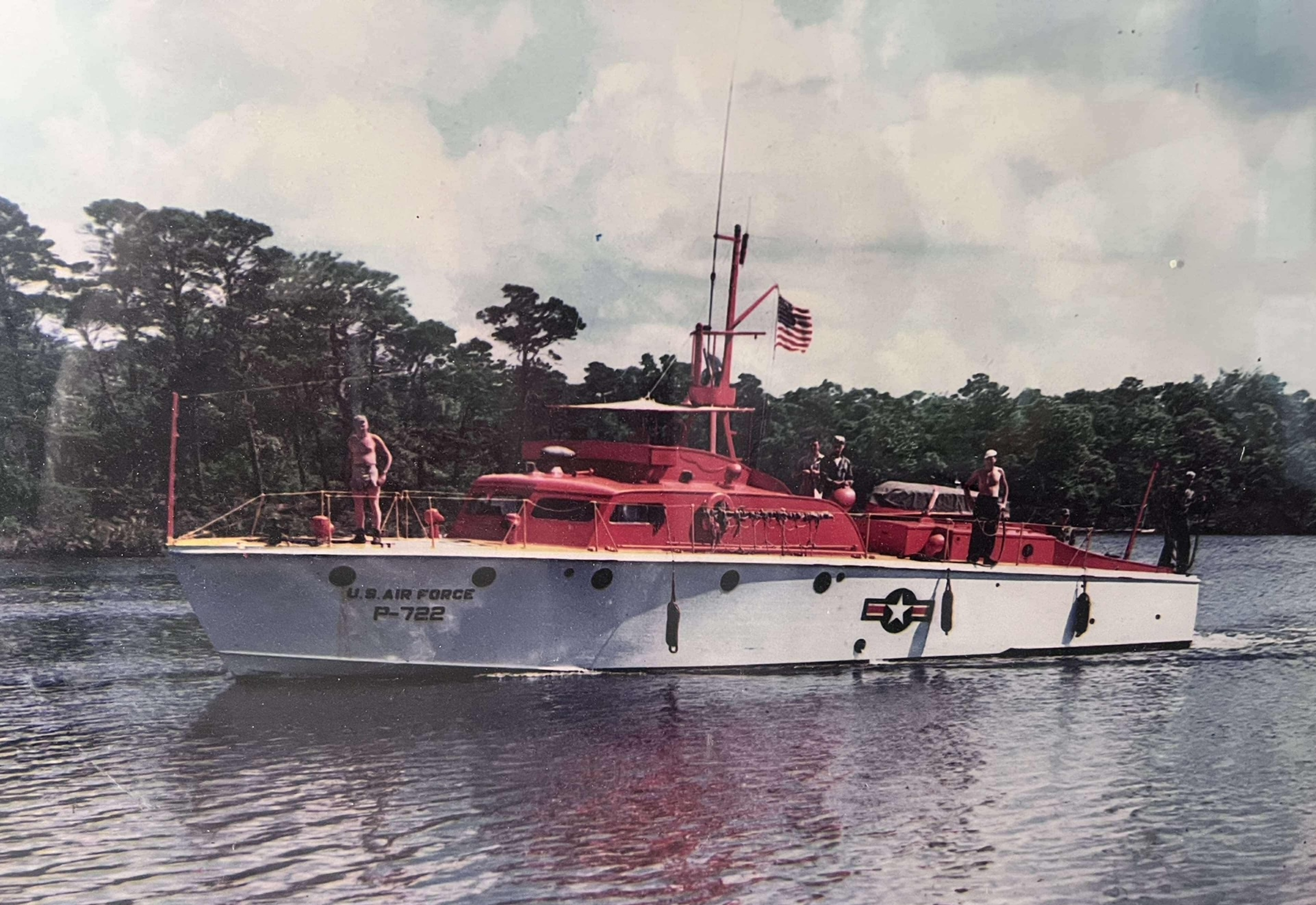
P-722, a model 314, was built in 1944 by Miami Shipbuilding. Photo shortly after establishment of the USAF, she still has her AAF number but above it is added U.S. Air Force. She is in peacetime colors. File: Folder P-722 Cropped
Model 314 – The Wartime Standard
By far the most significant of all 63-foot variants, the Model 314 became the standard U.S. Navy crash boat, with a remarkable 352 units built. It represented the culmination of earlier experimentation and practical refinements.
Most of the Model 314 boats were commissioned for the U.S. Navy, though smaller numbers were delivered to the Netherlands, the Royal Air Force, and later to the Coast Guard and U.S. Army Air Forces. Australia received about twenty of the type. The Navy ultimately absorbed around 240 of these boats, a clear indication of their reliability.
The 314 model emerged partly out of crisis. Production of the earlier Model 152 had been slowed by delays in the delivery of Watson-Flagg V-drive units. To address the bottleneck, Miami Shipbuilding redesigned the propulsion layout, keeping the Hall-Scott “Defender” engines amidships and eliminating the V-drive altogether. The result was a simpler straight-drive configuration using the same proven hull form.
The new internal arrangement maintained the familiar forward compartments—crew’s quarters, pilothouse, officers’ stateroom, radio room, and galley—but aft of midships, the layout was completely reimagined. The engine room was followed by a tank and dispensary section, a cockpit or “well deck,” and finally the lazarette, accessible through a seat hatch in the cockpit. This model also introduced the distinctive A-frame hoist, used to lift rescued airmen directly from the water into the cockpit for medical treatment.
When the Navy saw the success of the revised design, it expanded production dramatically, assigning Miami Shipbuilding as lead yard and design authority, responsible for supplying blueprints, parts, and supervision to seven additional shipyards. Technical refinements continued—engine shaft angles were adjusted, twin self-sealing 795-gallon fuel tanks were adopted, and a new torque tube steering system replaced the troublesome hydraulic gear. The Model 314’s exhaust exited just above the waterline, slightly aft of the last porthole—consistent with boats lacking V-drives.
By the end of World War II, the Model 314 had become the backbone of American air-sea rescue operations worldwide. However, by late 1945, many of these wooden craft had suffered damage or deterioration from years of tropical service. During postwar surveys in the Philippines around Samar Bay, nearly half the boats inspected were deemed unrepairable due to rot and marine borer damage. In the fall of 1945, the Navy chose to burn approximately 200 obsolete crash and PT boats rather than store them—massive bonfires that marked the quiet end of a wartime fleet.
In May 1946, the remaining serviceable boats were stripped of armament and sold off by the U.S. Maritime Commission. Many found new lives as fishing boats, charter vessels, ferries, or movie props. A handful survive today, lovingly restored by private owners and enthusiasts who recognize their historical importance.
Model (Design) 416, Production Run of 79
The US Army used the term Design number rather than model number and determined the number entirely independent of MSC. This was the model number for 63 ft. boats built to US Army Air Force specifications. This model was built on an Army contract and the boats were built by Herreshoff Industries, Stephens Brothers, and Truscott. This model was very similar, and in most respects identical to the MSC Model 314, with firefighting capability added. Two fire hose nozzles were mounted on the forward deck and other extra firefighting equipment also added. The firefighting system could supply water, foam, or fog to the two nozzles mounted to the fore deck. A small Kermath Sea Chief engine to power the single stage centrifugal fire suppression pump, foam generator, and associated plumbing to the nozzles comprised the system.
Model 440 – A Postwar Adaptation, Production Run of 20
The Model 440 was a rare variant based on the Model 314 hull but built under constrained postwar conditions. Only twenty boats were constructed, powered by two Hudson “Invader-168” 250-horsepower engines—an emergency substitution due to the continuing shortage of standard Hall-Scott engines.
Underpowered but reliable, these boats performed admirably in non-combat duties. The U.S. Army took delivery of six of the Model 440s, where they were reclassified as personnel boats under the designation “Q” instead of “P.” They were assigned to the Army Engineer Amphibian Command, providing transportation and ferry services rather than rescue or patrol operations.
The Model 440s marked the final chapter in the 63-foot line—a design lineage that had begun before Pearl Harbor and helped save countless lives through daring rescues in every theater of the war. Together, these vessels embodied the spirit of adaptation and craftsmanship that defined America’s small-boat builders during the Second World War.
63 Ft Aircraft Rescue Boats
Production Totals By Builder and Model/Type
| Builder | Model 127 | Model 152 | Model 168 | Model 252 | Model 293 | Model 314 | Model 416 | Model 440 | Model MK2 | Model MK3 | Model Mk4 | Aust Copy |
|---|---|---|---|---|---|---|---|---|---|---|---|---|
| Miami | 8 | 82 | 16 | 1 | 46 | 146 | 20 | |||||
| Truscott | 37 | 10 | ||||||||||
| Huckins | 33 | |||||||||||
| F & S | 41 | |||||||||||
| Harbor | 43 | 4 | ||||||||||
| So. Coast | 40 | |||||||||||
| Stephens | 12 | 33 | ||||||||||
| Herreshoff | 36 | |||||||||||
| Trumpy | 30 | |||||||||||
| Sample | 12 | |||||||||||
| Stonington | 27* | |||||||||||
| Sagstad | 23 | |||||||||||
| Detroit | 19 | 9 | ||||||||||
| Knutson | 2 | |||||||||||
| Halvorsen | ||||||||||||
| TOTALS | 8 | 82 | 16 | 11 | 76 | 352 | 79 | 20 | 16 | 69 | 9 | 2 |
| Grand Total | 740 |
For much more layout and construction detail, as well as more photos, see the book Crash Boats, by Linley & Holtham.
Mark 3 Specifications, Production run of 69
The hull was dimensionally the same as the earlier variants. Full load displacement was 66,300 lbs and the approximate weight of the shipping cradle was 14,100 lbs. Range at full power was approx. 395 miles; at 25 knots approx. 500 miles; at 15 knots 550 miles.