
Prototype 94 ft. Boat
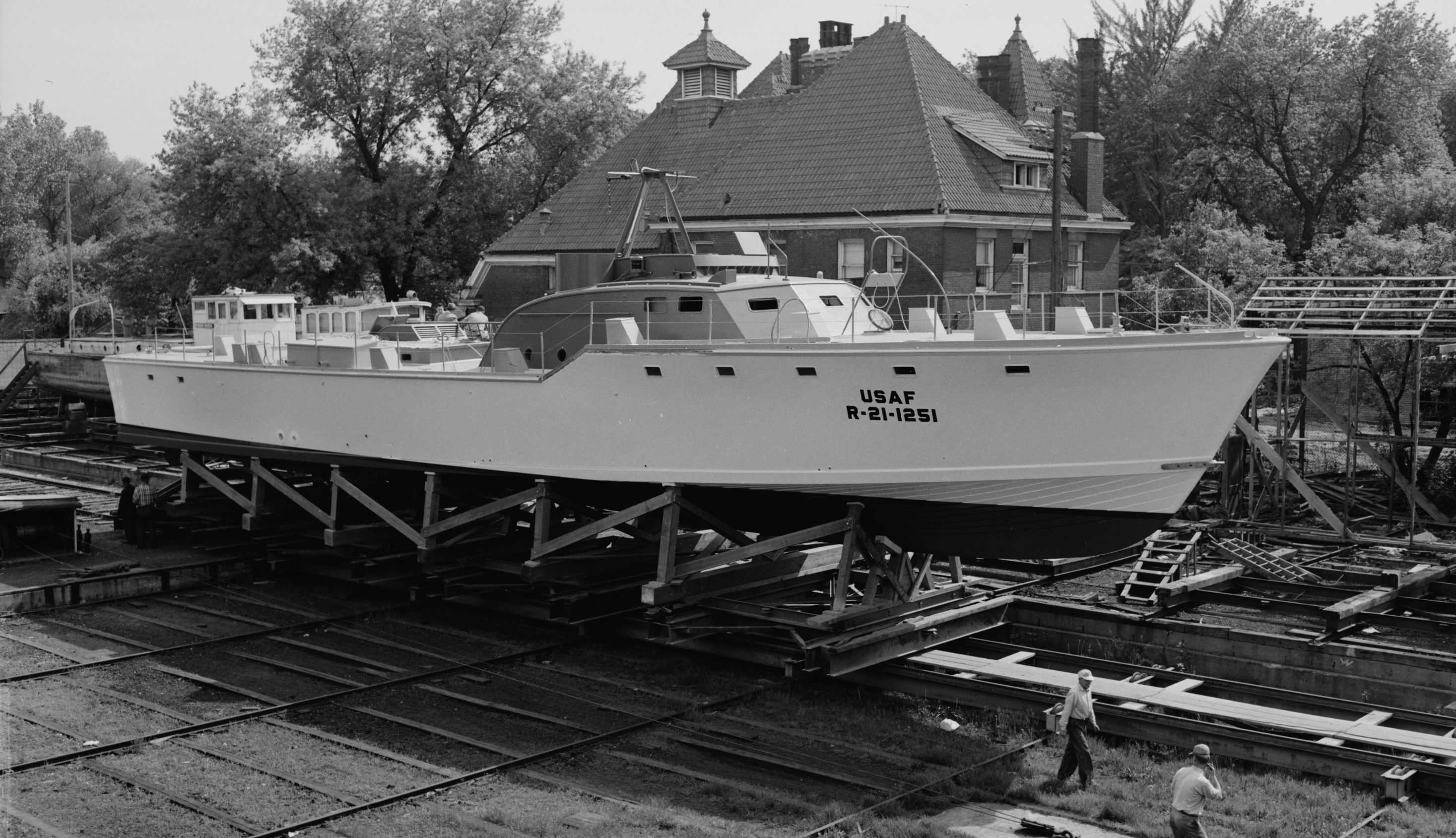
File: 94ft exp\rg19nn-b1571-003-012pr
Lt. Col. William Bodenstein eventually persuaded the Air Staff that the only sensible path forward was to stop trying to modernize obsolete World War II hulls and instead commission a completely new rescue boat, built around three of the modern diesels then available. His plan was modest and logical: design the boat first, then build one prototype for testing before committing to production. The Air Force, however, decided to build two—perhaps to satisfy political interests, or simply because no one wanted to appear timid.
After the usual rounds of inter‑service negotiations and bureaucratic self‑protection, the Army—whose involvement remains something of a mystery—agreed to contract the design work to the famed naval architect John Hacker. Hacker was tasked with creating a boat that incorporated the Air Force’s entire “wish list.” Once the design was approved, the Navy would handle procurement, provided the Air Force supplied the funding. But the Navy made its position clear: it would guarantee only that the boats were built to specification. Any design flaw, performance issue, or operational failure would be the Air Force’s problem alone.
In 1953, two 94‑foot prototypes emerged from this uneasy partnership. They were built with cold‑weather operations in mind—Korea was still the driving concern—and were powered by three Packard 4M‑2500 engines, even though those engines had been out of production for years. The boats boasted a 2,000‑mile range, a cruising speed of 33 knots, a top speed of 42, and a crew of eighteen. One prototype, R‑21‑1251, underwent trials at Langley AFB on the Chesapeake Bay; the other was tested at Hamilton AFB in California.
Originally, the Air Force had hoped to use three 1,000‑hp cast‑iron diesels, but those engines simply couldn’t deliver the required performance. Supply officers then pushed for a “powertrain in a box”—a modular system that could be removed as a single unit from engine to propeller. In theory, this would allow rapid upgrades or engine swaps, especially if better powerplants became available later. In practice, it meant a major redesign of the experimental boat, and it ignored the reality that crews would still need access to the components inside the box for routine maintenance. The idea reflected a growing awareness that the diesels were inadequate and that the Air Force might need to replace them quickly once production began.
By the 1950s, gasoline engines were falling out of favor in marine applications for safety reasons, yet the Air Force found itself circling back to Packard gasoline engines anyway. According to U.S. Small Combatants, the boat’s proponents even experimented with three Packard 1M‑3000 engines—sixteen‑cylinder monsters producing 2,500 hp each. With these, the boat reportedly cruised at 40 mph and reached 51 mph at full throttle. But using them in production would have required Packard to restart manufacturing or license the design, neither of which was realistic. Four of Packard’s 750‑hp diesels, the 1D‑2270s, were also tested, but they yielded only 28 mph cruising and 33 mph maximum—far below requirements.
Meanwhile, Air Force supply officers continued insisting that the boats be built from components already in USAF inventory, with little regard for the corrosive realities of marine service. They also resisted adding any electronics not already used in aircraft, which meant omitting basic maritime necessities like a fathometer or SSB radio. It was a familiar pattern: if it didn’t fly, it didn’t matter. And because senior officers could fly airplanes, many assumed they understood boats better than the Navy, which had been building them for generations.
Testing quickly revealed the consequences of these decisions. The prototypes suffered from repeated malfunctions and equipment failures. They were returned to the builders again and again for corrections and modifications. Aircraft hardware—especially instruments and electrical connectors—performed poorly in the marine environment, causing delays so frequent that test schedules became almost meaningless. In the end, no additional boats were built.
After three months of slow, frustrating progress, Lt. Col. Bodenstein requested release from active duty and returned to civilian life. By the time testing wound down, the Korean War had ended, and the Air Force’s interest in the project evaporated. Both prototypes eventually slipped into obscurity. One ended up in a salvage yard at Hamilton; the other in Bangor, Maine.
Another account claims that in 1956 the boats were transferred to the Navy and assigned to the Beach Jumper Unit at Little Creek, Virginia, becoming hull numbers C‑3727 and C‑3728. R‑21‑1252 (C‑3727) reportedly suffered a fire during Navy service and was scrapped. R‑21‑1251 was sold to the Lundeberg Seamanship School at Piney Point in 1968, then disappeared from the record until around 2005, when she surfaced for sale in Greenwich, New Jersey under the name New Buccaneer. As late as 2017, she was confirmed to be sitting as a derelict hulk.
Photographs of the 94‑foot experimental boats survive, scattered across archives and private collections—a faint reminder of an ambitious idea that never found its footing.