Prototype 40 ft. Boats
By the early 1950s, the Air Force knew its aging 42‑foot Owens rescue boats—veterans of World War II—were overdue for replacement. What the service wanted was a modern craft in the 40‑ to 45‑foot range. The historical record, however, is confusing. Some documents refer to a new 45‑foot rescue boat, while photographs from the National Archives clearly label a 40‑footer. It is highly unlikely that the Air Force was simultaneously developing two nearly identical designs at a time when helicopters were already being viewed as the future of rescue work. Far more plausible is that one source or the other misidentified the prototype.
As more photographs and documents surfaced, a clearer picture emerged. The boat under development was commonly called a 40‑footer, likely referring to its waterline length, but its actual overall length was 43 feet, 3½ inches. Meanwhile, the Navy’s Bureau of Ships was having very similar boats built for both the Navy and the Coast Guard. Rather than wait for the Air Force’s new design to complete testing and evaluation, the USAF decided to procure the Navy’s version as an interim solution.
USAF Mark 1
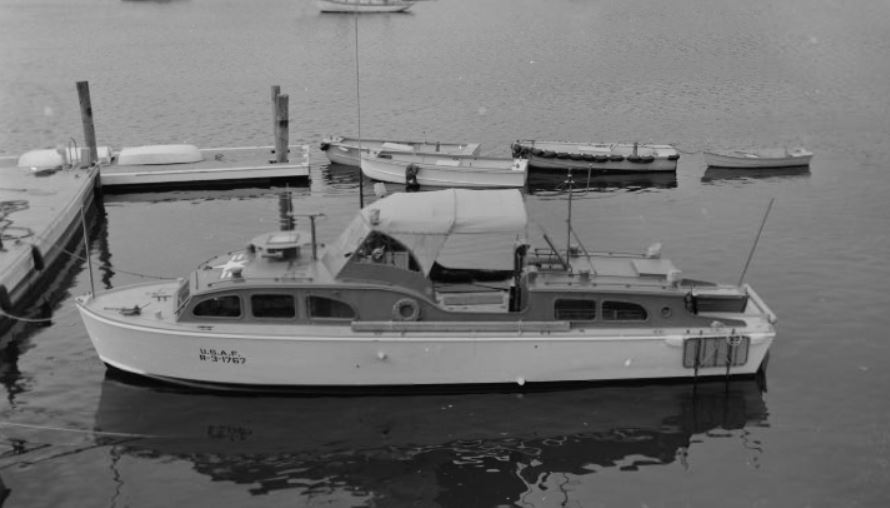
Photo Courtesy of Knutson Boat File: 40ft\Knutson
Navy Mark 2
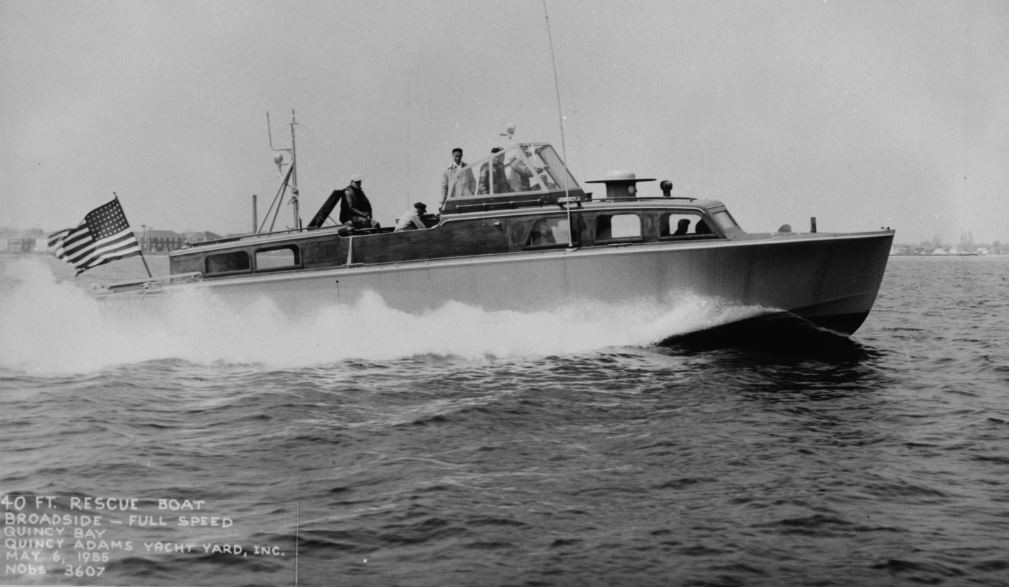
On sea trials, explains all the people. File 40ft\Mark 2\cropped
That interim solution soon became permanent. The Navy design proved entirely satisfactory, and the Air Force’s 40‑foot development program was quietly abandoned.
There is solid documentation showing that the Air Force took delivery of ten of these Navy‑designed boats between 22 August and 1 October 1956. Their Navy hull numbers appear elsewhere in the site’s database, though their USAF hull numbers remain elusive. What is known is that they were designated **R‑3‑**** in Air Force service.
One of them, R‑3‑737, was assigned to the 8th Crash Rescue Boat Flight at MacDill AFB in Florida. Three others were distributed to bases along the East Coast, likely for evaluation or operational trials. The remaining boats were delivered to the Air Force depot in Bayonne, New Jersey. But they never saw service.
Before the last of them could be assigned or deployed, the entire USAF Crash Boat Service was terminated. The boats arrived just as the era of fixed‑wing and helicopter‑based rescue was taking over, leaving these new craft stranded at the edge of a disappearing mission.
| Item | Mark 1 (Air Force Boats) | Mark 2 (Navy Boats) |
| Purpose | Waterborne Rescue | Waterborne Rescue |
| Capacity, Including Crew | 9 | 13 |
| Crew | 5 | 5 |
| Length Overall | 43' 3.5" | 44' 2.75" |
| Beam | 11' 6.5" | 12' 4.75" |
| Draft | 3' 6" | 2' 6" (2' 6" unlikely, probably 3' 6") |
| Full Load Displacement | 26,330 lbs. | 26,920 lbs. |
| Hoisting Weight | 25,670 lbs. | 25,600 lbs. |
| Hoisted by | Sling | Sling |
| Construction | Wood Frame, Carvel Plank Over Plywood | Wood Frame, Double Carvel Planked |
| Speed at Full Load Displacement | 20 knots | 21 knots |
| Fuel Capacity | 170 gallons | 200 gallons |
| 200 gallons | 140 nautical miles | 130 nautical miles |
| Engines, Detroit Diesel | Model 64H10, 165 hp @ 1800 rpm continuous, 225 hp @ 2100 rpm emergency | Model 64HN10 or 6072A Each made: 165 hp @ 1800 rpm continous, 225 hp @ 2100 rpm emergency |
| Props | (2) 22" X 16" X 1.75" bore 1 left, 1 right | (2) 21" X 15" X1.75" bore 1 Left, 1 right |
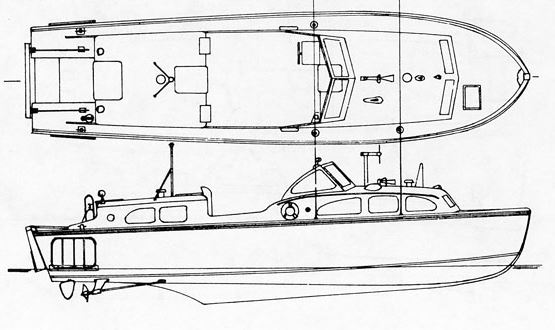
Exterior Plan Mark I Boats
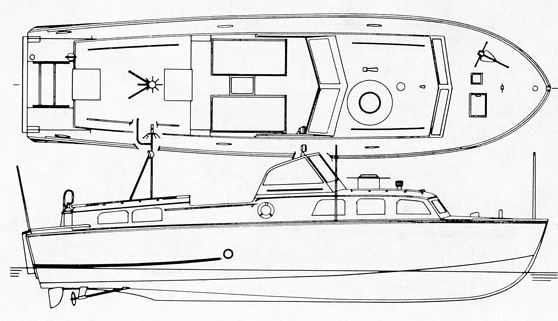
Exterior Plan, Mark 2