Kermath Sea Raider Engines
File: Engine\Kermath\001
The Sea Raider Special was a twelve-cylinder, V-type marine engine and served as the original powerplant for the early 104-foot crash boats. As engine technology advanced and operational demands increased, it was eventually replaced—first by the Hall-Scott Defender and later by the more powerful Packard 4M-2500 engines. With a displacement of 1,414 cubic inches and an output ranging between 450 and 550 horsepower, the Sea Raider Special was notably smaller than the engines that succeeded it, yet it represented a sophisticated design for its time.
Built specifically for marine service, the Sea Raider Special employed a dry-sump lubrication system and featured four overhead valves per cylinder operated by overhead camshafts. Each cylinder was fired by twin spark plugs, a configuration that enhanced combustion efficiency and reliability under demanding conditions at sea. For those interested in deeper technical details, the original engine manual has been preserved and is available in the Manuals & Publications section of the website.
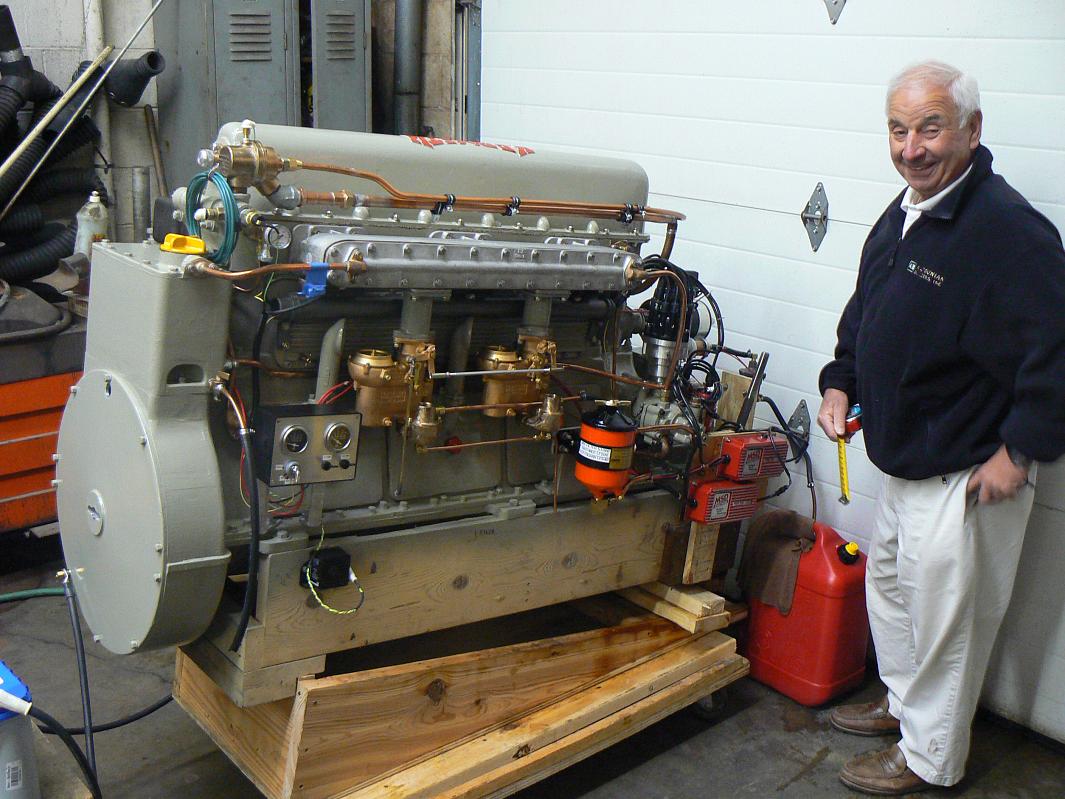
A smaller companion engine, the Sea Raider Six, powered many of the 42-foot rescue boats alongside the Hall-Scott Invader engine. Sources vary on its displacement, placing it somewhere between 800 and 1,000 cubic inches. Although it shared many design features with the twelve-cylinder version, it was not simply half of a larger engine block. Instead, it was purpose-built as a marine engine rather than adapted from an automotive design.
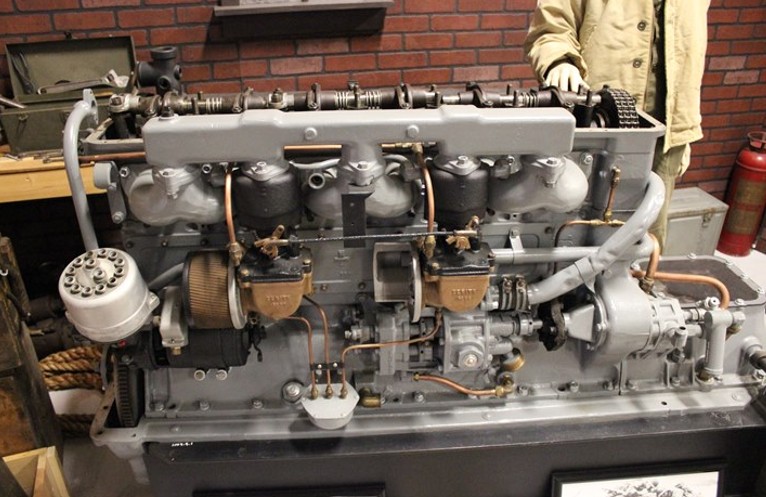
The Sea Raider Six was an inline six-cylinder engine, also using a dry-sump lubrication system with a 24-quart oil capacity. Like its larger counterpart, it featured overhead camshafts, four overhead valves per cylinder, and twin spark plugs for each cylinder. One published specification lists a bore and stroke of 5.75 inches by 6.00 inches, producing approximately 840 cubic inches—though the arithmetic behind that figure has been questioned. Power output was generally cited at about 200 horsepower at 1,800 rpm and 260 horsepower at 2,400 rpm, though most references simply describe it as a 250-horsepower engine. The 42-foot operator’s manual depicts the engine fitted with twin carburetors, operating at a compression ratio of 4.9:1 and burning 72-octane gasoline. However, the engine manual specifies 87 octane gas.
Complete with heat exchanger and reverse gear, the Sea Raider Six weighed approximately 2,500 pounds when filled with fluids. It should not be confused with the similarly named Sea Wolf engine, which displaced 678 cubic inches and produced 225 horsepower, despite sharing several design characteristics.
Before the war, Chris-Craft had a long history of using Kermath engines and was responsible for building a number of the 42-foot rescue boats. For that reason, it is widely believed that Kermath Sea Raider Six engines powered most—if not all—of the rescue boats produced by Chris-Craft, continuing a partnership between builder and engine manufacturer that predated wartime production.