
Class Two - 85 Ft. Crash Boats
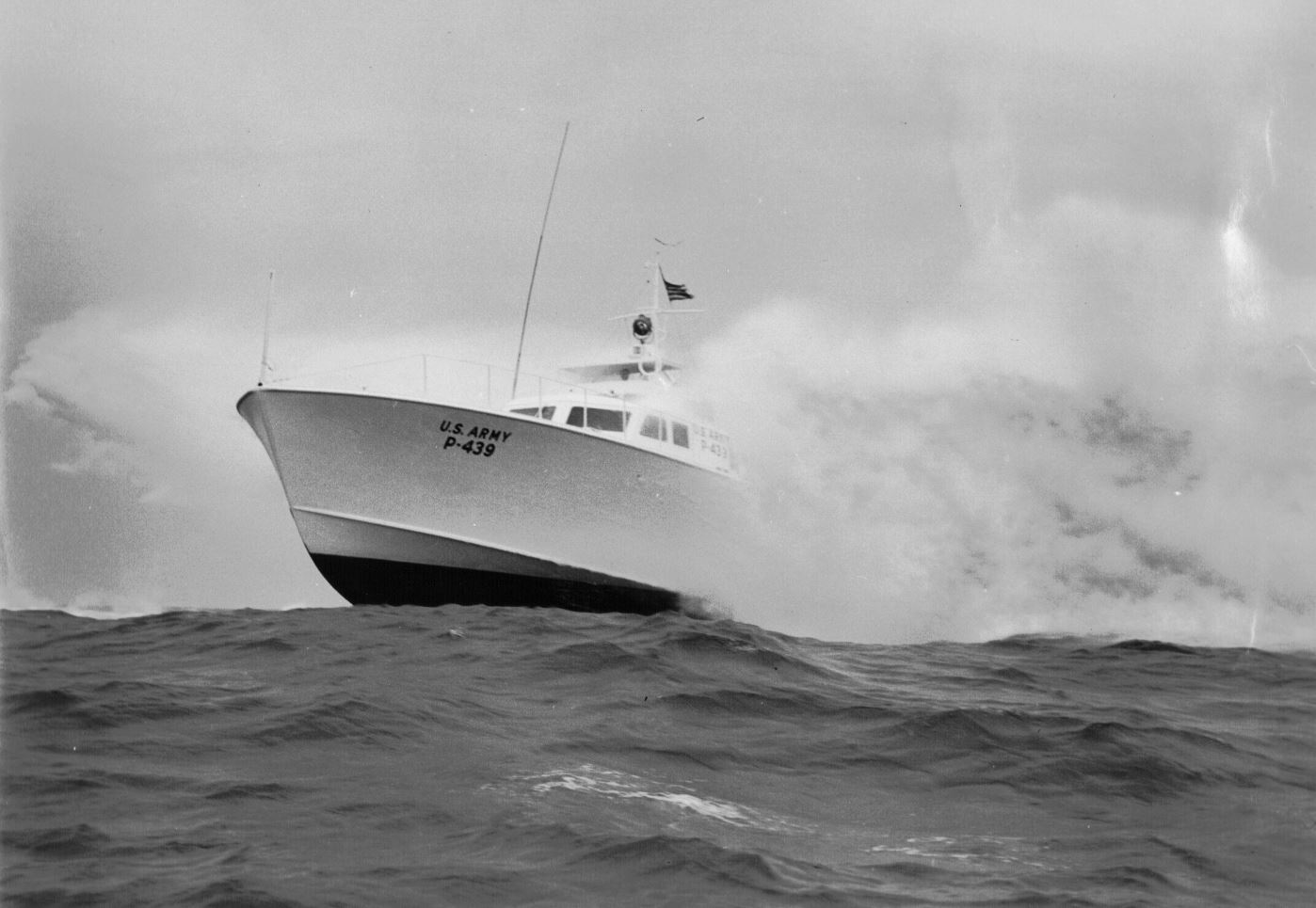
File: 85\P-439 Cropped
Among the rescue boats developed during the war, the ASR‑85s stood at the top of the hierarchy. Often referred to as “Class II” boats, they were considered the ultimate expression of the Army Air Forces’ rescue‑boat program. Their designer, Diar Long, had already proven his skill with the successful 63‑foot AVR. When the Quartermaster Corps approached him for a vessel faster than the 104‑footer, larger than the 63, and capable of crossing oceans, Long essentially scaled up his earlier design. The result was the sleek, powerful 85‑footer, delivered to the AAF in 1944 and 1945. In real‑world rescue operations, their range of roughly 800 miles translated into an operational radius of about 400 miles.
Theoretically, an 85‑footer could cross an ocean. A vessel with a 2,500‑mile range can usually do so in multiple legs, and the 85s—running solely on their low‑speed “cruising” Chrysler M‑10 engines at 6.2 knots—could have managed it, albeit at a painfully slow pace. No official record confirms that any 85‑footer ever completed such a voyage, but one attempt came close. In June 1944, the crew of the 131st AAF Rescue Boat Squadron flew from Gulfport, Mississippi, to Newark, New Jersey, where P‑358 was being modified in Nyack, New York, for a transatlantic crossing via the Great Circle Route to the Azores. Extra bladder tanks were installed in the aft cockpit to extend her range. But when the boat ran into a storm in the Bay of Fundy, the skipper chose to abort the mission and diverted to Halifax, Nova Scotia. By late June, the boat was back in Newark, and rumors circulated that the skipper faced a court‑martial for the decision.
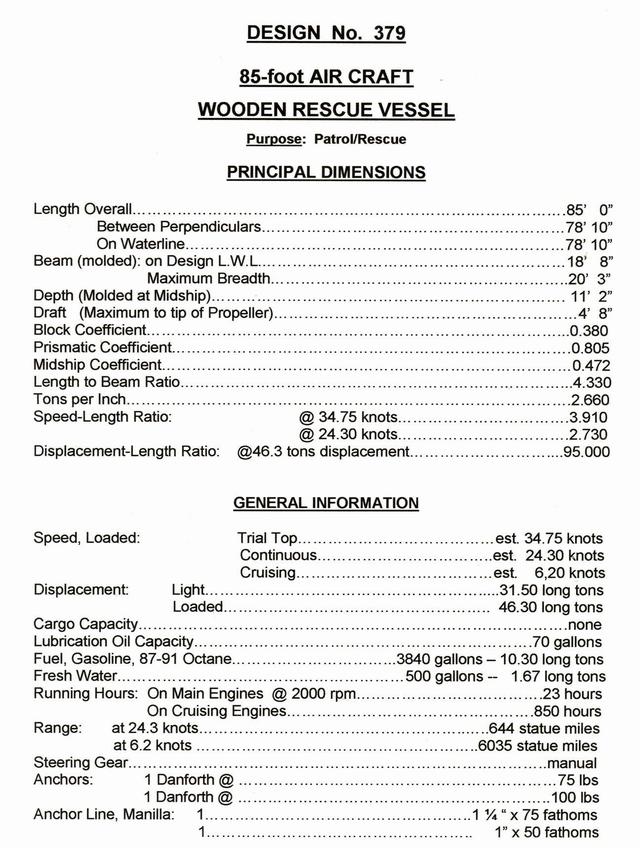
Very few 85‑footers were ever built with the auxiliary Chrysler engines. Plan views, the Operator’s Manual, and accounts from crewmen all suggest that only a handful carried them. One source even claims the “cruising engines” were actually Kermath marine conversions of small Ford 110‑hp V‑8s. Eliminating these engines freed up valuable space—space that was soon put to better use with Kohler 110‑volt generators, which crews desperately needed.
The space constraints created by the auxiliary engines may also explain why the 85s carried two Packard 4M‑2500 engines instead of the three used on PT boats. In part because of only two engines and no torpedoes, the 85‑footers were lighter and could reach an impressive 35 knots. They were originally armed with twin .50‑caliber machine guns in each of two tubs and a 20‑mm Oerlikon gun just aft of the engine room. Their armament changed significantly during the Korean War, especially for boats operating north of the 38th parallel. Most sources claim that 140 of these boats were built, though production records show 141. While more 63‑footers served with the AAF, more 85‑footers were actually built under AAF contract; many of the 63s had been constructed for the Navy and later transferred
Production Totals by Builder
| Builder | Location | Quantity |
| Burger Boat | Manitowoc, WI | 8 |
| Cambridge Shipbuilding | Cambridge, MD | 14 |
| Dooley's Basin | Fort Lauderdale, FL | 58 |
| Eddy Shipbuilding | Bay City, MI | 12 |
| Fellows & Stewart | San Pedro, CA | 10 |
| Herreshoff Mfg. | Bristor, RI | 12 |
| Nevins, Henry B. | City Island, NY | 5 |
| Peterson Boatworks | Sturgeon Bay, WI | 8 |
| Peterson, Julius | Nyack, NY | 5 |
| Robinson Marine | Benton Harbor, MI | 7 |
| Simms Brothers | Dorchester, MA | 8 |
| Truscott Boat & Dock Co. | St. Joseph, MI | 15 |
| Wilmington Boatworks | Wilmington, CA | 8 |
| TOTAL | 140 |
Both the 85‑ and 63‑foot boats were designed for temperate and tropical climates, and the 85s carried four gasoline‑fired heaters—one in the dispensary, one in the engine room, and two in the crew quarters. But boats assigned to the Aleutians, Alaska, or later to Korean waters quickly proved how inadequate this heating was. Crews improvised by lining the ribs with plywood to create dead‑air insulation and installing larger heaters, but even then the boats were frigid. Condensation dripped constantly from the overhead, shorting out what little electronic equipment they carried. Submariners in Arctic waters during WWII reported similar problems.
By the time of the Korean War, the original heaters were long gone—removed during earlier service in warm climates where they were considered unnecessary. Bob Frankovich, who served aboard an 85‑footer during the war, recalled requesting extra blankets for his crew, only to be denied. Instead, he requisitioned additional mattresses, and the men slept in what he called a “mattress sandwich”—wrapped in blankets and wedged between two stacked mattresses to keep warm.
navigator, one or two radio operators, two engineers, an oiler, a medical technician, a cook, and three able seamen. Together, they operated one of the most capable rescue craft the AAF ever put to sea.
The 85‑ and 63‑foot rescue boats were originally designed for short patrols—three or four days at sea, perhaps a week at most. Their crews lived and ate primarily at their shore‑based standby stations, heading out only when needed. But the Korean War pushed these boats far beyond their intended limits. For the 85‑foot crews operating off the Korean coast, it was not unusual to remain at sea for two months straight, refueled and resupplied by support ships. During these long deployments they often anchored at Cho‑Do Island, returning to Inchon every other week for a brief resupply. Heavy maintenance required a longer break: every 90 to 120 days the boats made the run to Fukuoka, Japan, where they spent about a week in the yard, depending on the work needed.
Crash boats served through World War II, Korea, and well into the Cold War, patrolling near‑coastal waters of the United States under the Coast Guard. After WWII, the Army Air Forces decommissioned most of their crash boats in a sweeping postwar drawdown, and the newly formed U.S. Air Force finally retired its remaining units in 1956. Many boats found second lives in foreign militaries, while others passed into private hands as yachts or commercial craft. Beginning in the late 1940s, Sea Scout groups around San Francisco Bay adopted several 63‑footers, and a handful more served Sea Scouts on the East Coast and in the Pacific Northwest into the late 1960s and early 1970s. Many others met a quieter end as target hulks, sunk during training exercises.
Those that survived into civilian ownership were almost always repowered with diesel engines. The original gasoline engines were expensive to operate and far more volatile than diesel. An ASR‑85, for example, burned 140 gallons of 87–91 octane avgas per hour at 2,000 rpm—an astonishing rate that made civilian operation impractical. Some wartime sources even claim the octane rating reached as high as 140, though the Operator’s Manual mentions 91 octane only in passing.
By the 1960s, one of the last operational 85‑foot crash boats—R‑1‑661—was still in active service at Tyndall Air Force Base near Panama City, Florida. During the Vietnam era, she found new purpose towing targets for helicopter‑gunship training, supporting anti‑mine exercises, and recovering drones. In 1971, recognizing her status as one of the few surviving World War II crash boats, the Air Force decided she should be preserved. Some sources mistakenly identified her as a 63‑footer, but R‑1‑661 was unquestionably an 85‑foot vessel.
The plan was to place her on display at Wright‑Patterson Air Force Base in Ohio, but the idea collapsed when it became clear that no available cargo aircraft could carry a boat of her size. Instead, she was donated to the PT Boat Museum in Memphis, Tennessee. Her journey upriver ended abruptly when she struck a submerged obstruction, damaging her running gear. After finally reaching Memphis, she sank at her moorings.
The U.S. Naval Sea Cadet Corps stepped in, expressing interest in salvaging the boat. R‑1‑661 was raised, placed on a barge, and shipped to Chicago, where the Sea Cadets hoped to restore her for training and eventually donate her to a museum. But finding a museum willing to take on such a large vessel—and house it indoors—proved nearly impossible. Over the next eighteen years, the boat passed through multiple owners and became entangled in legal disputes. Eventually she was barged to Muskegon, Michigan, where she sat outdoors in a cradle, neglected, for five years beginning around 1993.
In 1998, Dick Loderhose offered the boat—now in terrible condition—to the AAF/USAF Crash Rescue Boat Association (CRBA). Despite her decay, R‑1‑661 still held one priceless asset: she had never been modified and still carried her original Packard engines and machinery. The hull, however, was so rotten that the deck was unsafe to walk on. To remove the engines, the side of the engine room was cut away with a chainsaw and torn open with a front‑end loader. At the same time, Loderhose donated a second 85‑footer, P‑520, to the association.
Before the salvage of P-661, the CRBA had asked the Army—R‑1‑661’s original service branch—to move the boat to any Gulf Coast location between New Orleans and Fort Walton Beach to simplify recovery. The Army refused, not for lack of resources, but because, as they put it, they saw “no benefit to the Army using their resources for the benefit of the Air Force.” The CRBA found itself caught in a lingering inter‑service rivalry. Ultimately, the owner allowed the association to remove the Packard engines and equipment on site and even offered help disposing of the hull.
P-520 Before Restoration
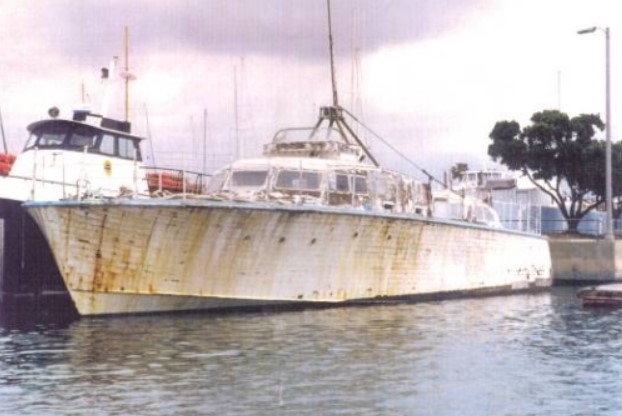
File: P-520 Folder Pre-restoration
P‑520’s story was very different. Located in San Diego, she was reported to be in excellent structural condition—hull, deck, and superstructure all sound—making her a strong candidate for museum preservation. Built in 1944 at Wilmington, California, she had been sold as surplus in 1947 and passed through several private owners. Loderhose’s donation came with one condition: he wished to remove the diesel engines that had been installed during private ownership.
Once work began on P‑520, it quickly became clear that she was far from the “excellent condition” first reported. A close inspection revealed extensive deterioration: large sections of both the inner and outer hull planking needed replacement, and the transom required a complete rebuild. The fiberglass sheathing on the main deck had to be stripped away, and when it was removed, the decking beneath proved so rotten that it, too, had to be entirely replaced. The deck over the aft cockpit was removed, and nearly every hatch—on the foredeck, main deck, and the removable engine‑room covers—needed repair or full reconstruction. Even the barbettes, the twin gun tubs port and starboard, had to be built from scratch.
The fuel tanks, aging fifty‑year‑old rubber bladders, required inspection and either repair or replacement. Bud Tretter also needed to locate and install two diesel engines and complete driveline systems. Fortunately, General Engine Power, Inc., the GM dealer in Long Beach, donated a pair of GM V‑1271 diesels. Every inch of plumbing and wiring had to be replaced as well. And this list didn’t even touch the interior spaces—living quarters, paint, cabinetry, or electronics—all of which needed attention.
Originally, Bud had agreed to carry out whatever restoration was required at no cost. But the scope of the work grew far beyond what anyone—Bud or the CRBA—had anticipated. A fifty‑year‑old wooden boat of this size can become a bottomless financial sink, and up through 2002, Bud bore the expenses himself. Eventually, friction developed within the group as the costs mounted. Late in 2002, the CRBA began contributing funds to the project, supplementing the occasional donated boats they had previously given Bud to sell for restoration money. By 2004, P‑520 was essentially complete. Photographs on this website show the result: a stunning restoration. But it is easy to understand how a seven‑year effort, costing what some estimate to be nearly a million dollars, could strain relationships. Ultimately, the CRBA transferred ownership of P‑520 to Bud Tretter to ease tensions over restoration expenses and dockage fees, though the long‑term goal remained to donate her to a museum.
That goal soon collided with a new obstacle. In late 1996 or early 1997, the U.S. Air Force issued a directive prohibiting all museums—except the main museum at Wright‑Patterson AFB—from accepting any new items for display. Transporting an 85‑foot boat overland to Dayton, a distance of seventy‑five miles, was prohibitively expensive. This effectively eliminated the possibility of placing an original 63‑ or 85‑foot rescue boat in a federally owned museum. Only a handful of private museums could afford the upkeep of such a vessel.
The CRBA continued searching for a home. Several museums declined. As late as December 2005, it appeared that P‑520 might go to the Alabama Battleship Memorial Park, but Hurricane Katrina left the park without funds to exhibit her. A possible donation to a Seattle museum never materialized. In 2013, an online post suggested she would be transferred to the Pacific Battleship Center in Los Angeles, but that plan also fell through. In July 2017, the Alabama Battleship Memorial Park again expressed interest, but by August 2018 the effort had stalled once more.
The greatest barrier was always the same: delivery cost. Moving the boat in about 2020 under her own power would cost roughly $85,000, while transporting her via a “float‑on/float‑off” yacht‑delivery service would run closer to $115,000. For many museums, the price of simply receiving the boat exceeded their entire annual acquisition budgets.
Bud Tretter passed away June 13, 2012 and his son Jerry continued to store the boat at the marina/shipyard in Long Beach, California until he passed in January, 2020. In June of 2020 Jerry's widow donated P-520 to the Louisville (KY) Naval Museum. However, that museum never had a physical presence in Louisville and currently the boat has no permanent home. For an extensive photographic tour of this restored vessel ,click here. This boat is very well restored but is not 100% period accurate as it is actually used and not a static museum piece. As an example, a hot water heater has been added to allow for comfortable showers, but it is still a commendable restoration.