
Packard 4M-2500
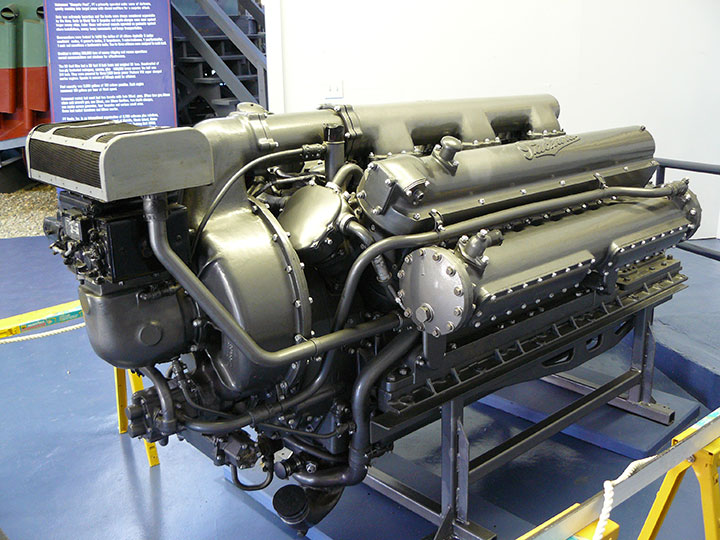
File: Engine\Packard\4m-2500w5
Contrary to what is often repeated in secondary sources, the Packard V-12 4M-2500 marine engine did not originate as a copy of the British Rolls-Royce Merlin. Packard did eventually build Merlin engines under license, but that production began well into the war years, and those aircraft engines were considerably smaller, displacing 1,670 cubic inches. The 4M-2500 followed a separate developmental path.
Some disagreement remains among historians over whether the 4M-2500 evolved directly from the Packard Liberty engine introduced in 1924. At most, the relationship can be described as distant. Packard had already produced earlier generations of large marine engines—the 1M, 2M, and 3M series—so the 4M-2500 was not an entirely new creation so much as the next step in an ongoing lineage. According to senior Packard management reports, Jesse Vincent, the company’s chief engineer, began work in 1939 on an experimental 3M-2500 by adapting Packard’s 2500-series aircraft engine for marine use. Seven of these experimental engines were built for the U.S. Navy.
The project quickly proved far more complex and costly than anticipated. Development difficulties mounted, and Packard ultimately lost $300,000 on the 3M-2500 program—a substantial sum in 1939. Yet the setbacks forced significant improvements. Engineers redesigned engine patterns, strengthened metallurgy standards, tightened quality control, and introduced numerous structural changes that amounted to a major redesign. Despite these revisions, the engine’s fundamental geometry remained consistent: a four-stroke, 60-degree V-12 with a 6.40-inch bore and 6.50-inch stroke, producing a displacement of 2,490 cubic inches. Each cylinder carried four valves, and the aluminum block incorporated steel cylinder sleeves. Weighing approximately 2,900 pounds, the engine operated at a 6.4:1 compression ratio and used a centrifugal supercharger; later versions added an intercooler to improve performance.

The resulting 4M-2500 became one of the defining marine engines of the war. It powered the 85-foot crash boats, the more widely known PT boats, and the British Power Boat Company’s high-speed rescue launches. Fuel was delivered through a Holley 1685F aircraft carburetor, and each cylinder was fired by dual spark plugs for reliability. The engines used a dry-sump lubrication system with an external oil tank fitted with special baffles to reduce foaming under high-speed operation. Cooling was achieved with fresh water circulated through relatively small tube-type heat exchangers, a system also used for the V-drives.
By the time of the Korean War, however, age and storage practices had begun to take their toll. The heat exchangers were increasingly prone to developing tiny pinhole leaks, possibly worsened by the way engines had been drained and stored during the years between conflicts. Crews often had to replenish coolant using precious water drawn from their drinking supply.
Unlike PT boats, which could optionally route exhaust underwater to muffle engine noise during covert missions, the 63- and 85-foot rescue boats generally lacked any such system. Their straight exhaust pipes made stealth operations virtually impossible; long before a boat appeared, it could be heard approaching. Nevertheless, substantial evidence suggests that three boats operated by the OSS—the wartime forerunner of the CIA—underwent extensive engine modifications. Vessels P-563, P-564, and P-565 were reportedly altered to achieve speeds approaching 55 miles per hour and fitted with some form of exhaust-muffling system for stealth operations. While multiple sources reference these modifications, detailed technical documentation has yet to surface, leaving much of their engineering a matter of informed speculation.
The earliest versions of the Packard 4M-2500 marine engine produced approximately 1,200 horsepower, an impressive figure for the time. As wartime development continued and engineers pushed the limits of performance, later models achieved significantly higher output. By the end of World War II, engines operating at increased boost levels were rated at 1,500 horsepower at 2,400 revolutions per minute. Some sources have claimed outputs as high as 1,800 horsepower, but Packard’s own documentation clarifies that this figure represented an emergency rating attainable only at 2,800 rpm under limited operating conditions rather than normal service use.
Fuel requirements evolved alongside performance improvements. Early engines were designed to run on 91-octane gasoline, while later W7 and W8 models were upgraded to operate on 100-octane fuel. Toward the end of production, several Korean War veterans recalled that the W14 engines required 115/135-octane “green” aviation gasoline. However, the official operator’s manual—preserved in the Manuals & Publications section—lists no requirement higher than 100-octane. It is also worth noting that modern methods for determining octane ratings differ from those used during the wartime era; gasoline tested today would likely register five to ten points lower than its historical rating despite being chemically similar.
Early 85-foot crash boats were equipped with W12-series engines, and during the war Packard produced somewhere between 12,000 and 14,000 marine engines, depending on the source consulted. The U.S. Navy’s 768 PT boats each carried three of these engines—two mounted aft and one amidships to improve maintenance access—while British Vosper motor torpedo boats also relied on the same powerplant. The U.S. Army Air Forces’ 85-foot Air-Sea Rescue boats, by contrast, used two engines per vessel.
The difference in engine count between PT boats and rescue boats likely reflected differing mission requirements. Crash boats required interior space for a medical dispensary capable of holding eight litters in the stern, while PT boats needed the extra power due to the weight of the torpedoes. Original design plans for the 85-foot Air-Sea Rescue boats also included two smaller six-cylinder Chrysler “cruising engines,” though some accounts suggest these were actually Kermath marine conversions of 110-horsepower Ford V-8s. Very few were ultimately installed, but their intended placement may explain why rescue boats never adopted the third Packard engine used in PT boats.
For engineers and historians alike, the PT Boat Engineer’s Handbook—essentially a Packard technical manual without illustrations—remains a valuable reference. Because both the Navy’s PT boats and the Army Air Forces’ 85-foot rescue boats operated with Packard 4M-2500 engines ranging from the W8 through W14 models, much of the guidance applied equally to both types of vessels.
Inside the 85-foot rescue boats, the engines were mounted facing aft and connected through Joe’s Gear transmissions. Each drive shaft fed into a Watson and Flagg V-drive, which redirected power back beneath the engines to the propeller shafts. The superchargers were positioned toward the stern, while the gear-shifting mechanisms faced forward toward the bow. Both propellers rotated clockwise—right-handed when viewed from astern.
Ideally, twin-screw vessels are designed so that the tops of the propeller blades rotate outward, improving maneuverability and docking control. That configuration, however, was not available with the Packard installations used in the 85-foot boats. As a result, handling characteristics could be challenging, particularly when maneuvering in tight quarters. Crews often found it nearly impossible to swing the stern to starboard, making docking a skill that demanded patience, experience, and no small amount of ingenuity. Much of what is known about these arrangements comes from Packard documentation and historical material preserved by PT-boat researchers and archives.
Packard Diesel Engines
Although best known for its powerful gasoline engines, the Packard Motor Company also maintained a lesser-known history with diesel powerplants. As early as 1930, Packard experimented with diesel technology, producing a nine-cylinder, air-cooled radial diesel engine intended for aircraft use. Despite its innovative design, the engine failed to gain widespread acceptance and never achieved commercial success.
In the years following World War II, however, Packard returned to diesel development with renewed focus. The company designed an entirely new family of turbocharged diesel engines intended primarily for naval applications. One of these engines went on to power a class of minesweepers, nine of which were reportedly still in operation as late as 1981—a testament to their durability and engineering quality.
These engines were specially constructed to be non-magnetic, a critical feature for minesweeping vessels operating near magnetic mines. To achieve this, Packard relied heavily on materials such as aluminum, stainless steel, copper, and brass rather than traditional ferrous metals. The engine family included several configurations. The smallest was the V-8 model 1D-850, of which only eight examples were built. Far more successful was the 600-horsepower V-12, designated the 1D-1700. With 451 units produced, it became the most widely used engine in the series, and four of these engines powered each of roughly one hundred minesweepers constructed during the period.
The most ambitious design in the lineup was the 760-horsepower V-16 model 1D-2270, which appeared to be the strongest candidate for potential use in rescue boats. Yet only five were ever built. Even with three engines installed, the power output proved insufficient for the larger 94-foot rescue boats, whose performance requirements exceeded the engine’s capabilities. Trials in a smaller 55-foot design reportedly produced promising results, but that vessel never entered production.
This family of Packard diesel engines was manufactured between 1952 and 1956, representing one of the company’s final major engineering efforts before the end of its independent automotive era. Though ultimately overshadowed by Packard’s famed gasoline engines, these diesels demonstrated the company’s continued innovation and adaptability during a period of rapid technological transition in marine propulsion.