Class Four - 40, 42 & 45 Ft. Crash Boats
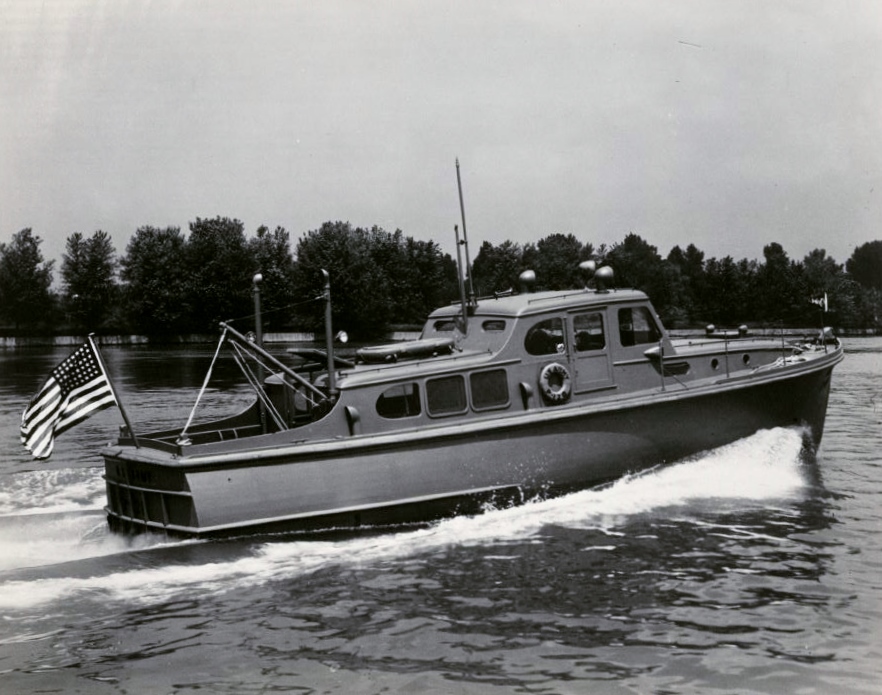
Standard 42 ft. Crash Boat with tall ventilator stacks in stern cockpit. File: 42\pP-128 strbd .qtr .
Design 385 and 221 – 45 & 42ft boats for use in inland and coastal waters were Class 4 boats. Their combined total production was 163 boats. They were recreational boat designs drafted for war time use.
The 42 ft. boat was twin screw, most sources indicate that it was designed by Owens Yachts as Design 221 and built by both Owens and Chris Craft, although Chris Craft primarily built Higgins boats. There are two sheets at the Mariners' Museum dated 1941 and credited to "Marine Design and Construction / Quartermaster Corps, U.S.A. One sheet shows the lines and offsets while the other shows the sections. While the boat was most likely a civilian design, the drawings may include modifications for military use. Most, if not all of these boats, were produced in 1941 and 1942. Their most notable feature is the two ventilator stacks located at the forward end of the cockpit. In 1944 famous marine architect John Hacker refreshed the design, the most obvious change being the removal of the two ventilator stacks.
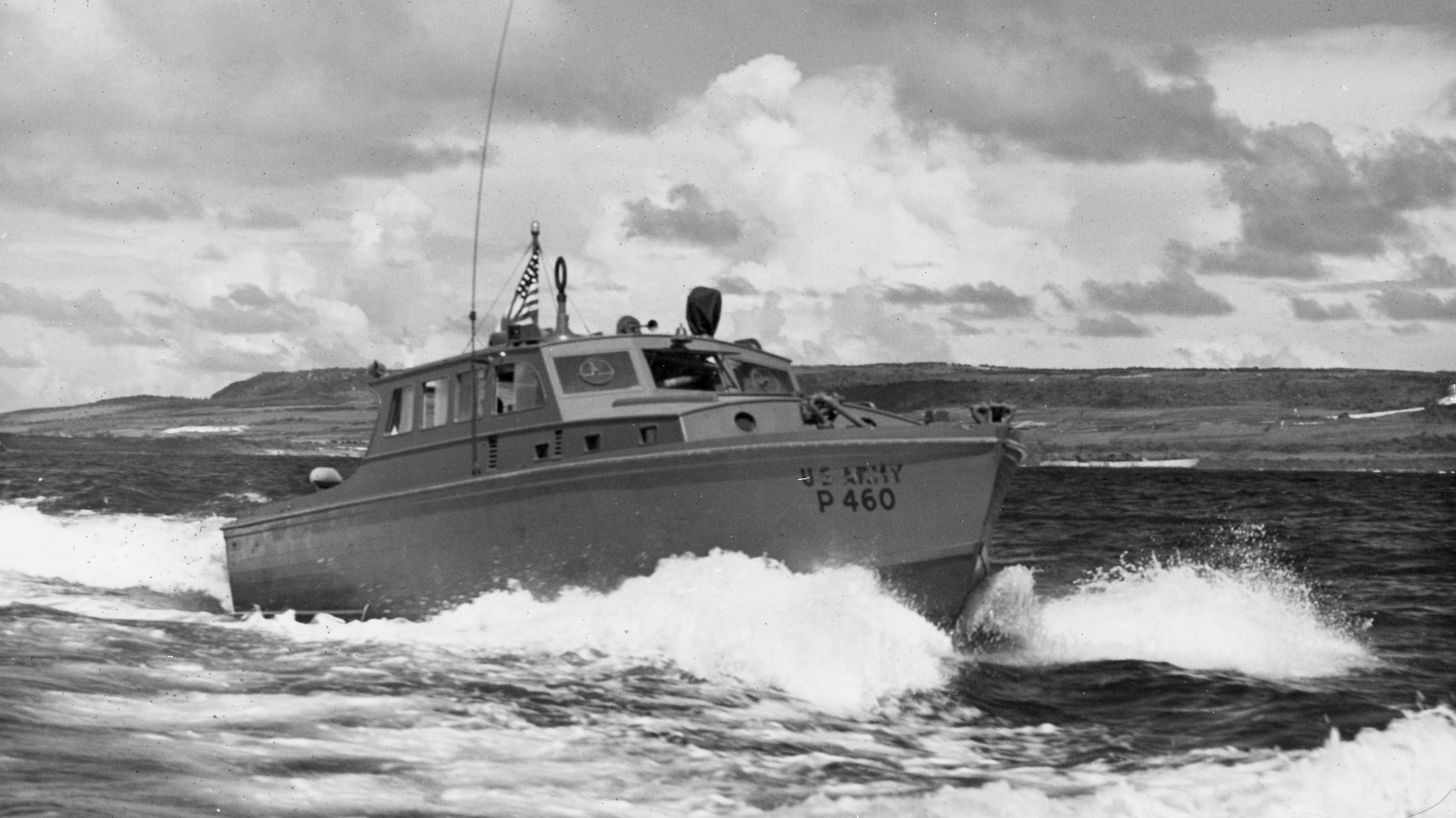
P-460, a 45 ft. crash boat off Tinian Island in the Pacific File: 45\P-460-1
Not a whole lot of reliable information is available on the 45 ft. crash boats, Design 385, which were intended for use in relatively shallow coastal waters and inland waterways. Horace Dodge Boat and Plane Corp. of Newport News, VA was the primary builder of this design. They produced 27 units under a 1941 contract specifically for the Army Quartermaster Corps. Another 18 of the 45 ft. crash boats were built by Sturgeon Bay Shipbuilding, in Surgeon Bay, MI.
Internet sources claim a maximum speed of nearly 40 knots, which seems optimistic. Medical supplies were basic as their primary purpose was to rescue the crew, provide basic first aid and to return them to shore where more extensive medical facilities were available.
Construction was typical crash boat construction, double planked with cotton duck and glue between the two layers. Powered with twin Hall-Scott Invader engines with a combined 500 hp, which provided an operating range of approximately 125 miles. Typically, these boats were crewed by 3-5 men.
Occasionally an army 40 ft. boat will be found Built by Palmer Scott & Co. of New Bedford, Massachusetts but they were classified as passenger boats and were given "J" numbers. There were about 157 of these boats built between 1941 and 1944 by Palmer Scott & Co. There may still be other builders that remain unfound.
The few 40 ft. boats designed and built in the 1950s are covered under the Modernization menu item at the top of the website.