Hall Scott Defender Engine
File: Engines\Hall-Scott\H-S Defender
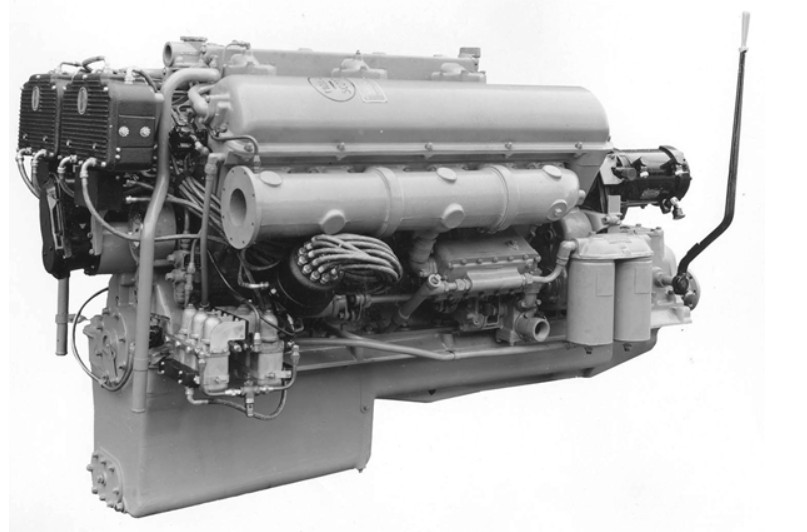
The Hall-Scott V-12 Defender engine came into existence in 1937, born from a request by the British government for a powerful and reliable marine powerplant. In response, Hall-Scott engineers combined two of their proven Invader engines—described in earlier sections—into a single, larger V-12 configuration. The result was an engine designed specifically to meet the growing demands of high-speed naval craft at a time when global tensions were rapidly escalating.
From the outset, the Defender was offered in two different displacements, along with a supercharged variant for applications requiring greater performance. Like the Invader engines used in the 42-foot boats, the Defender was produced in both right-hand and left-hand rotation models, allowing flexibility in twin-engine installations and improving vessel handling characteristics.
Production expanded quickly as war approached. By the end of World War II, Hall-Scott had manufactured more than 5,000 Defender engines. Many found their way into vessels operated by British Commonwealth nations, while in the United States the engine became standard equipment in the 63-foot crash boats used by both the Army and the Navy. The first of these engines was delivered to the U.S. Navy in 1938, marking the beginning of a long and successful service life.
Following the war, the marine industry gradually shifted toward diesel powerplants, signaling the end of large-scale gasoline engine production for many manufacturers. Even so, the Defender did not disappear entirely. A modified version continued in civilian use as a stationary power source, demonstrating the durability and adaptability of its design. Hall-Scott engines themselves remained widely respected, and their reliability carried them into another arena as well—serving as popular powerplants for intercity buses well into the 1950s, long after their wartime origins had faded into history.
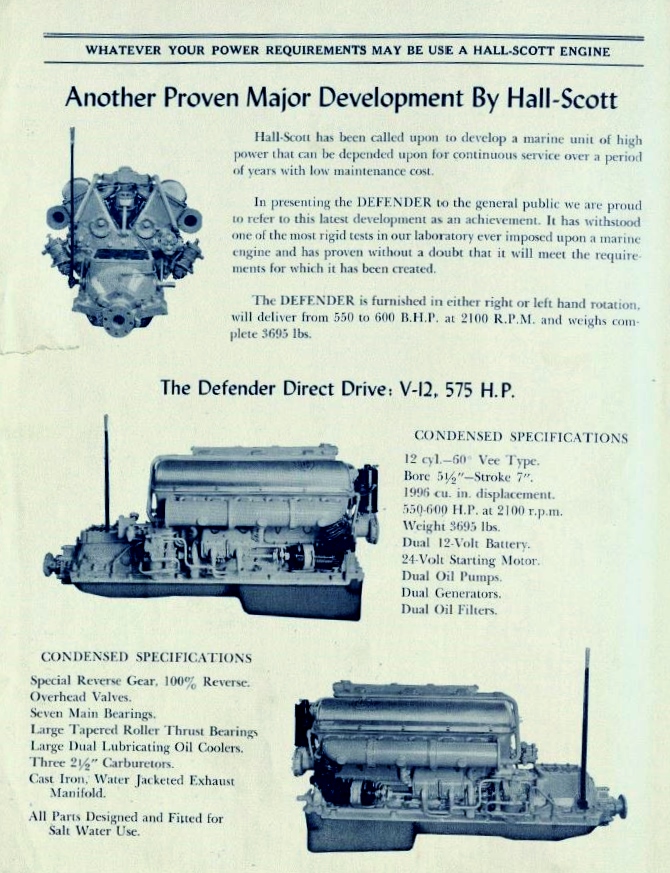
Depending on the specific version, the Hall-Scott Defender engine weighed between 3,600 and 4,600 pounds, a substantial mass that reflected both its size and the robust construction required for sustained high-speed marine operation. The earliest Defenders displaced 1,996 cubic inches and were rated at approximately 575 horsepower—an impressive output for the late 1930s and more than adequate for the first generation of high-speed rescue craft.
As wartime demands increased, however, the Navy sought greater performance. In response, Hall-Scott engineers enlarged the engine by increasing both bore and stroke to 5.75 inches by 7 inches, expanding displacement to 2,281 cubic inches. With the addition of supercharging, output climbed to roughly 700 horsepower, though reported figures vary somewhat depending on the source consulted.
Both the Defender and its predecessor, the Invader, incorporated a number of advanced engineering features that set them apart from many contemporary engines. They employed overhead camshafts and overhead valves, along with hemispherical, cross-flow cylinder heads that improved breathing efficiency and combustion performance. Aluminum pistons and crankcases reduced overall weight while maintaining strength, and a thoughtful design philosophy allowed many components to remain interchangeable between engine models—an important advantage for maintenance and logistics during wartime operations.
The six-cylinder Invader was introduced in 1931 as a 998 CID marine engine; beginning in 1940 it was used to power Autocar (their brand) trucks, buses, and a variety of stationary power sources with new model numbers. Hall-Scott offered these variants up to 1091 CID. The Invader, with all its variants was by far most popular engine produced by Hall-Scott. . E. J. Hall left the company in 1930, but all the engines produced until the early 1950s were heavily influenced by engines he designed before his departure.
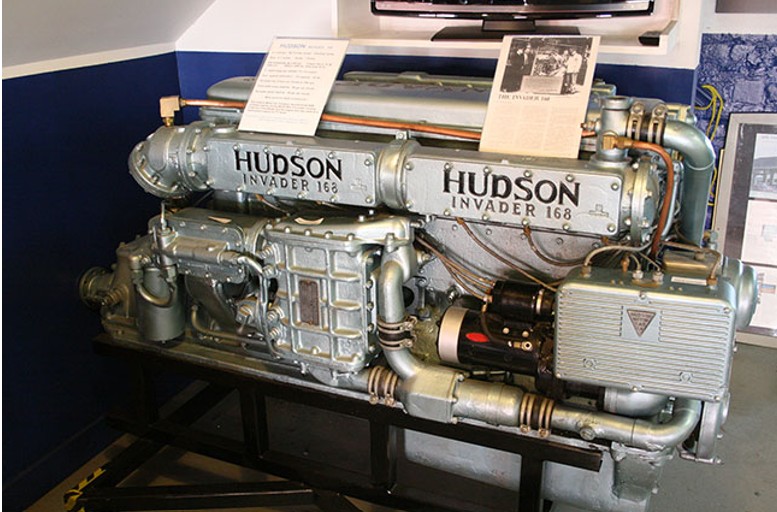
During World War II Hudson Motor Car Company was licensed to build the Hall-Scott Invader and labeled them "Hudson Invader 168" in several places, even though they were not authorized to label them as their own. However, in literature from the period it was identified as a Hall-Scott engine and not a Hudson. Hudson production of the engine ran from December 1942 until September 1944 during which time 4,004 were built for the US Navy, most were used in landing craft and an undetermined number found their way into 42 ft. AAF rescue boats. Their operation and maintenance is described in section 5 of the 42ft Operators Manual found the Manuals & Publications section.Select image
It was this engine, along with the Kermath Sea Raider Six that powered the 42 ft. AAF rescue boats. Of the 2 engines used in the 42 ft. rescue boat, the Hall-Scott was the engine most commonly used. The engine is listed as a 6 cylinder, 998 CID, with a 5.5” bore and a 7.0” stroke. . The engine produced 250 hp. at 2100 rpm and weighed 2480 lbs. dry. This was a straight six with overhead valves, two spark plugs per cylinder, and two updraft carburetors.