Missions
Incidents - World War II
P-11 on Standby During December 7, 1941
P-11, General Oscar Westover, the first of seven "Good Samaritan" class pre-WWII rescue boats, had been dispatched to the north shore town of Haleiwa. She was on standby while the fighter planes from Wheeler Field were on maneuvers at an auxiliary field on the outskirts of town. While the P-11 was providing this coverage, coverage at Hickam Field fell to the 22-foot Chris-Craft speed boat, J-115 and two utility boats of approximately 24 feet.
A lone navy observation plane approaching the entrance to Pearl Harbor was shot down by Japanese fighters and crashed into shallow water covering a coral reef. The crash was seen by the two crewmen of the J-115, who dashed to the boat and headed toward the crash site about a mile from shore. They stayed to the port side of the channel as they approached the plane, altering course and reducing speed to clear the reef and dodge coral heads. They soon had the two crew aboard, with the pilot seriously wounded, his hand almost severed. The other crewman appeared uninjured.
PFC Edward C. Lohr, skipper of the J-115, selected a course over the reef because destroyers were making a run for the open sea at full speed through the channel. One of the destroyers saw this small boat racing across the reef and assumed it was Japanese. Automatic weapons opened fire and streams of bullets surrounded the J-115 until she powered beyond range and escaped undamaged. Shortly thereafter she arrived back at the boathouse and the airmen were taken to the hospital. PFC Edward Lohr was awarded the Silver Star for his bravery and coolness under fire.
Edited from an article by Jay C. Groff, Jr. in the AAF/USAF CRBA News
Jean E. Buhler of Miami Shipbuilding Co.
- Wartime security restrictions prevented word getting back to the shipyard, after the boats were delivered, about the activities of the crews or fates of the boats. There are, however, a few tales about the boats before they left that are of interest.
In the first days of making speed trial runs along the County Causeway, the 63- footers created a great deal of interest not only to the public but to the operators as well. One such day President Roosevelt was embarking on an “R and R” cruise aboard the USS Tuscaloosa (CA-37); the R-Boat crew decided to give the president a thrill. While the Navy vessel eased her way out Government Cut, the 63-footer roared past with all four Kermath “Sea Raiders” at full throttle. Unfortunately, on the return run, the jaw clutch coupling the two starboard engines slipped out, disengaging the after engine which immediately raced to terminal velocity throwing engine parts all over the engine room. With only three engines still working, the 63-footer passed Tuscaloosa at a modest 30 knots and the crew waved casually to Roosevelt, who was seated in a canvas chaise lounge on the upper deck. Unaware of the problem, he waved back.
Later when the British Model 152 boats were being delivered in pairs via Canada, Canadian ferry crews came to the shipyard every two weeks to outfit and provision two boats for the ferry trip. At the dock, the boats were berthed two abreast and the American crews outfitting and provisioning their own vessels always insisted on having the inside berth. This was no problem until a U.S. Navy truck from the Opa Locka Naval Air Station showed up with supplies for the Canadians and they had to carry cases of beer and whiskey across the decks of the U.S. Navy boats. Such luxuries were not allowed on our boats.
During one of the delivery trips, MSC received a frantic phone call from one of the crews saying that the weather was so severe in the Atlantic that they elected to continue their trip in the Intracoastal Waterway. While doing so, the steering system failed, resulting in the boat ending up on the canal bank near Marineland, south of St. Augustine. Captain Pugh, the Miami Shipbuilding superintendent, and Jean E. Buhler a MSC owner, caught the next train to St. Augustine to investigate. Sure enough, the boat was on shore, 105 feet from the water!
The crew had started their trip offshore but put in at the Ponce de Leon inlet because of having to battle 50 mph northeast winds all the way. They were unaware of a small leak in the hydraulic steering system, which, because of the constant right helm, caused the steering wheel gradually to creep to starboard. They navigated the inlet but upon proceeding up the inland waterway continued to experience wind on the starboard bow. Just before coming to the area known today as the Palm Coast, the pilot found himself with the steering wheel maxed-out to starboard and thinking it was just binding rotated the wheel momentarily to port then hit it harder to starboard. He was not only unable to manage a slight turn to right but now was heading for the left bank and as he reached to close the throttles, he hit the bank, and was thrown forward shoving the throttles wide open.
Captain Pugh rounded up a local shrimper and a Florida chain gang from the local sheriff. The gang dug a ditch in the soft muck 16 feet wide, 3 feet deep, and 105 feet long from the stem of the boat back to the waterway. They then rigged a bridle around the bow of the 63-footer back to the shrimper and upon the order to “gun it” got a big surge of water in the new ditch which floated the boat off. The shrimper then towed the 63-footer south to the Daytona Beach Boat Works where she was hauled out on a marine railway. The shafts, rudders, props, and bottom were all OK and only the bottom needed a coat of paint.
In addition to the South Africans, British, and U.S. Navy, Miami Shipbuilding received orders from the Dutch, Belgians, and the Russians. All these crews had their first operating experiences in Miami. The Netherlands Government took delivery of two Model 314 boats for Surinam. They had no special requirements but insisted on testing everything before leaving, including setting off a depth charge in Biscayne Bay. This was no problem, but the bay is only 12 feet deep and there was some question whether they could get away quickly enough without blowing themselves up. With the test successful, they proceeded out Cape Florida Channel, south of Key Biscayne, into the ocean and returned via Government Cut and the Ship Channel. Before they could get to the MSC Main Yard on the Miami River, the Miami Herald called Miami Shipbuilding frantically to get some information on two “Free French” boats that had come in the ship channel at full speed and suddenly disappeared up the Miami River. The Herald reporter mistook the horizontal red, white and blue stripes of the Netherlands flag for the vertical blue white and red stripes of the French flag. There were no questions about the depth charges.
For the official trial runs of Model 168 Commander Bogle of the U.S. Navy came down from Washington to check out the boat personally. During the trial he ordered “full speed ahead” (48 knots) as the hull departed Government Cut into the ocean in six-foot breaking seas. Dair Long at the helm, obliged. After flying off the crest of the third wave, Commander Bogle lost his grip and fell down the companionway stairs into the crews' quarters. He was unhurt but he yelled up the companionway, “O.K., I accept the boat, take us back to the dock.”
Not long after the Packard-powered boats were in service, a Packard Factory representative was ordered to go to England to check on reports that the British were running the Packard engines in the 63-footers at higher than the prescribed rpm. Packard had issued strict instructions not to exceed 2500 rpm, and to run at that speed for no more than five minutes in any one hour of operation. Lenny, the Packard representative, came back confirming the report; they were actually running the engines at 3200 rpm, and they said they had to do so on channel patrol to save themselves and that they intended to continue to do so! Since I have not seen any source that states the British ever received Packard powered rescue boats, I am suspicious of this story. However, it may refer to their PT boats which were equipped with Packard engines.
A Letter Home from C. H. "Pete" Ruth Jr., October 27th (1943)
The cruise was probably on a 104-foot rescue boat (63’ and 85’ have only 2 prop shafts).
1007th Rescue Boat Co., Army Air Base, NO-LA (New Orleans, LA)
Dear Mama and Dad
Well, it was good to see daylight today. At 6:00pm yesterday we left the mouth of the Mississippi and headed about 225 degrees. We had stew for supper. The first sitting was the only one as the cooks and mess boys got sick immediately. My watch was to take over at midnight so we turned in for 6 hrs. sleep – up six – off six. Well, before midnight every man on my watch was sick including me – and I do mean sick. Some couldn’t even stand their watch. The chief engineer was tossed out of his bunk and sprained his hand and arm and the assistant chief couldn’t stop heaving. My first mate has been to sea since age fourteen and he was sick in the enclosure astern the wheelhouse, with water breaking next to him and then over him. The galley was the damnedest mess you ever saw. Five gallons of stew was on the floor, dishes everywhere; rolled together it looked like a six month job to clean up.
The wind was hitting between 35 & 40 so that this boat shook like a rat in a terrier’s mouth. The bow would dig in, raise, and then down we’d come with a thud that would about bounce you off the bunk, then one rail and then the other would go under. We had trouble steering as we had to run on wing motors as shaft on center motor was bent when we started. What men were on watch were sick off and on which made it pretty miserable. I practically wrapped myself around the wheel to keep my feet – once in a while I’d have to get an AB to hold it while I went for the rail. We’d check about once an hour to see that we still had all hands as I was worried that some were so sick they were apt to fall or be swept over. I had all wear their jackets all night. Outside at night you are constantly being challenged by Coast Guard or Navy so you have to be ready to catch the challenge and answer with blinker. Early we were challenged twice. In case we were challenged again, we wanted to be ready. We had two signalmen aboard – both sick as hell. I had the one on my watch brought up and laid out on the floor of pilothouse just in case. Thank God we didn’t need him as we would have had to hold him up. When you’d step out of the pilothouse where the enclosure tapers off you could hardly stand up as so many just opened the door and heaved right there. The damn stuff was tracked all over. This ship smelled worse than a fertilizer plant.
We were running blacked out of course. Taking water over the bow we had a hellova time seeing. A big freighter was straight ahead changing her course 50 times a minute as he couldn’t tell what the hell way we were going as every time we came down we were going a new direction. We would have liked for him to have rammed us and taken us all aboard. About 2:00am we changed our course and headed for the inland waterway. At 6:30am we were in calm water. When we stirred this morning everybody was in good shape again and then the clean-up started, some fun.
The paint in the lazaretto had jumped the guards and was all over the damn place. If a housewife ever saw her house in such a shape, she’d have burned the place. The food has been fair, but they never give us enough meat and milk. We had three meals of meat and milk – small portions and now none until Galveston. I guess this is the last cruise we’ll have. What they will do with us when we get back is anybody’s guess. Probably it will be just a case of sit and wait.
Maybe I’ll pick this up later if anything of note happens. At present we are just passing tows of oil barges in the low flat country and it is barren.
11-1-43
Well, I’m back in New Orleans. We came back thru the Intercostal Waterway thru Morgan City, La., Port Arthur, Tex. to a town 90 mi up the Mississippi from here. Coming down the river we were making good time until we hit fog at which time we turned back a few miles and then made a real Mississippi river landing – eased right up on the mud bank and put a man over with a cable from the winch and made fast to a tree. This was at 4:00am; by nine, the fog lifted and we pulled off and arrived here by 1:00 o’clock. I wish you were here where I could tell you all about everything.
Don’t know about the Galveston deal yet! Crew I had was all right except for the engine room.
I received your letters when I got back and enjoyed the news from home.
Love, Pete
On another training cruise, while still stationed at New Orleans, the boat had headed up the Mississippi and was miles from civilization. Several crew members wanted a little target practice with the .50 caliber and Pete said “Why not?” Soon enough he found out. The guns fired for a few seconds, in a few more seconds the skies darkened with birds, and a few seconds after that it started raining bird poop. They bombed that gray boat white. It took the crew hours to wash it off after it dried. That was the last time they took target practice in a bird sanctuary and off of the gunnery range!
Adapted from an interview of H. H. "Tom" Odiorne by Bill Clagett
The men who first shaped me as a boat handler were the old Army Transport Service skippers—fellows in their sixties and seventies who had spent a lifetime on the water. They taught with a kind of quiet authority that only age and experience can give. Another mentor was the commodore of the Miami Yacht Club, a man who seemed to know every trick a boat could play on you and how to answer it.
In March of 1943, a “hush‑hush” assignment broke the routine. We were told only that a VIP needed a day of quiet fishing. When he stepped aboard, the mystery evaporated—there stood General “Hap” Arnold himself, recovering from a brief illness, perhaps one of the heart attacks that plagued him. For one day, we ferried one of the most powerful men in the U.S. military across calm Florida waters as if he were just another fisherman looking for a break from the world.
A few days later, while on patrol in the Gulf Stream, I witnessed something that has never left me. The sea was glassy, the sky brilliant, and far on the horizon the water glowed a strange orange. As we closed the distance, the color resolved into thousands of floating oranges and splintered wooden crates—debris from a freighter that had gone down, likely a United Fruit Company ship. The sea was silent. No survivors. Only the fruit bobbing gently in the swell, as if the ocean were trying to return what it had taken.
The months that followed carried us far from Miami. We delivered crash boats to the Naval Base at Guantanamo Bay, Cuba, and made long runs to New Orleans and across the Gulf to Brownsville, Texas. Between these missions, we continued our offshore patrols along the southeastern and west coasts of Florida.
Then, in late February 1944, my life shifted. Our crash boats had been moved to Biscayne Bay, tied up behind the Nautilus Hotel, which the Army Air Corps had converted into a hospital. That’s where I met the woman who would become my wife—a nurse, an officer, and the most beautiful person I had ever seen. She and the other nurses lived in guarded guest houses on a nearby island, and because I was only a PFC, our courtship required creativity. We spent many evenings dodging guards and MPs, and more than once she and a friend rowed across the dark water to meet us at the docks for a double date. After a short but certain courtship, we slipped away to Fort Lauderdale and married quietly. Life felt warm, full, and promising.
But the war had other plans.
In mid‑1944, I boarded a ship with a load of GIs and crossed the Pacific into a world I could never have imagined. My Florida days—sun, sand, palm trees, boats that looked like yachts, and a new wife—felt like a dream I had somehow wandered out of. What I found in the Pacific was a kind of hell I have spent years trying to forget. I was not a combat soldier or sailor, but the “leftovers” of battle were more than enough. Our rescue missions brought us face‑to‑face with the wounded, the maimed, the drowned, and the desperate—military and civilian alike. Many we saved. Many we did not. Out there, rank meant nothing. We lived in grubby shorts, indistinguishable from one another except by the weight we carried in our eyes.
Often we answered distress calls only to find debris and empty water. But one day, in a monsoonal downpour, we spent hours alongside other boats pulling bodies from the rough sea. A transport plane had gone down, full of Australian troops returning from the Dutch East Indies. We ran out of body bags and ended up stripping the covers off our mattresses to stack the dead for the trip back to northern New Guinea. It was a grim, heavy voyage.
Not all our missions were like that. One of the more unusual assignments was ferrying a medical officer to remote island villages where he treated natives suffering from yaws—horrific blister‑like growths common in the tropics. We carried him to the Jolo Islands, Los Negros, Bohol, Cebu City, Puerto Princesa on Palawan, and other scattered islands whose names still echo in my memory.
My most gratifying moment came unexpectedly. We were en route to deliver a 63‑footer to a base in the Celebes when an urgent call came through: retrieve a body at the end of a runway. An Australian flying sergeant had crashed near shore and was presumed dead. But when we reached the wreckage, we spotted him floating face‑up. We hauled him aboard and discovered he was alive—barely. His nose had been sheared off by the cockpit windshield. We rushed him to a field hospital, unsure whether he would make it.
Less than two weeks later, a man wrapped in bandages from forehead to chin appeared at our dock, asking for the crash boat crew that had pulled him from the sea. He had a new nose, though we couldn’t see it beneath the layers of gauze. What mattered was that he was alive, and he wanted to thank us.
That, in all its twists and turns, is Tom’s crash boat story—a life shaped by old skippers, wartime seas, love found in Miami, and the unforgettable faces of those saved and lost. Stories like his, shared by him and others, are what make the history of crash boat service not just a record of missions and machines, but a deeply human legacy.
From the diary of John ”Jack” Shaw by George Shaw & edited for brevity by C. H. Ruth
My father, John C. Shaw 3rd, Jack to most people, kept a handwritten daily diary commencing 22 July 1944 and ending on the official termination of his Army career on 29 January 1946.
His service began in December 1943 when he was given a temporary appointment as WOJG in the Army Air Force and ordered to the New Orleans Army Air Base by 4 January 1944. He was designated as First Mate and assigned to QM Rescue Boat Operation Training Unit (Aviation).
He had several training assignments at Keesler Field in Biloxi and attended Rescue Boat School in Gulfport in February and Training Boat Emergency Rescue School as a potential master in April.
On 1 June 1944 he was assigned to the 172nd Army Air Force Emergency Rescue Boat Crew as Master with a crew of 12. His boat, P-252, was inspected on 6 June and was chosen as “presenting the best appearance.” The citation for the inspection recited “I am very pleased to take this means of recognizing the fact that you are carrying out your responsibility. It is hoped that you will continue to do so.”
P-481, a new 85’er, was officially turned over to him as master on 22 July 1944 at Dooley’s Basin & Drydock Company’s yard in Fort Lauderdale and proceeded to Miami and Nuta’s Boat Yard for final fitting out there.
P-481 made its way around Key West and on to New Orleans where it and a sister crash boat were loaded on a transport ship, the S.S. Monterey. Deck space was always hard to get for shipping rescue boats.
On 6 September 1944 Monterey, carrying two rescue boats and their crews and 600 troops, left New Orleans and steamed in a convoy of ten ships to Guantanamo Bay, Cuba for three days. Monterey then joined a smaller that stopped briefly at Trinidad, continued to Belem, Brazil in the mouth of the Amazon River and then down the coast to Recife, Brazil. This was the winter route to deliver bombers to Europe, Africa and the C.B.I. theaters of operations. Monterey docked in Recife on October 9 after three weeks of a rather pleasant cruise. Recife “looks like a pretty town”, he commented. The two crash boats were off-loaded and the boat crews disembarked and proceeded to USAAFSA HQ at Piedade where they remained for the next two weeks. His journal recorded about this stay, “No duties at all – days spent on beach acquiring sun tan and evenings at Officers Club and movies. Nice vacation but rather boring after a while.” Their barracks were about 150 feet from the beach- “beautiful”. He sent a cablegram home and made arrangements to pay the crew. He was ordered to re-embark on Monterey, and three weeks later she docked in New Orleans on November 16. Total time of this round-trip cruise was two months and 10 days. Upon his return he was given 15 days of leave.
In December 1944 Dad and his crew received orders to report to the Coast Guard Station, Rockland, ME, for 90 days “in connection with the ability and degree of practicability of Rescue Boats in very adverse weather and sea conditions”. He and his crew picked up a new boat, P-444, in Newark, NJ. Just north of the George Washington Bridge the boat hit a submerged object, bending the starboard propeller and strut, then ran into ice, cutting the boat “pretty badly.” On 6 January, they departed Nyack and made trips to Sheepshead Bay for radio installation and to City Island, hitting another submerged object and bending the starboard propeller again. After necessary repairs, P-444 headed for Rockland, a trip characterized by heavy weather, slush ice and 35 knot winds in Buzzards Bay with a forced layover day in South Portland because of a heavy northeast winds and snow, and heavy following seas from Portland to Rockland where they arrived 30 January. I remember Dad telling me that he and his crew took their boat out in the worst possible weather and drove the living hell out of it to test its durability and seaworthiness. Diary entries gave a sense of the tasks and conditions:
Feb 5 Snowing hard in A.M. Off shore tests in afternoon in a 3-4 sea. Lots of spray flying but not freezing.
Feb 6 Playing around with a P.T. on the off shore range and taking Navy big wigs for a short ride. 0-1 seas.
Feb 7 Off shore again.0-2 seas.
Feb 8 Off shore range 5-6 seas. Had collision with P-439 – breaking 10 ribs and some planking. Bad blizzard tonight.
Feb 9 Still snowing in A.M. Off shore course in PM with Dair Long, the designer of the 85’ aboard plus Maj. Ruth [see Addendum], Maj. McGough and Capt. Sheroris {SP?}. 6-7 seas but we ploughed all around the test course at 25 knots. Plenty rough ride.
The boat made a 294 mile trip in heavy fog to Lurcher Shoal, Nova Scotia. In February boat was hauled in Camden to repair damaged ribs. The boat’s Rockland experience ended on 25 March 1945 when it and two others left for the East River in NYC in excellent weather, stopping for the night in New London, averaging 23 knots for the two days.
Apr 2 They picked up P-439 in Newark to deliver it to Miami, arriving 8 April.
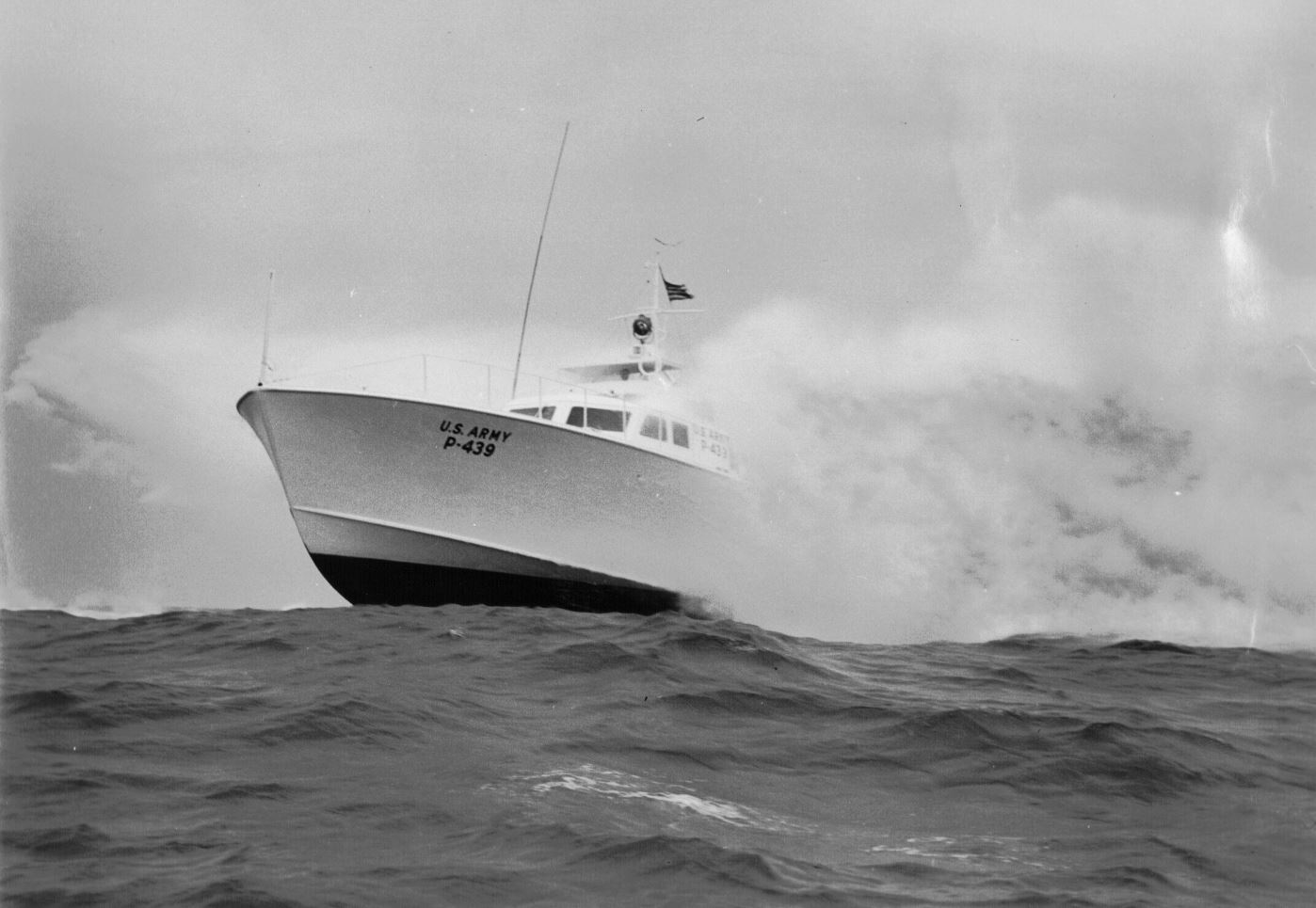
Apr 20 they picked up P-558 in Miami and took it to Key West for 120 days “to continue evaluation of Army, Navy and CG Rescue Boats.” There were trips to Havana, Bimini, Nassau, Miami, St. Petersburg, Kingston (Jamaica), and Port-of-Spain (Trinidad).
May 8, the day Germany surrendered, ending the war in Europe, they made a 129-mile run to Rebecca Shoal Light and back, reporting that the boat ran beautifully. While the war continued in the Pacific, pilot training was scaling back.
May 30, P-439 & P-558 (his journal does not show the boat he was on) with Coast Guard brass aboard for Memorial Day Week-end, they went from Key West to Miami, staying only long enough to gas and then ran over to Bimini for the night. The next day they fished off Bimini all morning and ran back to Miami in afternoon, liberty for all hands in the evening. Continuing a busy weekend, they sailed from Miami to Nassau where they spent the night and headed for Ft. Pierce. On the way the universal joint on starboard shaft broke. They proceeded on one engine to Miami.
In early August 1945 Jack took over P-508 in Miami. He and his crew went from there to the Canal Zone via Guantanamo Bay, Kingston, Barranquilla (Colombia) and Colon and Balboa (Canal Zone), arriving 16 August (two days after Japan’s surrender) when they turned over P-508. They flew back to Miami on 9 September. At the end of that tour of duty in the Canal Zone, the four crews received a letter of commendation from the Commanding General of Sixth Air Force. The letter provides insights into Dad’s activities:
“Upon their arrival, they immediately volunteered to train the Masters, Mates, Engineers, and Radio Operators of the 12th Emergency Rescue Boat Squadron in the operation and maintenance of the 85-foot AAF Crash Rescue Boats. In the short time between their arrival and departure (8 Sept 45) a school was established, course outlines were written, training aids and reference materials were procured, questionnaires were written and published and a total of seventeen (17) Masters, nineteen (19) Engineers, ten (10) Radio Operators were given not only instruction in the handling and maintenance of 85 foot boats but also refresher courses in basic seamanship. This accomplishment was made possible by the diligence of the [crews] who worked long hours and gave unstintingly of their individual and collective experience and time in order to impart as much knowledge as possible in the limited time available.
The [crews] were divided into two (2) groups, some acted as instructors, others acted as crew members of boats of the 12th Emergency Rescue Boat Squadron in order that the regular crew members could be withdrawn to attend the school.
The cheerful attitude and the accomplishment of these officers and men is very much appreciated and it is believed they are deserving of commendation for the efforts which they put forth over and above the line of duty.”
After his return from the Canal Zone he was assigned to Rescue Boat Maintenance unit at Headquarters, Marine Shop and Marine Facilities in Gulfport and was given 25 days of leave.
On 16 October 1945, as part of the separation from service process, he was given a “high excellent” rating for the period 14 November 1944 to 9 October 1945 and determined to be capable of acting as master. He was declared eligible for the American Theater Service Ribbon for “thirty (30) consecutive days service while permanently assigned to duty as a member of the crew sailing ocean waters, even though the vessel may be based with the continental United States.”
In November 1945 he was engaged in the transfer of various size rescue boats between duty stations on the Gulf coast.
He was released from the Army at Westover Field, MA on 18 January 1946 and formally separated from the service on 29 January 1946. His Separation Qualification Record recites as his Military Occupation: “Master Maritime: Master of 85’ Army Rescue Boat. In complete charge of all navigation, operation and general up-keep of boat. Directed navigation, repair, and training of personnel. Supervised manning of guns and maintenance of ships equipment.”
The diary notes that he traveled approximately 12,135 miles by 85’ crash boat during the period of his service plus 15,960 miles by land, 10,100 miles by transport and 1,510 miles by air.
To give some idea of the finances at the time, his Officer’s Pay Data Card dated 1 December 1944, about halfway through his period of service, shows that his monthly base pay was $150 to which was added $60 for rental allowance and $42 for subsistence for a total of $252 per month.
Dad kept in touch over the years with a couple of his crewmates. Bob Williams and Virgil Wylie are two names that stick in my memory.
In some notes about his life Dad left for me and other family members (at my request), he described his war service thusly:
“World War II started for me on Jan 5, 1944 when I reported to the U.S. Army Air Force in New Orleans for training in the Air-Sea Rescue Service…. Suffice it to say that I had a fine war. I never heard a gun fired in anger, was on the water as skipper of my own boats, covered the Atlantic coast from Nova Scotia to Panama, was associated with a great group of guys and just had a great experience.”
Addendum from Carlos Ruth: When George first contacted me, we had no idea of any connection. It turns out that my father (Maj. Ruth above), who had received his license to skipper crash boats in January of 1944, was in Gulfport just a few months ahead of Jack Shaw. I have had photos from the Rockland, ME tests at home for years but was never sure if my father was there, or the photos just came to his desk at AAF HQ in Washington, DC. From just two words in Jack’s journal I have learned that, not only was he there but he was actually on the P-444, Jack’s boat. See the 85 ft. Photo Gallery for more photos from the tests and P-444s final resting place.
Wartime Missions of the P-399, Guadalcanal to the Philippines
P-399 – She was shipped as cargo aboard the Corbett from San Francisco to Suva Harbor, Fiji, only to find the crane there was too small. They continued another 250 nautical miles to Espiritu Santos in the New Hebrides, about 1,00 miles east of northern Australia (new name is Vanuatu) through Japanese sub hunting grounds. Even though a large crane was available, they were to continue to Guadalcanal, another 200 miles northwest, where she and P-400 were finally unloaded in May of 1944.
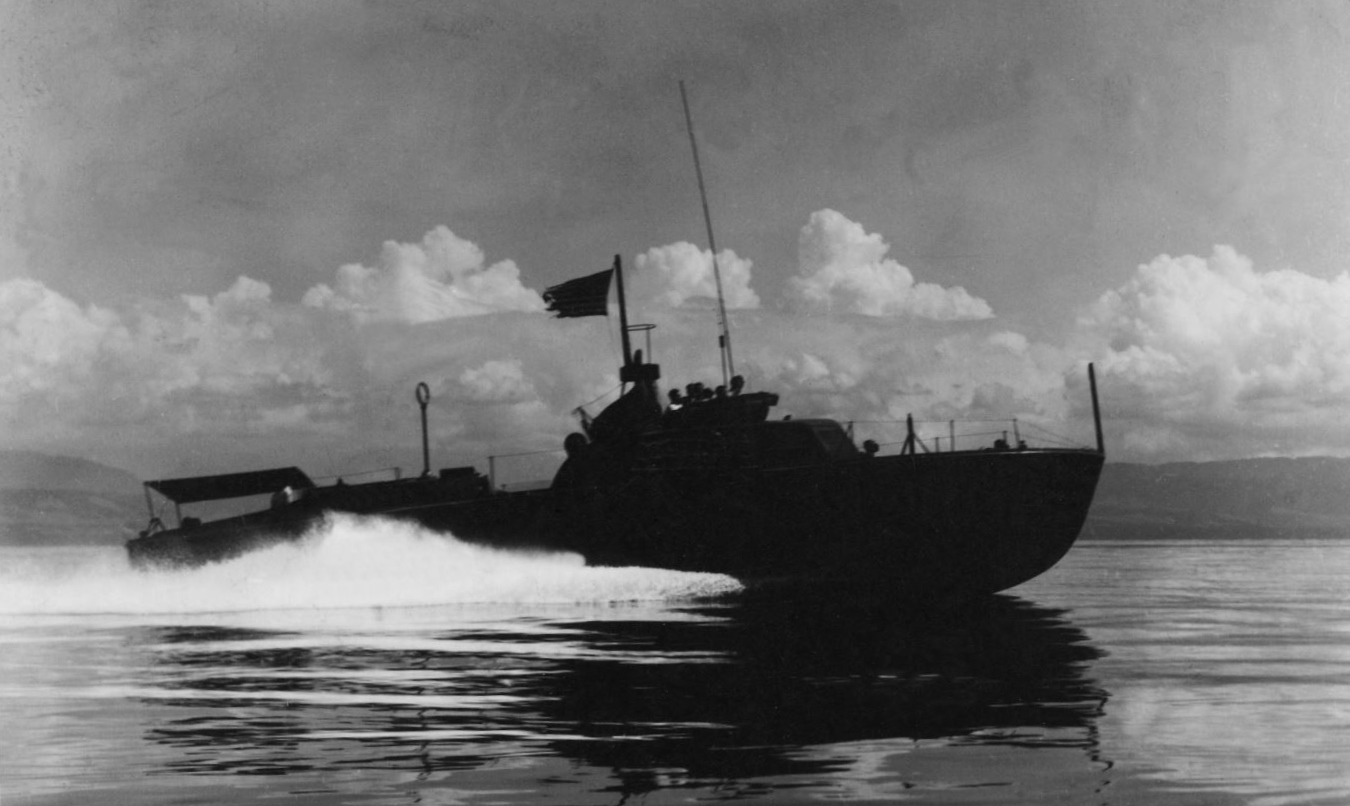
P-399 – After one patrol they were ordered to pick-up a party at 0800 the next day. The “party” turned out to be 4 officers and 3 nurses and they were told to take the party to a “good fishing spot” and later to unload them at a beach. A few days later it happened again. Some weeks later the skipper learned that one of his crew had written the following V-letter to Office of Rationing, Sacramento, CA.
Dear Sirs:
If my father comes to your office, and requests ration stamps to purchase 20 gallons of gasoline for fishing, please give him the stamps, because yesterday our air-sea rescue boat used up about 80 gallons, taking officers and their lady friends out fishing.
Corporal William Chancey, P-399
Eventually a copy of the letter made its way to Gen. Hap Arnold’s AAF headquarters. The same local officers who had partied on P-399 in the first place conducted an inquiry and were about to hold the skipper responsible. It would have cost the skipper, Earl A. McCandlish (author of Crash Boat) his command had it not been for the intercession of a full colonel who got him and P-399 out of harm’s way.
P-399 – 13 DEC 1944 –patrolling calmly off the north end of Halmahera (northwest of New Guinea), as recounted by Earl McCandlish, skipper. Pitoe tower called that an Aussie pilot had ditched near Galea Bay, about 30 miles south of our position. Bake (Homer Baker) called general quarters, knowing the area was hot with Japanese. We closed to the area in about 40 minutes, but Jep, (George Jepson, mate), our lookout couldn’t spot the plane or pilot offshore. Suddenly he turned to me on the bridge:“We’ve got trouble. The pilot tried to land on the beach.”
I saw a Navy PBY making a run over the bay for a landing. The plane could easily have been blown out of the water as soon as the Japanese guns protecting the air strip were alerted. We got word to the PBY to get the hell out of there, just as the plane was about to hit the water. The pilot went “balls to the wall” on both engines and the Catalina lumbered back into the air.
The crew had spotted the RAAF pilot near his upended plane. So I circled and made a run toward the beach, where we could see that the pilot had crawled up under the plane’s wings. Out of the corner of my eye, I could see tall geysers of water off our port beam. I zigged and zagged to avoid enemy fire, but soon realized that the shots were going over our head as we got nearer to shore. The Jap 90mm antiaircraft guns were restricted as to how down they could go. So we were safe as long as we were close to shore.
Our two best swimmers volunteered to swim ashore and bring the pilot back to P-399. Baker tied a line around their waists. I could see that the downed pilot was wearing a Mae West but was not making any attempt to get out from under the plane and down to the water’s edge. I was certain he could see us trying to reach him and concluded that he was too badly hurt to move. Our swimmers (Jep and Whitey Chaney) jumped into water less than a fathom deep and started to shore. But more trouble. When the Japs realized that couldn’t hit us with their 90mm guns when we were near shore, they brought up riflemen to shoot at our swimmers, who were making their way towards the pilot. P-399 was also a target. I heard the whine and splat of metal hitting our hull. Our 50 caliber gunners began pumping lead into the trees behind the downed plane, covering our swimmers. I yelled to the swimmers to come back aboard. Barzow, who had been giving Pitoe field and the island of Morotai a play by play account of the action, pulled them back on board.
I took Sea Horse (P-399) out across the danger line, zigging and zagging as the Japs blasted away but fortunately still missing. When we got a half-mile off shore they quit firing. We radioed Pitoe and requested air cover. They replied that the 38th Air Group would cover and to “stand by. ”We spotted PT-162 and PT-365 coming across the bay, as well as P-406 which came alongside. Our plan was to have PT-365 lay down a smoke screen with her 50mm mortar on her bow. PT-162, along with P-399 And P-406, would strafe the palm tree area, where we believed the antiaircraft guns were located. Just then our air cover came roaring out of the sky. Eight P-38s had been sent to help us! They strafed the gun emplacements and the Jap riflemen moving toward the beach.
I advised the tower that we were making another run for the pilot on the beach. This would draw fire and the P-38s would be able to spot the hidden gun emplacements. We went in again and the Japs continued to miss, but this time the P-38s came down on them hard and the 90mm’s no longer fired on us. We started our strafing run – along with PT-162 and P-406 - shooting where we thought the small arms fire was coming from. The P-399 closed to within 40 yards of the pilot (the tide was rising and the sea running higher). Our swimmers were headed to the beach when the unthinkable happened – our port engine conked out. I needed it’s reverse to keep us from washing up on a very unfriendly shoe. Our substitute engineer was of no help. John Cranston, skipper of P-406 helped keep us off the beach. About then one of the swimmers reported that the RAAF pilot was dead. I was sure that the downed pilot had been used as a decoy, and that the Japs had shot him as he lay under his wing.
PT-365, which had laid the smoke screen, didn’t move and had taken a hit and suffered casualties from shrapnel. PT-162 towed PT-365 back to their base. Barzow called Pitoe to report. The P-38s were ordered back to base and with only one engine I requested the same, which was approved. We were base heroes for a day, with Col Wallace Ford, our squadron commander, congratulating everyone. I was beat and flopped on my bunk and then got really scared – and sometimes I still do.
Our regular engineer returned the next morning, mad that he had missed the excitement. He went below and in fifteen minutes identified our engine trouble, a cracked distributor cap. He had a spare and in a few minutes the engine was purring like a kitten.The text Above is from the book Crash Boat, Wartime Missions of the P-399, Guadalcanal to the Philippines by Earl McCandlish, edited by George L. Jepson. Photo taken from the deck of P-400 by George Jepson off Halmahera Island in late 1944
P-95 Panama Explosion
Sometime in late 1943, the 104 ft. P-95, was drydocked at the Mechanical Division of the Panama Canal Dept. for extensive hull repairs and an engine change. Her Chief Engineer was WOJG William E. Schuitt. The engine room hatch had to be removed in order to change an engine. It was held down with 4" brass flat stock, screwed down every 2 " on all sides, after the seam was well caulked.
P-95 departed the Mechanical Division bound for her anchorage on the east side of the Fort Amador to Flanenco Island Causeway. During the trip WO Schuitt noticed fuel leaking from a filter on the forward bulkhead of the engine room. He knew he would be getting bells soon, so he rushed forward, placed a bucket under the leak and rushed to his control station.
When the skipper rang "FINISHED WITH ENGINES", Schmuitt secured the engines and went forward with some hand tools to fix the leak. While riding at anchor P-95 rolled considerably. Schuitt lost his balance, somehow dropped one of the wrenches from his hand, and it fell against something electrical in the engine room forward of the engines. The spark set off the fumes of the 100 octane avgas and the explosion was so severe that the engine room hatch broke the the spine of the canopy support that covered the deck from the wheelhouse aft.
Schuitt was able to exit the engine room and sound the alarm bell before the crew knew what had happened, For his valor WOJG Schuitt was awarded the Soldier's Medal. Later it was determined that the CO-2 system self-activated when the hatch blew. This doesn't diminish Schuitt's heroism in any way. P-95 was determined to be unseaworthy and was towed back to the U.S. She later worked in the Louisiana offshore oil field service industry before eventually being abandoned in a swamp near Lafayette, alongside US Hwy 90.
14th ERBS Historical and Intelligence Reports June 1944 through March 1946
This collection of reports covers the actions of the squadron from the early days in New Guinea to the challenges they during the early days of the occupation on Japan. It covers missions and boats lost, along with individuals promoted, killed, or sent home for discharge at the end of the war. There is a large amount of information from their time in the Philippine Islands. Covering 44 searchable pages. The document is too large to include under "Missions", so I have placed it in "Manuals and Histories" section.
P-510 New Years Rescue, by Chuck Cloudy
It was New Year's Day, 1945 as we monitored a Rescue Director call to the Navy 63' crash boat regarding a P-38 which had crashed in the vicinity of Nevidiskov Bay, Alaska. We were standing by and generally grumbling about the Navy always calling their 63 footers before they turned their attention to us. Finally Rescue Director called us and we got underway ten or fifteen minutes later.
This must have been around noon, because our cooks had roasted a turkey for an early New Year's Day dinner and the turkey was about done. Seas were running ten to fifteen feet, not bad for the P-510, but murderous for the 63' Navy boat. Our sense was, when we started out, that we were going to overtake the Navy and have the rescue to ourselves. We caught up with the Navy, and when our bow was aside her stern, we took off into the air on a big fifteen foot swell, and when we hit the water again our stern was aside her bow. Eventually the Navy turned back because they were taking quite a beating.
Arriving in Nevidiskov Bay, we put a shore party on the beach and they soon found the pilot. Other than his pride, he did not appear to be injured. By the time the pilot and the shore party were aboard, the turkey was done, so we made a leisurely return to Casco Cove with the pilot. According to the pilot, his squadron had enjoyed quite a New Year's Eve party. The next morning, to clear his head, he requisitioned his wing commander's P-38 and went for a joy ride over Attu. He intended to shoot down the steep valley behind Nevidiskov Bay and level out over the bay. As he was approaching the ridge, he noticed something loose on the floor of the cockpit and reached down to pick it up. When he had successfully rescued the dried piece of mud, he looked up and noticed that he had lost both of his propellers (apparently ground them up going over the ridge) and wisely decided that all he could do was to put the plane down on the first flat spot he could find.
Later on, as the enormity of what he had done and the shock began to bear down on him, he was nearly distraught. But he managed to eat most of our turkey dinner on the way back to base while worrying out loud about court martial, loss of pay for loss of the aircraft, etc..,etc. AAF personnel were waiting at the dock in Casco Cove when we arrived. That took the pilot away and we never heard another word from or about him.
We did learn later that an officer on the Navy crash boat had a motion picture camera and took pictures of the bottom of our hull as we passed them some 10-15 feet in the air. It was Chuck Cloudy's understanding that the officer was going to supply us with copies of the prints at some point, but that never happened.
Nevertheless it was a good day for the 510:
1. We outran the Navy 63 footer which reportedly could make 50 knots ( in their dreams) for the second time.
2. We proved the 510 lived up to its nickname "The Plywood Express", that the 510 could, in fact fly, and we returned with a live pilot.
3. That was the only live airman we recovered in the nine months I served on the P-510.
Today the P-510 a.k.a. Dream Maker has been converted into a handsome yacht available for corporate events, wedding receptions, etc. in the Newport Beach harbor. The company babies this grande dame as she no longer goes to sea, but is limited to the harbor for "limited use". Limited use means six knots, flat out!
P-512 - “Foxtail One-Two; Alexei Tower: We have a plane Down!
We all dropped whatever we were doing, grabbed warm heavy gear and scrambled to our stations. This was December 7, 1944, and we were on station off Alexi Point, Attu, out at the end of the Aleutian Islands. Engines coughed, boomed, and rumbled as deck crew slipped the mooring bridle and P-512 (an 85-footer) swung around and gathered speed to weave through the outer reefs instead of heading for the harbor entrance. How Skipper Mike Hatton snaked us through the reefs, we’ll never know. We all expected the bottom to be ripped out at any moment as 512 charged over the snaggle-toothed expanse of rocky reefs.
Alexai Tower meanwhile had fixed the approximate spot where a P-38 fighter went into the water a couple miles SE off the point within sight of the beach. “Bring him back dead or alive,” the tower had said. “The pilot has the squadron’s Christmas funds in his pocket.” A mile or two ahead we could see an orange dot bobbing on the surface. As we neared the raft, we could see the pilot seated, still but upright. He’d been in the water about 20 minutes; almost three times the usual survival interval in those Bering Sea waters.
Mike cut the speed as we came close. Two husky crewmen dropped a cargo net that unrolled down the side as we circled and brought him along our port side. They clambered down to water’s edge and each with an opposite arm swung him bodily up and on deck to hands waiting to grab him and hustle him below. The pilot had been unable to move or assist in his rescue, so cold and stiff, as he was almost comatose.
Once below we peeled his bulky flight suit and boots off, as well as most of his clothing. No way could he be stuffed into one of the 24 volt “bunny suit” warmers; think General Electric meets Dr. Denton. He was too wet and awkwardly stiff; so three guys peeled to their skivvies and piled in a berth around him with blankets over all.
At full speed across the bay, we pulled into Casco Cove base less than 15 minutes later to meet a waiting ambulance. For Lt. Bernie Stone, 54 FS, the date, December 7th, had become doubly memorable. Not only was he intact, so were the funds for the squadron’s Christmas party. On the P-512 we painted our fourth red cross in its small white disk on the side of the flying bridge.
On another occasion one of her crew of P-512 reported: We were standing by off Alexai Point… Cold! Weren't they all? A radio call from "Rescue Director" --that's out Navy controller -- and we are off again at full speed in P-512, an 85 in good shape. If you were near the stern you had to hang on when the skipper went to full throttle from a stand still; with 2 right hand engines and the screws being big biters,the 85s would move about 4 ft sideways before they started moving forward. We must go around Sarana Head and up the other side of the island, probably 20 miles, because the standby at Chichagof Harbor has engine trouble. A P-38 of 54th Fighter has ditched offshore and his wingman is holding above him. We take a couple risky shortcuts flat out and in about 35 min. we are within acouple miles of him. The wingman has been vectoring us straight to him with low-level high speed passes that paralyze our lookout on the quad mast. Then a little cold cell, no larger than a city block, passes over the pilot slumped in his seatback raft. Flurries of snow hide him for several moments. When it's past, he is no longer to be seen, but two small seatpack rafts, his and one dropped by his wingman, both emprty, float on a calm sea that only moments ago showed white, dancing catspaws. We combed the area for an hour or so and recover a single main landing wheel and strut, as well as a grapefruit rind.
The pilot's disappearance haunts me still, yet we know what must have happened. Freezing and comatose, or nearly so, he simply toppled out of his tiny raft. Benumbed beyond feeling, he would have had a painless passage, doctors told us. But, oh, he was so close to the rest of his life.
P-512 Continued – It’s the fall of 1945 and Sherman Green and the rest of the crew (Skipper is CWO Mike Hatton) are on their way home from Alaska. From Attu at the end of the Aleutian chain (“not the end of the world, but you can see it from there”) we were bound for the “South 48” in late September. We stopped at Adak for several weeks awaiting orders, Navy clearance or something. A long delay while we turned over several 104s to the USN. There was a dispute over how clean bilges had to be with several nattily dressed, self-impressed junior officers who tried to impress us with their visions of freshly painted bilge spaces, in vain.
Then on to Dutch Harbor – must have been about November or so as the weather was wintery by now and the seas lumpier. We refueled and headed eastward again toward Kodiak, but before we even entered Shelikof Strait, a howling gale came at us from the north out of the Aleutian Range that forms the backbone of that long peninsula. Well, we ran for cover in a wind so cold that I couldn’t remember whether we made 12 miles in 18 hours, or the other way around climbing into that fiord with Chignik at its head. The cold and the wet made for multiple clothing changes – so many in fact, that we could get tired just changing big, thick, heavy garments from the skin out!
It was an all-night struggle as P-512’s bow smacked into every gale-driven wave and, even with reduced speed, blasted each one to a salty mist that froze on contact to everything. The canvas covered decks were an icy glaze thickening by the hour. Cable handrails on the foredeck grew as fat as an old whore’s thighs, then broke off in foot long chunks and slid aft on the icy deck as the boat plunged and reared. Before long P-512 began to stagger with a couple of tons of ice debris stacked aft and more gathering by the minute.
The 104 accompanying us, was doing nicely, as her slim bow parted the waves, seemingly without much effort, and with little or none of the clouds of spray that marked our painful progress. We on the P-512 thought enviously of her warm, oil-fired galley stove and water heated compartments. One by one, and sometimes in groups, our all electric boat was shorting out its circuits from leaks, condensation of our breathing, and pure cussedness, it seemed. We groped in the dark from one cold compartment to another, with flashlights growing dim. Toward the end of our passage, the boat’s only electrical circuits still working were the Packards’ ignition and one or two radio transceivers. The electric range was useless. Due to the cold, no food was about to spoil in the refrigerator!
Shivering bodies crowded the cramped little wheelhouse seeking the warmth and comfort of others. It was the warmest space except for the engine room. Helmsmen did only 30 minute shifts before fingers went numb or their ears filled with ice cores. Some seasick crewmen found their way to plywood wastebaskets sawn from discarded drop tanks. The smell grew heavy and disgusting, but no one could empty them topside.
Eventually we had to do something about the growing load of ice on the afterdeck. The wallowing motion presaged disaster if the load weren’t somehow lightened. Our skipper, put several volunteers into the 20mm gun tub aft of the engine room; each man snubbed with a short, makeshift lifeline to the gun mount, and they began tossing or pushing over as many blocks of ice as they could grab by hand or reach with a pike pole. The pointed iron end was as effective on ice as it was on logs. The heavy stern grew lighter and our clouds of bow spray lessened somewhat.
Before dawn we’d seen the dim outline of the cannery’s buildings and made for a berth at the pier. We tied alongside the 104’ and collapsed in our bunks. Mine was a lower berth in the fo’csle, and I found that the bedding was frozen together from the now-solid drips of condensation that had fallen off the overhead and into cooler air below to refreeze. The sheets separated with a ripping sound as I slid myself in, wearing several layers of wool. Weary past caring, I slept soundly.
St. Lucian Cruise: George Dunning possible author
We picked up the new 85-footer at Dooley’s yard in Fort Lauderdale, a clean, sharp-looking boat that still smelled of fresh paint and new gear. From there we ran her down to Nuda’s yard on the Miami River for final outfitting. That’s where our new orders caught up with us: deliver this brand‑new rescue boat to the air‑sea rescue crew stationed at St. Lucia, then bring back whatever old boat they were retiring. The specs on that old boat were anyone’s guess, which should have been our first warning.
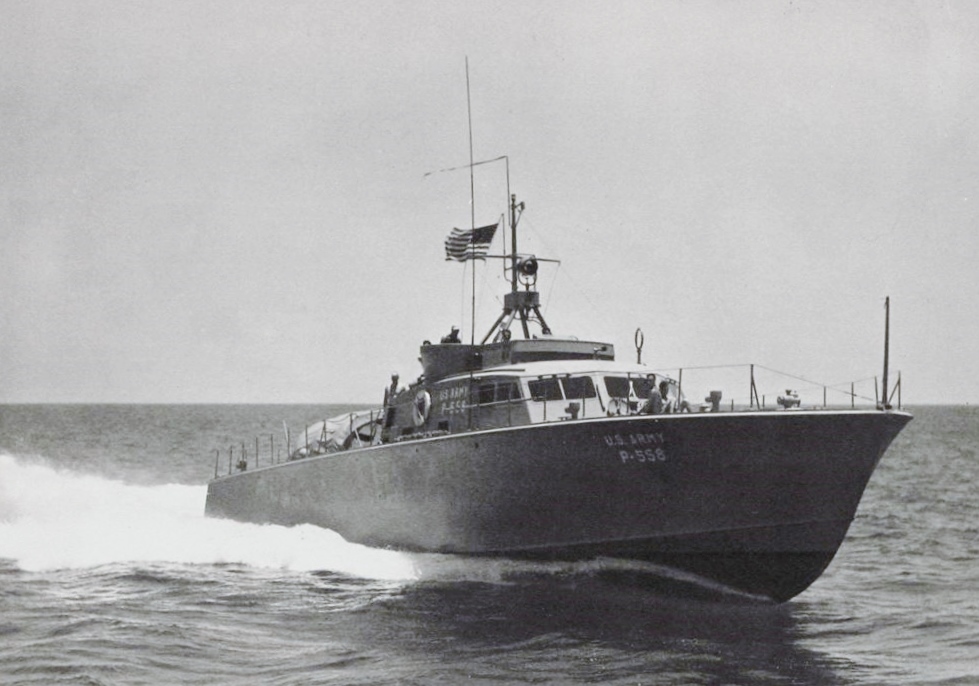
P-558, an 85 ft. rescue boat exactly like the one in George Dunning's story. File: P-558-2
In August of 1945, with the war winding down but the tropics still humming with activity, we headed south for St. Lucia, island‑hopping our way through the Caribbean. I remember San Juan vividly. As we eased into the harbor, low on provisions, we spotted a Navy destroyer riding at anchor. We tied up alongside and asked if they could spare anything. The Navy eats well—far better than we did—and soon enough we had crates of food coming over the side. It felt like Christmas.
When we reached Castries, the capital of St. Lucia, we met the rescue crew who would be taking over the new 85. They were stunned when they saw her—sleek, fast, and nothing like the tired old boat they’d been nursing along. They knew almost nothing about operating her, so the next morning, twenty‑six of us took her on a familiarization run to Bridgetown, Barbados, about a hundred miles ESE. We spent the night there and returned on Sunday. Afterward, they insisted on taking us around St. Lucia in their old boat—the one we were expected to bring back.
Note: The boat they were to return to the U.S. does not exactly match the description of any boat I have found. As time passes, memory of the details may fade. The two most likely candidates are the Coast Guard cutter or AAF rescue boat pictured below. The AAF rescue boat most closely matches the description, although neither boat appears until about 1940
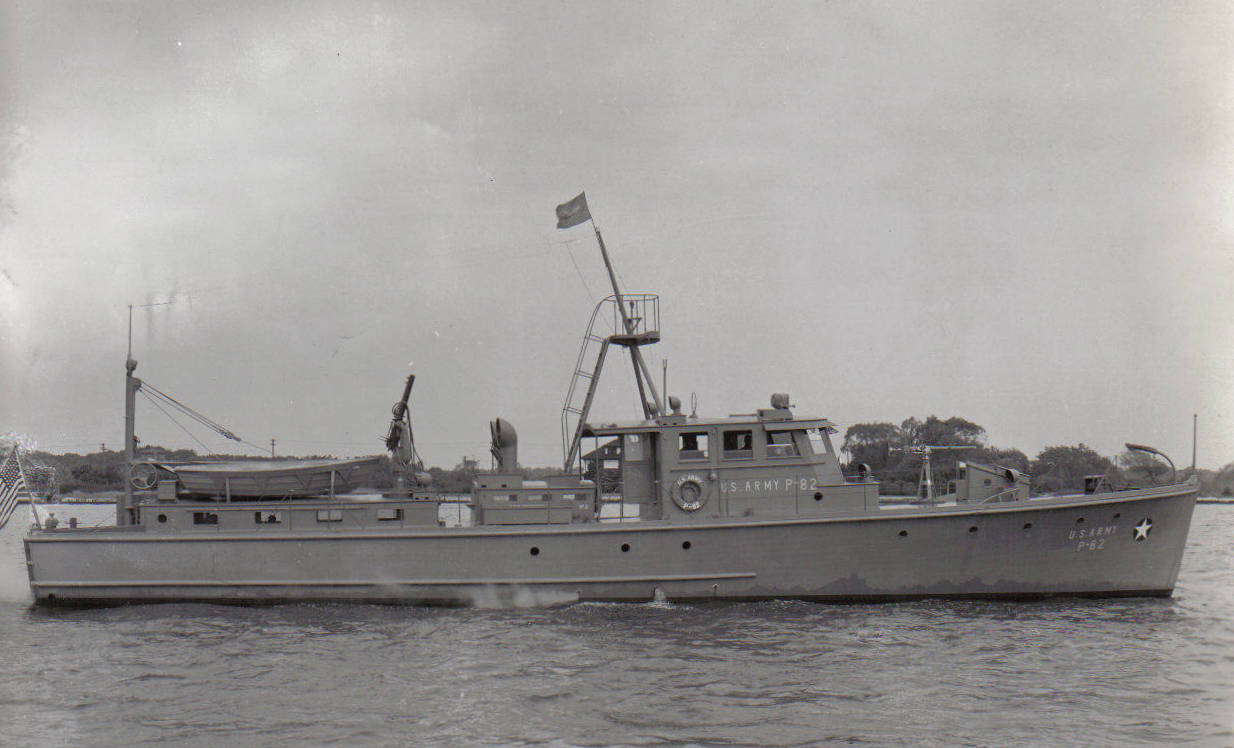
AAF 83 Ft. Crash Boat, notice aft crane and crow's nest. File: 83\ P-82
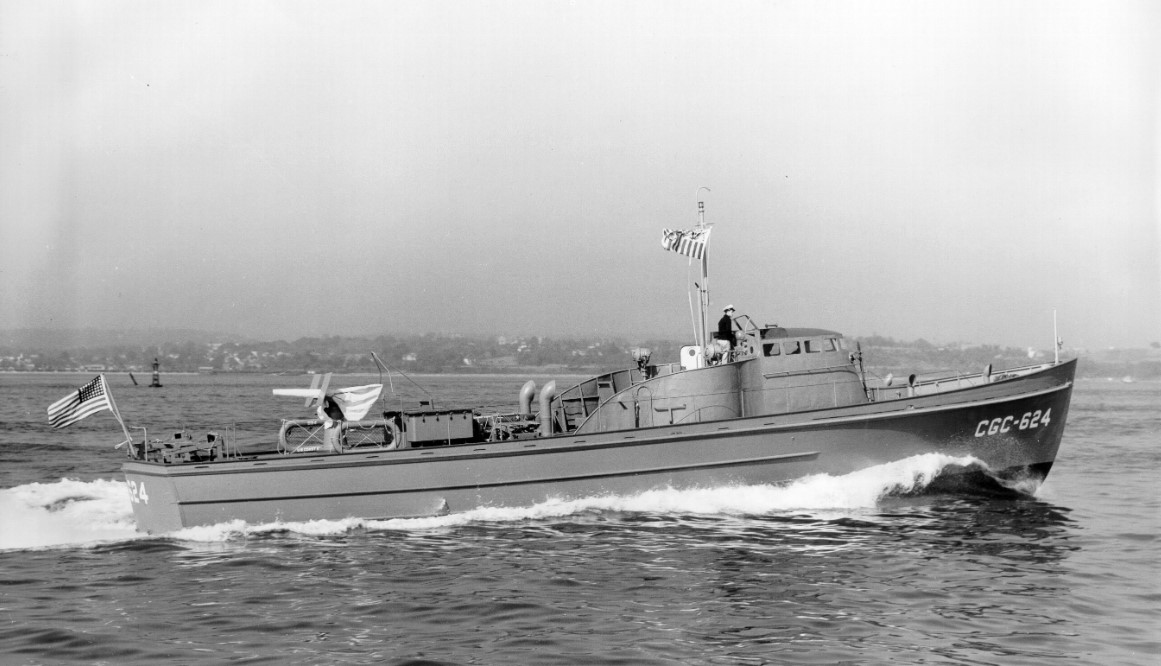
US Coast Guard cutter, 83 ft., no "heavy crow's nest" or aft mast. File: USCG\83 CGC6624
That’s when we got our first look at our “next command.” She was an elderly ex‑Coast Guard cutter, probably early 1930s vintage. To their credit, the crew had scrubbed and painted her until she gleamed—every square inch, including the engine room. But no amount of paint could hide her age. She carried two cast‑iron Kermath V‑12s—heavy, underpowered beasts—and a steel mast with a crow’s nest perched high above the flying bridge. A shorter mast aft held a cargo boom for hoisting their dinghy aboard. At least the generator and fire/bilge pump setup matched what we had on the 85.
We left St. Lucia on August 28, heading north toward Antigua before turning west for the long haul home. An hour out of Castries, the easterly trades hit us square on the starboard beam. In a round‑bottomed, top‑heavy old cutter, that made for miserable going. Within the hour we decided the crow’s nest mast had to come down. We got it lashed to the deck, and the rolling eased immediately.
Then the main generator quit. The engine gang dove into it—valves, wiring, anything they could reach—and somehow coaxed it back to life. We all breathed easier.
Once we turned west from Antigua, the seas settled behind us, but the old cutter still couldn’t make much speed. That’s when the skipper had his stroke of genius. We had a large inflatable raft aboard, complete with a massive tarpaulin. Using the cargo boom, we rigged the tarp as a makeshift square sail. I swear it bought us a couple of knots.
Just before we reached St. Thomas, the port engine’s oil pressure began dancing wildly. Plenty of oil, no reason for it—until it simply gave up and died as we docked.
Now we were halfway home with only one main engine, and even that one didn’t inspire confidence. We knew there was a sizeable air‑sea rescue unit at Aguadilla, Puerto Rico, with engine‑rebuilding facilities. We radioed ahead. By sheer luck, they were in the middle of rebuilding a port‑side Kermath identical to the one we’d just lost. Kermaths were counter‑rotating, unlike Packards, so the match mattered. They offered us the engine if we helped finish the rebuild.
We limped into Aguadilla on September 7 and went straight to work. Two days later the engine was ready, and we removed the big engine‑room hatch to swap it in. Just as we lifted the hatch clear, the weather station at Borinquen Field issued a frantic hurricane warning.
With no hatch cover, we had no choice. We fired up the starboard engine and crept into the harbor, set two anchors, and lashed our trusty “square sail” tarp over the open hatch. It was barely enough, but it held. The hurricane was a strong one, and we rode it out praying the anchors would hold and the tarp wouldn’t tear loose.
When the storm passed, we returned to the dock, finished the engine swap, and got underway again—ten days behind schedule.
From Aguadilla we ran to Santo Domingo, then Jacmel, Haiti, then Guantanamo Bay for fuel. Through the Windward Passage to Nuevitas, Cuba, retracing our southbound route. But on the long leg toward Miami, the oil pressure on our newly rebuilt engine suddenly dropped to zero. Just like that, we were back to one engine. We suspected the oil pump, but there was no fixing that at sea.
The skipper decided Miami was too far to risk, so we turned toward Matanzas, Cuba. As if things weren’t bad enough, radio reports warned of another hurricane barreling westward—straight toward us. We reached the Matanzas River and took the cutter as far up as we could, spreading her wide with lines in the narrow upper reaches.
We survived that storm too, though the old cutter groaned and rolled like a living thing.
When the seas calmed, the skipper said, “Let’s shoot for Miami.” So off we went—after dark, no running lights, a beam sea on the starboard side, and the remnants of the hurricane still stirring things up. The 83 rolled violently. One wave slammed the skipper clear across the wheelhouse, smashing his face against a porthole. Our surgical tech patched him up as best he could, but he was in rough shape. He still had the sense to turn us back to Matanzas.
The next day the sea settled, and we tried again. Slowly, stubbornly, the old cutter made her way north. Around 1:30 in the morning we entered Biscayne Bay, and half an hour later we reached the mouth of the Miami River. After waking four or five bridge tenders, we finally tied up at Nuda’s yard.
The skipper turned to give the signal to cut the engine, but before I could touch the controls, the engine quit on its own—and never started again.
Our mission was complete. Eleven days to deliver a brand‑new 85 to St. Lucia. Thirty‑six days to bring back an old 83. Not exactly what headquarters had in mind, but we made it home.
104-Ft. Delivery - Poor Workmanship
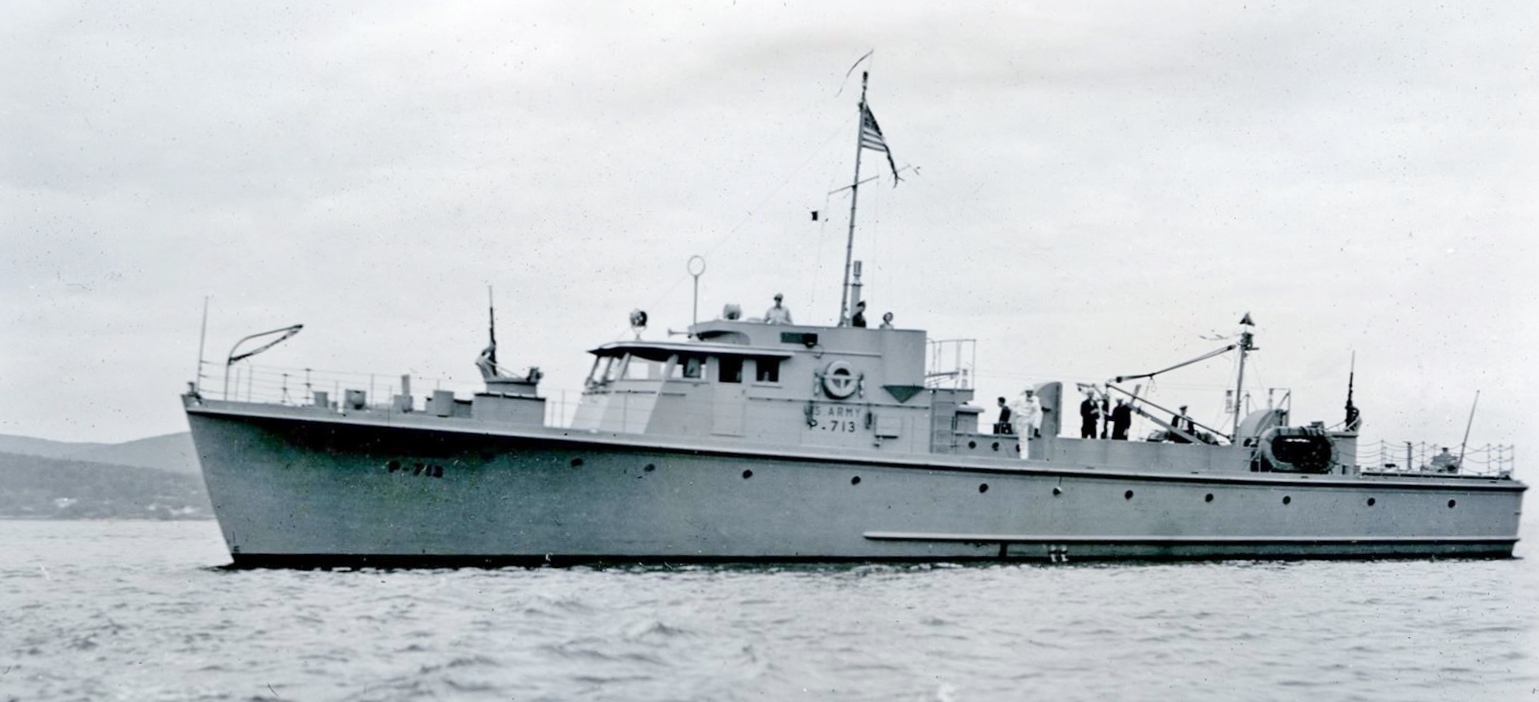
Harry Sperling shared this information in March of 1990 which I paraphrase as follows: I served in both generations of 104s and briefly in one of the 85s with the 10th AAF ERBS in the Aleutian Island for 2 1/2 years. Our first 104s were built on the West Coast and were not bad. Those built in California were suitable in terms of construction quality and seaworthiness but the best were built in Seattle by Sagstad Shipyard, which specialized pre-war in fishing boat construction for the North Pacific. The P-700 series were built in Brownsville, Texas and I have always felt those Texans should have stuck to punching cows and drilling oil wells rather than building rescue boats, for their products were complete dogs. Three 104s came out of the Aleutians in 1944 for replacement and we picked up the Brownsville boats in Wilmington, CA. The trip up the West Coast enroute back to the Aleutians was a nightmare.
There was heavy weather all the way to Seattle and all three boats leaked like sieves, not so much through the hull as through the deck and deckhouses. We made it to San Francisco for refueling with minor problems such as wet bunks, water leaking over the radio equipment and into engineering through the overhead, etc. There was a howling Nor'wester blowing when we headed up the coast again and by the time we were abeam of Oregon, all three boats had most of their electrical systems shorted out so there was no hot food or heat. When we reached the Columbia River lightship, there were only two sets of running lights and one blinker functioning among the three boats and that solitary blinker had some heavy going to explain all this when we were challenged by a Navy PC.
Repairs in Seattle made the boats reasonable seaworthy again but it took nearly two months, which didn't add much to the war effort but was a good break for the crews. However, the boats never were up to the quality of the first 104s and you haven't really lived until you've been aboard one of these packets quartering a 60 knot gale off the port bow trying to make it to Seward from Kodiak, Alaska, with the wirerope liferails 6" in diameter from ice buildup (and the entire foredeck in similar condition) when a baffle plate in one of the main fuel tanks breaks off and you can hear it thud against the tank walls each time the boat rolls. Only thing we could do was fill the tank with CO2 foam and pray a spark wouldn't set off any residual gas fumes while we put about and hauled ass back to Kodiak. Never were there so many volunteers to chip and chop ice off the foredeck when we were running downwind, probably because this was about as far away from the fuel tank as one could get. We made it to Seward some three days later in much better weather, but that baffle plate still kept sliding around. Fortunately, I had orders to get off the boat in Seward for discharge from the service (this was in early December 1945).
A Letter from the Pacific, July 8, 1945, by Charles "Pete" Ruth
Hq FEA SC, APO 323, San Francisco
Dear Mama and Dad,
I’m not actually at the above APO My location is near Manila again. I have just come up here again from a trip down south of the Philippines where my clothes were never dry. We had plenty of rain and wind and a wooded camp [illegible]. The sack felt wet all the time tho [sic] the tent didn’t leak. The rain must have driven the rats into the tent.
While I was getting a haircut a 6-foot snake (reported to be a Boa) crawled out from under the supply tent getting the barber all hopped up; he finally finished the job telling me all about how unfair the point system is – so far as he is concerned. Everybody wants to go home. These poor fellows who’ve been over here a matter of years are well fed-up with the climate, being away from home, and with the food. However, with few exceptions the food is normally good considering the problems.
The work done by the planes is astounding. They use them just like Jeeps. If you have to go anywhere, you just ask for a plane and, in a few hours, cover the distance from home to Chicago and come back for chow that afternoon as though you had driven over to Alexandria [Virginia]. Today we are having a little trouble getting a plane. However, some planes hauling lumber are coming through this afternoon so we are in hope the field is open so they can pick us up.
Last night they had a dance here. Frank and I looked on. It was in a thatched club that is quite swanky in a rough sort of way and right on the beach. Sand all over the rough concrete provided the wax for the floor. The GI band was good as was the floor show though a bit basic in breezy jokes. Everything is crude out here. When a girl gets home from out here, she’ll be shock-proof. If you “gotta go” you go right where you are and if a few girls pass by nobody jumps in the ditch, it is all just a matter of course. I know these natives think the Americans spend half their lives taking a leak. Before take-ff everybody stands around the plane giving nature a break and repeat the process on landing. That is why grass doesn’t grow on the runways. The [illegible, maybe natives or Moras] aren’t so modest themselves. Down in Zanbo while traffic passed, natives on foot and the army wheel borne, the Mora’s squat by the beach at the water’s edge doing their chores finishing off with the aid of one hand a little water – now I know why the[y] eat with only one hand.
In about 10 days I expect to be back to Hollandia and leave for home arriving about 1 August 45 tired and dirty but not noticeably thinner.
One of the boys I knew at New Orleans had me on his boat for chow one night. He had just completed a trading deal with a ship in from Sidney. We had steak, synthetic ice cream, Aussie beer (stronger than our beer) and lots of Scotch. It was some occasion. All aboard hardy guts to be able to gorge themselves and not get sick with that boat rolling around. Trading is the main activity here. Few have what they want so they swap off. In fact, units have to guard their stuff carefully as they swipe each others property & use excess for bait to get a Jeep, ice box, dry dock, airplane, or whatever else can be thought up. In Manila, a Jeep without the gearshift locked to the dashboard seems to be public property. A Jeep on a dock needs a guard as ships clearing a location will pick-up with the hook any vehicle, locked or not, and put it in the hold for their use at any gay spots they hit.
The boys jabber all the time and in ten minutes you know their life history. However, the conversation doesn’t lag then for then they hit the main subject of common interest over which there apparently has been much studying, experimenting, and planning for future projects – the subject of women is never exhausted. It is my opinion that many suffer from deteriorating vision; those with over 18 months’ service seem to be most effected. The symptoms are expressed roughly as follows: See those white native girls? Yeah, those blonde fuzzy wizzies[?]! If you catch a hop with a GI operated Jeep the soldier steps on the accelerator firing the engine & his imagination simultaneously and goes a dream conversation about his exploits down in Sidney where he joined forces with the fair sex leading assaults on every pub ending the campaign with a rest in a hotel with his fair ally. It is a strange code of war under which they operate; the successful campaign falls on the field of battle to be carried off by witnesses of the struggle. The cause is mysterious as no woman from that section of operations have any wounds indicating the cause of their fallen “victory”.
My thoughts now are getting home. I know I’ll appreciate it more too. If I end up back here, I’ll not like it! Some of the officers have a pretty good time raising lots of hell which seems to be fun for them but I’m afraid I don’t get fun out of the few sources of fun available to a fellow here. I favor the Mexican army’s policy of permitting the men to take their wives with them.
When I get to Hollandia I hope I have enough mail to keep me reading until I get State-side. Send this to Graziella too.
Devotedly, Pete
The Crash of C-9453, Remembering a Veteran - An Excerpt From Dad's Memoirs, Copyright by Robert A Boyden
My Father, Donald Boyden, enlisted in the Navy during World War II. Due to his familiarity with small craft and his knowledge of Narraganset Bay and nearby waters he was assigned to the boat house at the Quonset Point Naval Air Station. What follows is the story of the demise of crash boat C-9453. I don’t recall his ever disclosing the cause of the incident but he does so in this story. It is transcribed from handwritten memoirs I discovered after his passing. I apologize for names that are misspelled or omitted and to readers who may not be familiar with some of the nautical references. To honor his memory, it is presented here as he wrote it.
Shortly after new year’s I was assigned to the 63’ crash boat C-9453 that a crew had brought up from Miami Shipbuilding Company in the last weeks of December. The skipper was Davey Carroll a boot lieutenant - green as grass. He had been a school teacher in Texas. Don’t think he ever saw a boat before but he was a 90-day wonder. He was a nice enough guy and said he did not know much. The first thing he did with us crew was call us together and ask the first class bosun’s mate and me to make up a list of gear that the boat needed. We gave him a list a mile long. Two very important items, as the lack of them later proved, were a spare anchor and line therefore. Much about this later.
The first thing he wanted was the sick bay aboard to be painted white enamel. What a job! The boat was built flexible and was comprised of many light closely spaced ribs and deck beams. The enamel was the best I ever saw but what a job to paint all those deck beams.
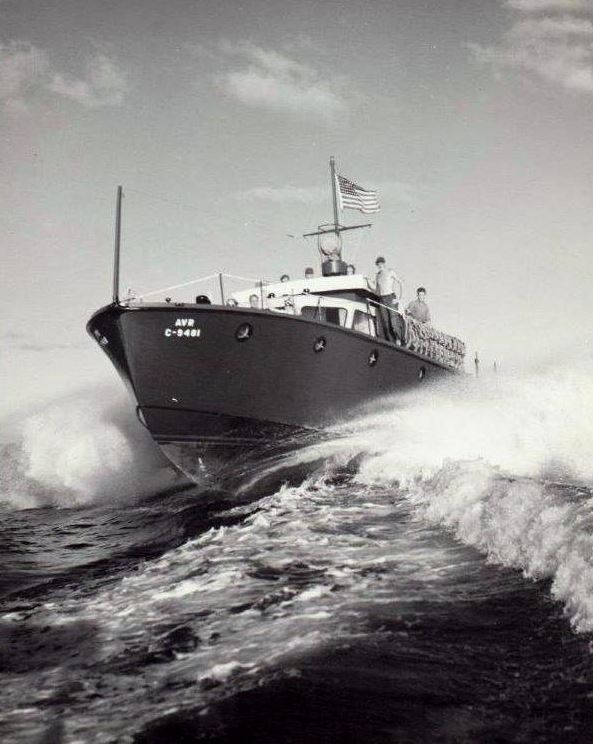
C-9481, same design as C-9453, the boat in the memoir. File: Navy\C9481-H
We did a little practicing with the boat and had a few skirmishes with some PT boats at Melville. They were a bit larger and had three engines similar to our two 1300 horsepower Packards. We kept up with them or edged them on occasion. What a bumpy ride in any sea. (We) had a civilian(?) assigned to the boat and after he was thrown against the overhead on his first trip he refused to set foot aboard again. Somehow, he arranged a transfer. There were some gasoline heaters aboard for several compartments. I remember one Saturday night in late January three of us had to spend on a mooring off Quonset for some reason rather than joyride inside the boat house (ashore) where heat was available. The temp was about 10 degrees outside Sunday morning and the heaters had given up the ghost during the night. We had slept with all our clothes on and also put on heavy fleece quilt outerwear. Brrrr!
Things progressed and we gradually were finishing many items to make us functional. However, on Saturday February 13, 1943 my watch had the week-end duty. We had gone to early chow at 1100 and returned to the boathouse. The other watch had taken off for the week-end ashore. About noon a big flurry of brass and gold braid descended on the boathouse and soon we were told to warm up the engines as there had been a plane crash in Buzzards Bay and probably we would have to go. Shortly, the skipper, Lt. Carroll, arrived at the boathouse and the boathouse day officer Lt. Petrie was with him. About 1200 we took off for Buzzards Bay. Aboard was Lt. Carroll, Cmdr. Petrie, Machinist Mate Bodtha, Bosun Mate First Class Barshof (recruited from the other boathouse crew as he had helped bring in the boat from Miami), Allie Osborn a signalman 2nd class, myself and several miscellaneous gold braids.
We went over to Newport and they opened the net gates for us to go out. When we got out around Brenton point and headed east for Buzzards Bay it was really choppy and uncomfortable. We had a fresh southeast wind and we were banging into some rough seas. I went below to get some binoculars for the skipper from his cabin and observed that the built-in desk that abutted a bulkhead pulled away from it about a quarter of an inch when we bounced into a few waves. She was flexible alright!
We arrived at Vineyard Lightship and went up Vineyard Sound to Quicks Hole where some fisherman had picked up the surviving pilot from the downed plane that had sunk off Quicks in Buzzards Bay. The decision was made to rush the pilot to New Bedford Hospital for a checkup. We arrived in New Bedford just before 1500. All gold braid and the pilot went to the hospital and were soon back. He was OK.
We started out for the return to Quonset in a strong snow storm. We made Hen & Chickens Light Vessel and set a course for Brenton Lightship. I had never been given the wheel for any length of time prior to this. When we got to the light vessel Lt Carroll said “take the wheel Boyden – course 270”. There was quite a sea running and the wind was west at 25 to 30 knots. We were rolling and twisting quite a lot. It took me a few minutes to get the hang of steering her and settling down to a more or less steady course. I kept thinking that they had not allowed anything on the course for the thrust of the wind and waves so I kept 10 to 15 degrees above the 270 (255 to 260) as much as I could. Whenever any of the gold braid got near I had to steer 270. We ran our time for Brenton’s and, no lightship. Visibility was probably a quarter mile at best. We slowed down and eased along for a bit and wallowed in the seas. Finally, I was directed to come about and circle. I picked as flat a spot as I could and made it with great rolling. Soon we saw a red buoy which had no identification on it.
About then one engine coughed off. Lt Petrie who was supposed to be a mechanic went aft to help. Buda was seasick in the engine room. Petrie soon got back and then the other engine quit. Ollie and I got out the light Northup anchor and line – the only one aboard - and put it over. There was not enough scope so we bent on another line and finally got the anchor to hold. The lines were only five eights diameter. From then – sometime around 1700 – we rode at anchor rolling and bouncing. All had been instructed to wear lifejackets. The snow finally started to let up so we could see shore. The Coast Guard Artillery picked up our blinker. They said a tug was on her the way from Newport to rescue us. We never saw a tug. About 1900 the anchor let go and we started our journey ashore at Cherry Point. On the way ashore we pulled all the bunk cushions into the cockpit for cushioning if we ended up against the rocky cliffs.
Bodke had been so seasick for a couple of hours that he lay in the cockpit as if dead. We had a tough time to get him up on his feet for abandoning ship. Ruskus too had been pretty sick. Ollie steered us in and eased us over a sand bar about half way in. The Coast Guard Artillery had a big spotlight on us all the way in. We ended up alongside a rocky ledge. All of us stepped on to a shelf like area and were helped up to high ground by the Artillery men and a rope. Not one of us even got our feet wet. The pilot had cheated death twice that day. The boat was being smashed very heavily against the cliff. We were taken to an Army mess hall in the carriage house of some big estate and enjoyed getting warm and eating. The temperature outside was about 10 degrees. After we had eaten and gotten warm Lt Carroll asked for volunteers to go back and see how the boat was making out. I went with 3 or 4 others in a Jeep. When got there the boat was still being smashed against the cliff, her decks were awash, the light on the top of her mast was still on and her flag was still flying from the gaff. We all slept like dogs that night in army barracks in the carriage shed or barn. Next morning it was clear, cold, west wind and pieces of the boat were match sticks all along the shore in the next cove to the east. The engines ended up in that cove. We all went back to Quonset in a Navy truck and were restricted for a couple of weeks until a court martial was held. We were all asked questions but no opinions. The next thing the chief examiner wanted to know was why the engines stopped. He never asked me thank goodness. We ran out of gas.
P-716 and P-717 Mission in The Philippines
We arrived from Morotai (northeastern Indonesia) on the 21 Nov. 1944, after a gruelling 113 hour trip. During December 1944 the boats were active standing off Tacloban (Philippines) and Tanuan air strips on the alert each day. Several rescues were made during the period. The P-717 was given the task of taking a group of Intelligence Officers from FEAF around the island to Ormoc to investigate a new type of Japanese plane reported to have crashed in the area. During the mission the craft was subject to a strafing attack. Twin-fifties were subsequently installed on the bow of each boat as a result of the trip, as it was found almost impossible to bring the bridge guns to bear on a low flying aircraft approaching from directly over the bow.
During the month of January 1945 one of the 85 ft. boats was sent to Panaon Island, meanwhile the P-720 returned from a three day search mission on the 18th January with a score of 17 dead Japanese and three prisoners. The crew had been given information from a local informant on Carnsea Island which enabled them to surprise the enemy attempting to escape to Luzon. On the 25th January two boats including the P-716 departed for Mindoro and operational control of the 309th Bomb Wing. During February 1945 the boats were mostly on air strip alert duties or under repair, however four further craft which included two 85 ft. boats and the P-720 and P-717 were sent to Mindoro and then on to Subic Bay on Luzon.
The unit was still well dispersed, as six craft left Biak on the 20th February under navy tow – the boats included P-398 and P-718, both 63 ft. boats . On their arrival they made up half the HQ total boats, as only five 45 ft. boats remained at the base. The P-717 is recorded as having rescued 8 people on the 11th February in an operation off Pintayan. By the end of May 1945, the unit was based ashore and also reported that five new 63ft boats arrived – all of which had to be fitted with radios on arrival.
Brits & Americans in the Bahamas- WWII
The following information is from The Tribune (Bahamas) and forwarded to me by an unknown source. I include it on the website because of the reference to USAF crash boats. I have edited the article for brevity but have not altered the basic information. Although the article refers to them as HMS boats, the numbering of the boats indicates them to be American, at least in origin. British boats had a red, white and blue target on each side of the bow, followed by a number, typically three digits about 3-4 ft high. The USAAF crash boats ID number started with a ”P” as do the boats in the article. The specs for P-339 are based on the assumption that it is a British built 63 foot boat, which she clearly is not. These boats may have been transferred for British use under Lend Lease but I have not researched that possibility. Under Lend Lease, the U.S. acquired bases in Bermuda, Bahamas, and some British Caribbean islands primarily in exchange for some WWI surplus destroyers, “four pipers”.
After about eighty years it is very understandable that Mr. Ross’ memory might not be perfect or that the reporter may not have been knowledgeable of crash boats and made some inaccurate assumptions. My comments within the article are in italics.
July 19,2024
Fredrick A Ross was a Scotsman who joined the Royal Air Force during WWII and was assigned to a crash boat division called No 250 Air Sea Rescue Unit. He was an engineer, and even though they were based at Montagu Foreshore in Nassau, Fred obtained the coveted posting to Dunmore Town, Harbour Island, as often as he could. The men stayed at The Little Guest House, run by sisters (not nuns?), and apparently so much fun was had that an RAF accountant had to fly to Harbour Island after the war just to negotiate final payments.
After the war, Mr Ross returned to Scotland, married, and had a daughter. However, he was determined to return to Harbour Island. After about three years, he returned to the Bahamas with his young family and opened Ross Garage at Colebrook Street. Known as “Pa Fred,” he lived to age 91, passing away in January, 2012.
This is the story of rescue boat HMS P-339. By mid-1942, the RAF had two large air bases in New Providence, Windsor Field, and Oakes Field. Since nearly 200 aircraft had accidents or were lost, they needed crash boats stationed throughout The Bahamas to go rescue or recover them quickly. The boats were spread from Maya Guana to Exuma, Bimini to Walker’s Cay, Clifton and Montague Bays on New Providence near Nassau, Royal Island and Harbour Island, Eleuthera.
P-82 above is the same design as P-89 and also built by Cambridge Shipbuilding listed below. File: 83\P82-1
Fred Ross’ unit, the 250 Air-Sea Rescue Unit, was formed on September 1, 1943, at Harbour Island and Nassau and disbanded on 10 October 1945. “It was equipped with amphibious aircraft and fast launches.
They had seven boats:
- HMS P-89, 83 ft, by Cambridge Shipbuilding
- HMS P-170, 42 ft, by Chris-Craft
- HMS P-190 42 ft. by Owens Yacht
- HMS P-191 42 ft. Owens Yacht
- HMS P-250 104 ft, by Casey Boatbuilding
- HMS P-339, 42 ft. by Richardson Boat
- HMS P-712, 63 ft, by Miami Shipbuilding, transferred to the Royal Navy as HSL 2779 March 1944 at Nassau; disposed of locally March 1947
Tasks included finding dinghies, bodies, fuselage, retrieve IFF or “identify friend or foe” codes and other sensitive materials. The units rented almost all the vehicles on the island, built hospitals, and requisitioned most of the hotels.
Ross served primarily on HMS P-339. There may have been some misunderstanding between Mr. Ross and the reporter. P-339 was not a 63-footer. So, if Mr. Ross served primarily on a 63-footer, he primarily served on P-712. Apparently the reporter assumed that the boats were British built, and that they were likely a British Power Boat Company Type Two HSL “Whaleback” which was 63 feet long, 18 feet wide, drew 4 feet, was 22 tons and had three Napier Sea Lion engines of 500hp each. The boats could make 36 knots, had nine crew, and could range up to 500 miles.
On September 21, 1943, ASR launch P-339 was dispatched from Montagu Bay to the scene of a raft, then it was learned a Baltimore-type bomber plane had landed on the beach in northwest Andros, and a dinghy put to sea to attract attention. P-339 was unable to approach near shore because of shallow water, so it was instructed to stand-by and await high tide, then approach. Before that, a blimp picked up two survivors and took them to hospital, so P-339 returned to base.
The next day, another aircraft ditched in the sea just two miles north of Tarpum Bay, Eleuthera, with depth charges aboard. The crew were uninjured except the radio operator who had face injuries. HMS P-712 was dispatched from Harbour Island, arrived at Rock Sound, found and took the majority of the aircrew to Nassau and berthed at Prince George Dock. Later, an amphibious Mariner aircraft observed a dinghy, and HMS P-339 was instructed to proceed to that position. However, they were unable to remain at sea due to an oil leak resulting in significant oil loss.
On another occasion, a B-25 bomber sighted a disabled Mariner PBY plane signaling at sea. HMS P-339 was told to put to sea to locate it, which it did, and managed to attach a towing line to it and began pulling the floating plane towards Eleuthera. Then the US Navy seaplane tender or depot ship USS Christiana IX stationed at Royal Island took over the arduous tow from HMS P-339 as its tow-rope was unable to stand the strain, so P-339 returned to base.
On April 26, 1944, HMS P-339 was instructed to put to sea and to rendezvous with the frigate HMS Dominica to search for the dinghy of a downed plane. In 1944, HMS P-89 left Harbour Island to pick up the airmen, then rendezvoused at Ship Channel Cay with HMS P-191 from Nassau.
On D-Day, June 6, 1944, HMS P-712 was dispatched from Harbour Island to Rock Sound to find downed pilots from a bomber. By January 8, 1946, VE-Day and VJ-Day were passed and the Bahamas RAF base population for No 250 ASR dwindled to just 14 non-officers, so “by request of the Garrison Commander and the Colonial Secretary, two Air Sea Rescue [ASR] craft were employed in evacuating repatriates and released service personnel from the Island Monarch. The boat anchored outside the bar and an officers’ reception party proceeded to welcome the repatriates” to Nassau Harbour. Other duties were pulling boats and seaplanes back to safety when they dragged anchors in harbour.
On December 13, 1944, the US Navy submarine chaser USS SC-1059 ran aground at night in Fleeming Channel, near Current, Eleuthera. An ASR boat out of Montagu arrived immediately, launched a wherry, or small row boat and in rough seas transferred 11 men to a large US Navy tug then left.
On 16 January, 1946, “ASR Officers took Clerihew House as Headquarters for duty crew only. The moorings for the ASR vessels remained in Montagu Bay, pending the loan of the port dredger for their transfer to sites opposite Clerihew House.” Then on March 22, the Accountant Officer departed for Harbour Island to investigate a claim for compensation submitted by the owner of The Little Boarding House (remember the sisters) in which ASR personnel were billeted 1943 to 1945.” The war was truly over.
As for HMS P-339, the sequence is difficult to ascertain, however the likeliest scenario is that the boat was sold locally in Eleuthera. What is known is that HMS P-339 blew up while fueling. The hulk – probably still burning – was towed to Three Islands dock, visible in the shallow bay to the east of the dock for many years.
From the Lawrence Journal - World 6 May 1944
(Found on the genealogy site FamilySearch.org) Leaves from a war correspondent's notebook by an overly dramatic Sid Feder, Anzio, May 1, 1944 (Delayed)
If you're around the Mediterranean battle zones some time and happen to spot a handy little gadget that looks like a surfboard with St. Vitus dance and behaves like a bucking bronco in a rodeo, don't be surprised. It's only a crash-boat.
The fellow who named this sea going instrument of torture ought to get a medal for the war's best job of calling them right. It knows all the old ways of whacking the waves and has invented a whole set of new ones to drive your backbone up around your neck.
This 63-foot craft is a Coney Island roller-coaster with salt water flavor. And if you want to prove it, inspect the collection of black and blue bumps decorating a traveler who has ridden one for the 90 miles between Naples and the Anzio beachhead.
In spite of all their tricks they're as useful a tool as Uncle Sam has roaming around the Mediterranean. They were built originally to handle rescue work for aviators coming down at sea. But since then they've covered an assortment of jobs all the way from capturing an island to running a bus service.
Lt Herbert Grant Prizer, who hails from Evanston, Ill., runs one that had its pint-sized bridge house blown away once by an artillery shell. This happened when it and a few more crash boats were participating in an attack on an island that enabled a force of 50 Americans to capture a garrison four times that large.
Another time a piece of shrapnel went clear thru the gun turret, which is about as big as a stall shower in the modern bathroom. As a souvenir, the shrapnel - about the size of a pie plate, is kept aboard by the crew: Warren (Brownie) Brown of Lemon Cove, Cal.; Vic Grossi and Lou James of Long Island; Lea Perjean of Lafayette, La.; Bill DeYoung of Patterson, N.J.; Jack Terry of Hammond, Ind.; the usual Brooklyn delegate, Whitey Nyquist, and a sea-going soldier, Cpl. Matt (Shorty) Majka, the army's assigned radioman from Star Junction, PA. Incidentally, James, after being away from home about a year, was sitting on the dock in Naples the other day and who should show up but his father. It seems pop is an engineer on a Liberty ship now.
If you're spending the night on a crash boat and there's an air raid don't worry about a thing. The roof of the cabin is of sturdy plywood - and the bunks are mattresses laid over large gas tanks. What could possibly go wrong?
14th ERBS Historical and Intelligence Reports June 1944 through March 1946
This collection of reports covers the actions of the squadron from the early days in New Guinea to the challenges they during the early days of the occupation on Japan. It covers missions and boats lost, along with individuals promoted, killed, or sent home for discharge at the end of the war. There is a large amount of information from their time in the Philippine Islands. Covering 44 searchable pages. The document is too large to include under "Missions", so I have placed it in "Manuals and Publications" section
10th ERBS From Adak to Kodiak, January 6-10, 1945
This is a personal log of the trip kept by an unidentified crewman aboard the P-216. The document is too long to include under "Missions", so I have placed it in "Manuals and Publications" section.
Check out the OSS Operations for some really interesting accounts of their missions
Incidents – Between the Wars
Bermuda Hurricane Rescue - The Fools Were Lucky
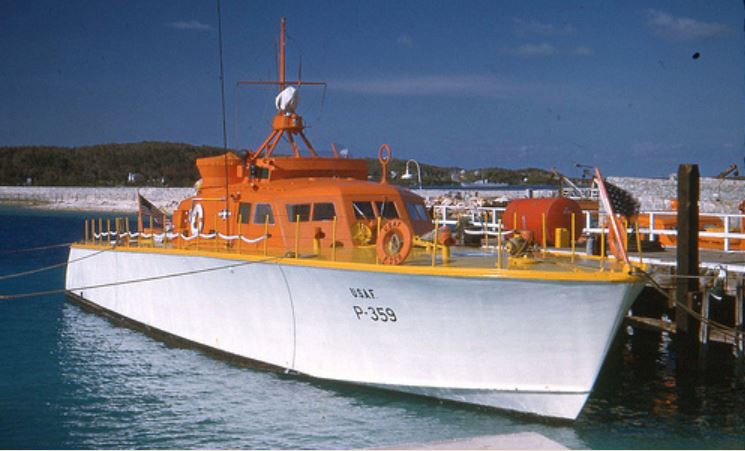
Don Slessler remembers a hurricane was approaching Bermuda and hoping to beat the storm, the Arundel Company decided to send its floating wooden drydock, housing three ships, back to the States the evening after completing a dredging operation at the entrance to St. George's Harbor. This turned out to be a foolhardy move when the tugboat towed the the huge structure slowly out of the harbor and directly into the path of a fast moving hurricane. An hour or so later,a May Day alert announced that the drydock, pounded by gale winds and surging waves, was in danger of sinking. With skipper Joseph A. O'Connor at the wheel and applying full power, we set out on P-359 to get to the drydock before it went under with its twelve member crew.
From the moment we turned out of St. George's Harbor the P-359 took the full brunt of the storm. So much stress was put on the engines on this brief, but turbulent run that they shuddered and shook on their mounts. Switches kept kicking out and several pipes broke. Burkett, Ernie Tholke and I staggered from one leak to another, clamping and hammering to stay one step ahead of disaster. Of course the Packards performed flawlessly as always, overcoming whatever pressures the sea had in store on that wild and wooly night.
When we reached the coordinate points indicated by Rescue Command, there was no drydock in sight. The battering waves and 100 mph winds had ripped its superstructure to pieces and sent the three boats in its hold to the bottom of the Atlantic. The searchlight beam of the circling C-54 provided fleeting glimpses of pieces of wood on the towering waves, leaving no doubt that it had been sunk. At first, it seemed as though the entire crew had gone down with the drydock. Only one tugboat that had towed the drydock was still afloat, telling us that at least some of the crew were alive and within reach. Then faint but unmistakable cries for help were heard above the incessant shriek of the wind and crash of the waves. At this point the tugboat captain radioed O'Connor that he and his men were searching for the Arundel crew, all of whom had gone overboard before the drydock had been shattered and had its buoyancy tanks ripped open.
Our crew spurred on by the chance to save lives, went feverishly to work to scan the waves for survivors, with the help of the C-54's high-powered searchlight. Over the next two turbulent hours, the crews of both boats battled the full force of the hurricane to find the men, throw them lines, and lower Morrison litters to hoist up the injured. Skipper O'Connor, controllong throttles and clutches, moved ceaselessly from forward to reverse and back again while twisting and turning up, over, and down the relentleess wall of waves. Down below tending the engines, I missed this hectic action but had my hands full monitoring instruments, pipes and controls to spot problems. All the while the hurricane seemed to be gaining strength, intent on destroying the rescuers and the rescued. At one point, two crash boat crewmen were nearly swept overboard by the wind while helping survivors aboard P-359. Even the return to port, with survivors safely aboard, was a challenge. The storm, still trying to prove its mastery, attacked the boat from all directions. Amazingly, it came through with no significant damage except that some of the paint was ripped off the hull.
The next day dawned bright and clear as high pressure moved in to replace the tropical low which had fueled the hurricane. As fierce as it was, the storm actually did little damage anywhere on the island and all twelve of the crew members of the drydock were reported alive and well in the Kindley Base Hospital. During the next few days the dramatic story of the "destruction of the world's largest wooden drydock" and our rescue of its entire crew was described in detail by newspapers in England and stateside.
Bermuda Skydiver
Another out -of-the-ordinary rescue followed a report that a crewman had fallen into the ocean out of the hatch of a weather plane at 1,000 feet! His fellow crewmen had seen his parachute mushroom and watched him hit the water so they were able to target his location. Two SB-29s, a Coast Guard cutter, a C-47, a Navy 63 footer, and our 85 footer all converged at the indicated splahdown area on the south coast, 30 miles from St. George's Harbor. It was a cold, blustery day with 20 foot swells being whipped up with up to 50mph winds. I remember sliding around the engine room more than once as the rough seas pounded the P-359 on the way to the scene. The 63 footer lost part of its bow railing and some of its paint was stripped off.
The airman had all he could do to stay righted in his Mae West as the waves pounded down on him. Having been tossed about in the water over an hour, he was so sea sick that he vomited continually after being hauled aboard. When he got his stomach settled, he was confronted with the embarrassing question, "How in hell could you fall out of an airplane in mid-air"? Apparently the hatch had been open to observe the effects of the wind on the water and he inadvertently stumbled through the opening. At any rate, we all agreed that the bizarre accident wasn't going to help his Air Force efficiency rating.
Louis Risolio - How I found Myself in Korea
Louis Risolio was at Langley AFB in VA as a cook’s helper when he got the chance to transfer to the Special Service Boathouse at Langley. They had row boats and sailing dinghies. I taught people how to sail, etc. One day I got a call and they wanted to know if I would like to help pick up a crash boat in Mobile, AL. I said, “When do I leave?” (I didn’t know what they were talking about or what a crash boat was.) So that’s how I got into the boat outfit.
Later he was sent to the Philippines and when the Korean War broke out he was shipped to Fukuoka, Japan. He was assigned to the R-1-667 and later to R-1-676. He says of his military service: “It was a good life. I met a lot of good people and got my education the hard way. Would I do it over again? You're damn right I would…!”
Bolling Field & Pentagon Shuttle
Bolling Field has a long history, established in 1917, it is actually two separate military bases. Part of the real estate was called Anacostia NAS, with its own runways, and the rest was Bolling Air Field, with its set of runways. Just across the Potomac was Washington National (Reagan) Airport. There was legitimate reason to have a Crash Boat Flight based at Bolling, if only due to the dense air traffic. On Dec. 12, 1949, Capital Airlines Flight 500, en route from Memphis to Washington National Airport, crashed in the Potomac. The DC-3 aircraft had stalled at too low an altitude to permit a recovery. Twenty-three people were on board Capital 500. Members of Bolling's crash rescue boat flight pulled out 19 survivors from the water. I don't have any additional detail on their participation in this rescue operation. The unit began operations in 1941 and its primary mission was to provide water rescue coverage for all three fields. The Bolling / Pentagon Ferry service was established later.
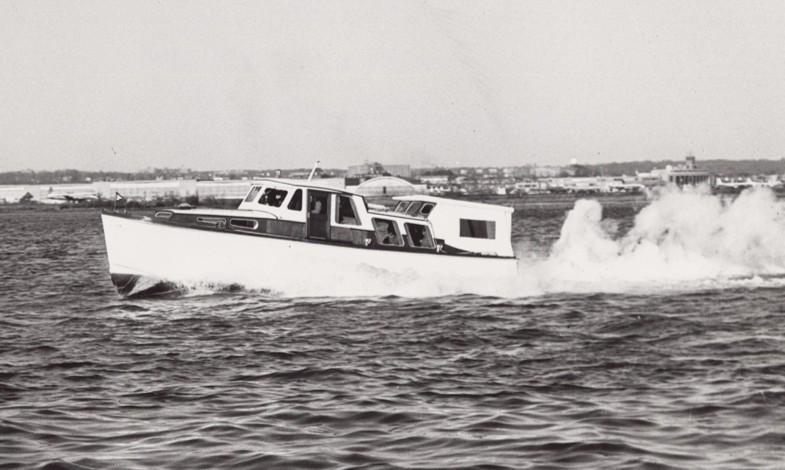
File: 42\Pentagon Shuttle
Peter Kekenes shared information about his duty on a 42 ft. boat, RP-9-846. I was assigned to the Staff Boat in 1954 and 1955. The configuration was that of a 42-footer; after that all similarities ceased. There was varnish work inside and out, including a false mahogany transom with gold lettering. The deck fittings were all chromed, as well as the Danforh anchor. The aft cabin was reserved for generals. It was furnished with rich-looking blue cushions, and a coffee table whose top was made from a solid piece of black walnut. The boat's appearance made you feel like it was too nice to actually use ... that it should be kept in the boathouse and admired.
In October of 1954, Hurricane Hazel struck the Washington, DC area, with gusts up to 99 mph. Staff Sargent Bob Gordon, Sr. and I usually alternated morning and evening runs to the Pentagon. We assumed, due to the weather, that the evening run was canceled ... WRONG! Our office decided the run was still on. S/Sgt Gordon and I decided against taking another crewman to handle the lines. This way there were only two fools on the boat, instead of three.
I have never seen waves like those we encountered, not on an inland river. There is a junction where the Potomac River and the Anacostia join and just above it is the Washington Channel. Separating the Channel from the Potomac is Haines Point Park. Under normal circumstances, here are several feet of retaining wall between the river surface and the park walkway. When we reached Haines Point, it was completely under water and only the tops of the park trees were visible. Our greatest concern became that there might not be sufficient clearance to pass under the 14th Street Bridge. Our second concern was passing between the bridge abutments without smashing our hull.
The Pentagon Lagoon was next. The cleats on the retaining wall were under a foot-and-a-half of water. We held the boat off the wall, and we dutifully waited for twenty minutes. We called the boathouse and were directed to return to base. I was reassured to find that, by the time an officer was promoted to general, he had picked up enough good judgment to order his staff car so that he could travel in comfort and safety. The boat had following seas on the return leg. This called for large, constant corrections. An immediate worry was the state of our engines. S/Sgt. Bob Gordon recalls that starboard engine was overheating and when he reached Haines Point, he shut it down and proceeded back to the boathouse on one engine. Upon returning to the dock, it was under water and only the pilings were above water. WO Rolf was the detachment commander and was knee deep in water, standing on the dock. Pete Sikes, who was the NCOIC of the night Alert Crew was also standing with him. Due to the high winds, Bob did restart the engine to use it backing into the boathouse.
Back in 1952, when George Zarvis arrived at Bolling, the boat complement consisted of one 42 footer (RP-9-1204) and two 24 foot J boats. The Ferry Service consisted of three 40' launches which carried a maximum of fifty passengers and two 42 footers (RP-9-853 & RP-9-953) for Air Staff ferry Service to the Pentagon. One of these was probably the former P-258 from Panama. Those two boats were referred to as RP boats; Probably to justify their existence (rescue) at the base. Yet in the 1950 redesignation of Army boats, P became R, but the 42' boats became U class boats.
The crash boats and the other available boats and crews experienced a few major crashes into the Potomac River. One of these was in 1948 or 49 when a P-38 and an Eastern Airliner had a midair crash while the airliner was on approach to National. All were lost except the fighter pilot, who survived after being rescued by the skipper, possibly MSgt. Flonlacker, of one of our boats. A short time later, a Capitol Airliner went into the river in heavy fog. Attempts to locate it were hard as we had zero visibility on the river but we got lucky when one of the boats almost ran into it. Zarvis recalled 19 were rescued thanks to Sgt Kissell, who was skipper of the boat.
There were several other incidents, crashes, etc. on the river, along with pleasure boaters and even excursion boats where drunks would jump into the river, some were OK, some drowned. Then there was the lady who jumped off the 14th Street Bridge and ended up on the boat, mad as hell at the skipper for not letting her die.
With the impending closure of flying operations at Bolling and the disbanding of Crash Boat Flights service wide, the crash boat operation was closed out, although the Pentagon Ferry continued. However, we were still expected to react to any waterborne emergency. We were out of the Crash Rescue business, unless there was crash boat business to be done..
During the final years of the shuttle service to the Pentagon, they were always trying, and usually succeeding, in cutting personnel and creating stiffer priorities for passengers using the ferry service. It got so bad that we had only one person operating each boat. Zarvis remembered once that when the staff boat made a run to the Pentagon with just a skipper. When it arrived and the Generals got on board, the lines were let go, everything went fine until the boat backed into the boathouse. One of the passengers came up and said there was a gurgling sound and the cabin was filling with water. All the passengers got off in a hurry and the boats was run under a crane where it sank in 4 feet of water. When she was hauled out, we found that the stern line was wound up into the prop and had torn the strut off. Whoever (passenger) let the line go didn't pull it into the boat and upon backing, it went into the prop. Needless to say, the one man operation was not popular after that.
The RP-846 was a 42 footer used as a Bolling AFB / Pentagon ferry. It was built in 1942 by Dodge Boat and Plane and was originally powered by two Hudson Invaders of 250 HP at 2100 RPM. Later she was repowered with two Chrysler M45-Sp3 of 275 HP at about 4200 RPM. She left Bolling in the late 1950s and went to Madagorda. In June of 1973 the boats made their last run and shortly after that the RP-853 was gutted, the pilot house cut off with a chainsaw, ports and anything of value removed, and the hull sold for $711.00 as scrap on a sealed bid. However, she reappeared a few years later as a pleasure craft on the Anacostia River. Zarvis went to work as manager of the marina at the base and acquired the 40 footers with the intent to use them as sightseeing boats but the cost associated with getting them to pass a Coast Guard inspection killed the plan and the boats were sold. George continued as manager of the AF Marina until 1992.
MSgt Rex Neptunus - MASCOT
MSgt Rex Neptunus was the mascot of Bolling Field's 21st Crash Rescue Boat Flight in the early 1950s. A black and white of uncertain lineage, Rex started his path to canine fame when he attached himself to the Crash Boat Flight... or vice versa. He soon adapted himself to the life of a rescue boat dog and became a skilled river dog.
When the crash alarm would sound, by day or night, Rex was always within earshot, sleeping in the alert room. He would leap aboard a boat and assume his duty station at the stern. He would remain silent until water came from the boat's exhaust, his bark was the signal to cast off. His personnel records show that he did go AWOL once for about four days and the crewmen were heartbroken. Finally he was located at the D.C.. Dog Pound. For his misdemeanor he was restricted to the compound for thirty days and reduced to the grade of SSgt. He was soon returned to MSgt.
Master Sergeant Rex Neptunus died 23 October, 1952. His death was attributed to the ingestion of rat poison which was put out by the bug people the previous day. He died surrounded by the crew and other friends. The boat crew buried Rex near the boat dock along the Potomac River and they chipped in to buy his grave marker as lasting evidence of the friendship and affection for the stranger of non-descript breed. Bolling Field, the boats, and the crews are gone but the marker is said to remain at the site to this day.
Korean War
R-1-667, Jim Jarvis, Skipper
R-1-667 - In late 1951 and continuing at least into early 1952, boats out of Cho-Do Island were harassed by “Bed Check Charlies” who flew over at night in their bi-planes and dropped hand grenades on them. Of greater concern were the MIGs from whom they would try to hide in darkness and fog banks. Mr Don Nichols, effectively field commander for special operations, personally recognized the achievements made by R-1-667, skippered by James Jarvis (now promoted from mate) as follows, “These men have been a great asset to this organization and their departure [to Japan] constitutes a considerable loss.” However, typical of special operations, this recognition came in a letter marked “RESTRICTED”. Three months later R-1-667, while operating in North Korean waters, came under fire and suffered “Holes in and through the planking on the port side, hot water heater jacket punctured, a hole in engine room blower, and various holes in galley compartment.
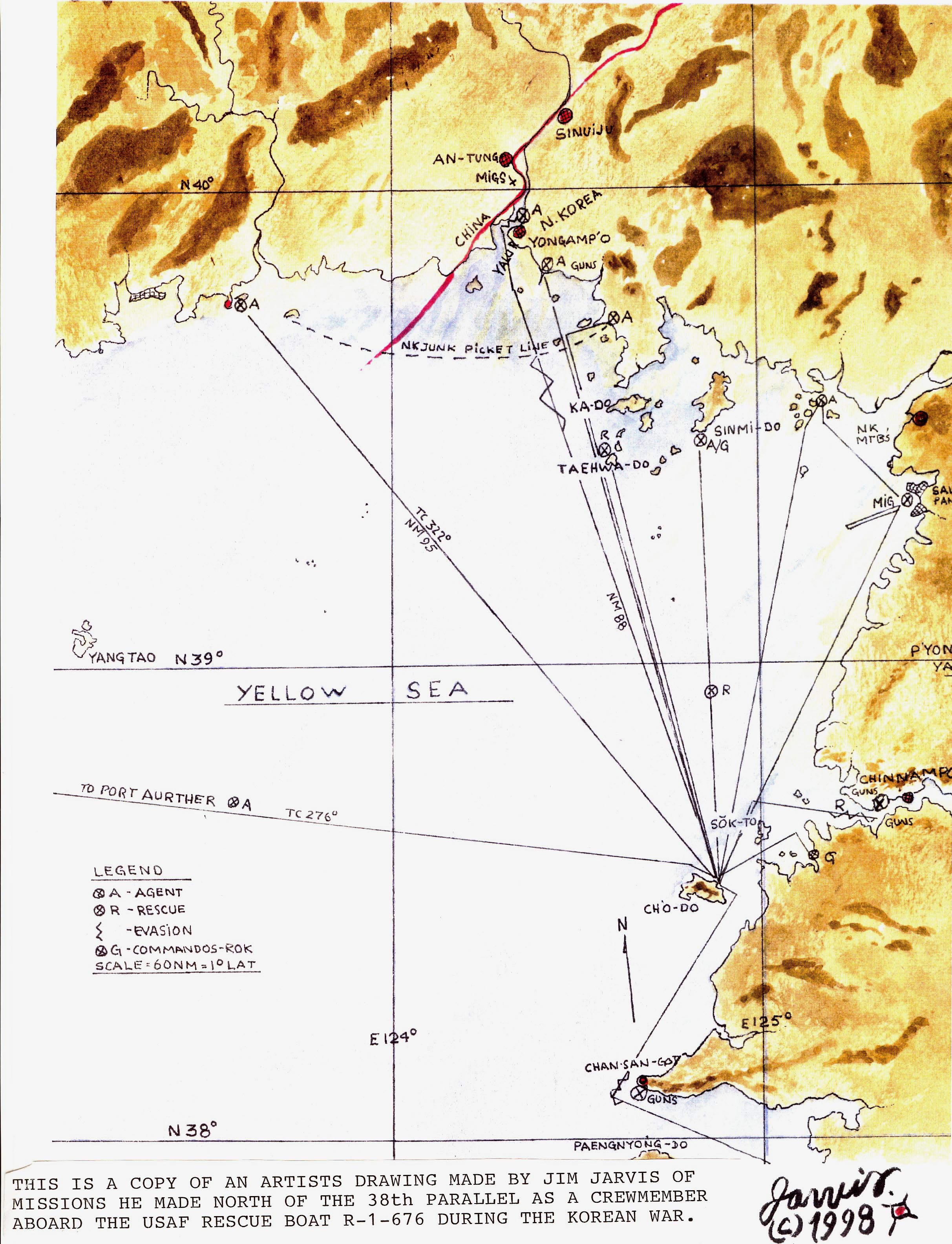
File: Boats at Cho-do\Jarvis Map
The story continues,
We were chastised upon return to Japan after 3 months operating out of Cho-Do, that we should not have patched the bullet holes in our boat (R-1-667) with tin can lids because they rusted, and stained the paint! We should not have worn paratrooper coats and leather flying boots to keep warm; after all we were not in the Army nor were we aircrew. We should have sorted out the spent brass from the .30 caliber and .50 caliber guns into separate barrels before we turned in the brass for new bullets.
This was typical of the different mentality of officers commanding a desk rather than commanding men who were risking their lives. Winter temperatures in Korea frequently went below zero and the personnel in Japan were concerned about those airmen being “out of uniform” for battle, when no adequate uniform was available. Really?
Contrast the "uniform" of the crash boater to that of the submariner dressed for winter bridge duty in heavy wool underwear, a wool shirt, two pairs of special submarine trousers, three pairs of wool socks, aviator's fleece lined boots, plus rubber over boots. He then climbed into an additional pair of trousers lined with sponge rubber and put on more sweaters and a parka. Regular issue rain gear might be added if the weather was particularly foul. Finally two pairs of woolen mittens and sometimes rubber gloves over them. How he moved is beyond me, but he was certainly warmer than a crash boater on the bridge in a Korean winter.
Based on Jarvis’ experience on the R-1-667 and the U-52-1197, the Freight Passenger “mother ship” of the crash boat fleet off North Korea, the majority of the missions were not rescue. They were in support of intelligence operations – period! When a crash boat was discovered by the North Koreans or Chinese, it resulted in open combat at sea against armed North Korean junks, PT boats, and enemy aircraft.
Further, these operations ranged far beyond the so-called UN High Command boundaries. Crash boats and crews ranged from Port Arthur (China) up the Yalu River (China), all the way to the Russian waters off Vladivostok. Working through enemy picket boats to drop UN and South Korean agents, usually in the dark, without radar, without clear specific locations, directed by sometimes overzealous intelligence personnel, the crews prevailed to the man.
Jim Jarvis encouraged his crew to participate in all phases of running the boat. Francis Stroup said, “We learned how to monitor the radios and to steer the boat or whatever, and I found for the first time in my life a sense of “belonging”. It was not until he was sent back to the states that he realized how much he missed the boat and the “buddies” that all of his shipmates had become.
R-1-667 Bob Frankovich, Skipper
R-1-667 Bob Frankovich, skipper after Jim Jarvis, relates “… that two Australian pilots bailed out between Honshu and Korea. The Australian Wing Commander and his Adjutant wanted to see how we were conducting the search. We were out a few hours when the weather worsened. I told the Wing Commander that there was an island about ten miles away and that I was going to go in the lee of the island and ride out the storm. There was a radar site on the island and I called them to see if there was a dock I could tie up to overnight. They said there was but didn't tell me it was a forty foot dock and very difficult to get into. When I tied up, my stern was almost sticking out past the breakwater. A man from the radar site came out to meet us and I asked him what damned idiot told me I could tie up here. He was the Captain in charge and said he was the one that told me. He apologized and said he didn't’t know our boat was so big. I guess he thought I was an officer also, and I never told him any different. After a few minutes I left because my boat was getting beat up at the dock. The Aussies were able to spend the night at the site. We came back the next morning when the weather calmed down and picked them up. Later we took them back to Honshu. When the commander got off the boat he said, ”I thought flying fighter jets was dangerous, but they're easy compared to riding that little boat in that big ocean.”
Prior to the R-1-667 Bob had served in WWII, and in Korea as skipper on R-2-1196, a 63 that saw duty in zones K-3, K-8, K-9, and K-16 in South Korean waters. He had many other assignments in the Pacific, the U.S.., and France in the course of his service in the Navy, AAF, and Air Force. “My time in the boats was the most enjoyable. I made the best friends there. I had some good times and some sad times.” These sentiments have been repeated by several other crash boat veterans.
When he could, Bob traded 10 lb. bags of sugar for vegetables as crewmen were getting sick from a lack of vegetables in their diet. Technically that was illegal, but then technically they were not supposed to be there, and he could not complete his missions without a functioning crew.
Returning pilots “home” could be to a variety of places and generated a variety of “tips”. On returning a British pilot to a British ship, the commander of the ship asked if there was anything they needed. Bob responded that showers would be appreciated as it had been about 2 weeks since their last one. They were welcomed aboard and given clothes to wear and while they were enjoying long, hot showers, the ship’s laundry washed and pressed their uniforms. On another occasion, returning a Marine pilot to his base resulted in their receiving a large box of beef. All the beef in the box had been frozen together and the marine cook didn't want to bother to separate the steaks so he gave them the whole box. However, sometimes there was no “tip”. On returning a U.S.. Navy flyer to a ship, the commander wouldn't even let them top off their water tank.
Another R-1-667 crewman, Bruce Miley, had earlier served on a 63 at K-2 and K-14 (a small airfield south of Inchon. He served on P- 667 for the last 90 days of the war. “Cho-Do recalls some scary moments, like when we started up the Yalu River and hit a sunken Japanese battleship, tearing our rudder about in half. One of the guys dove into the cold water and tied the rudder so we could go straight ahead.
Once we had to go to the aid of a British ship with many wounded, to have our medic assist them. In return they gave us some mutton, which we ate for our last 30 days on station. That incident happened because the ship’s commander told his men to “load and fire” but not in what quantity. By the time they fired their last rockets, the “gooks” zeroed in on them and blasted the hell out of the deck.
Francis Stroup remembers that on another assignment one night and anchored at some little island awaiting orders along with several ROK Navy boats nearby, a B-26 happened to be heading back from his sortie and spotted a light where the pilot knew there should be no lights. "He also just happened to have a 500 pounder left. He figured he would be better off to get rid of it, so he dropped it right in our midst! It was 'all hands on deck' in about a split second. Luckily for us, we were not damaged."
Extracted from The US Air Force Air Rescue Service by Wayne Mutza
After reporting problems with two engines on October 31, 1952 a B-29 bomber returning from Korea to Kedena AFB, Okinawa was met by a search and rescue SB-29. When a third engine quit, the bomber had no choice but to ditch in the sea. SB-29 crew lost sight of the bomber but dropped its lifeboat in an area lit by a flare. The flare burned out, causing the wreck and the lifeboat to disappear in the blackness. An H-19 helicopter that had been dispatched was led to a light spotted by a SC-47crew that had also responded to the scene. The H-19 crew lowered its sling to pick up a survivor but backed off as a crash boat (length undocumented), which could make a safer pick up was approaching. The H-19 continued to light the area while the crash boat rescued two additional survivors.
Boat Beached at Ashiya, Korea
A P-51 Mustang crashed on the beach not far from its base and as luck would have it there were two 63 footers in the area. Jim Connors was tied up to the bridge up the Ashiya River and my boat (Tom Gould writes) was on the way to relieve him, so Jim got there before I did. It was right at dusk and the tower at the base thought he went into the drink but he crashed on the beach, right at the water’s edge. Jim could see him through his glasses as the pilot was walking around in a daze and they could see that he needed help by the blood on his face and head, so Jim put a raft over the side with the medic in it but it capsized when it hit the surf. So Jim’s next move was to beach the boat to give aid to the pilot, which he did as it took the base quite a while to get there due to not having vehicles that could make it through the sand or over the dunes. It was believed that Jim’s action saved the pilot’s life as he was in bad shape.
Then the fun started, getting the 63-footer off the beach! Jim drove it on the beach bow first at full bore with a heavy surf, which really helped to put it high and dry. I should mention that I got there right after the beaching and swung on the hook overnight. Well, the first thing we did when it got light enough to see was to row ashore with a couple of my crew to see what we could do. The first thing we had to do was to pull the props, shafts, struts and rudders. Then we got bulldozers from the base to dig around the hull, sort of built a dry dock. By doing that the hull sank lower in the sand, but we had to be really careful so as not to tip it on its side. So, after all was done, I went back aboard my boat, then got a line to the stern of Jim’s boat, then had a dozer break the dam at the end of Jim’s boat, then with a dozer pushing at the bow and us pulling at the stern, we got it afloat. We took Jim’s boat on the hip and hauled it back to Fukouka. After we tied up eight or nine men collapsed from exhaustion. You had to give those guys credit; they wouldn't give up ‘'til those two boats were tied up and secure. Jim and I went to the club and opened the bar, had a few drinks, and fell asleep right there on the bar. No one ever said a word about it, I guess they knew better, we were beat.
We didn't’t have a boat basin at the time (at Ashiya?) so we tied up in the river with stern lines to the bridge and an anchor off the bow. Conditions weren't’t the best as the crew had to stay aboard at all times.
R-1-664 and Her Mascot "Eightball"
Milton Seagraves- We had a small dog on R-1-664 and her name was "Eightball." One of the other crew members (Keithly) brought the dog on the boat. She liked to drink beer and some of the guys gave her too much beer and she got drunk.
File: CB\Dick Best 3\ Eight Ball
She fell down some ladder steps about four feet and broke her left front leg. We put it in a splint until it healed. Live mascots were fairly common on the boats. The P-399 in the southwest Pacific had a dog named Salty and later a monkey for a short time. In Hawaii, one of the boats at Hickham had a dog named Skipper in 1954. There were many other mascots that I have not recorded.
Standing guard at night on the boat was very difficult. The nights In North Korea were total darkness. You could not see your hand in front of your face. The noise of the wind blowing across your ears and the waves lapping on the side of the boat made it hard to hear much of anything. The dog had very keen hearing and she always stood guard with me and others at night. As I recall, guard duty lasted for two hours.
One night about midnight, when Eightball and I were on guard duty, she started making a low whining noise and I knew something was going on. If I listened very closely, I could hear the distant sound of an engine running at a very low RPM or just idling. Feeling my way along the boat in the dark, I went to the stern of the boat and called to the South Korean house boy (Kim) to come and challenge the intruders. The house boys were also our interpreters. The boat crew is never in a deep sleep. Anything out of the ordinary would always bring several of the crewmen checking to see what was going on. In just a minutes, our boat was a beehive of activity. The skipper turned on the spotlight and lit up the North Korean junk. The house boy went to the bow of the boat and called to them. (I don't know what he said but it was probably "who goes there") No one answered but I could hear the anchor chain clink as the anchor was being lowered. The house boy called again and still no answer. By now, our engines had been started and the anchor line removed. Members of the crew were standing topside with guns. One of the men standing near the bow, shot a machine gun over their heads and through the reed sails. Immediately, a man appeared on the deck and began to shout very loud in Korean with his hands up. Suddenly, the lid to the engine room opened very quickly and out of the heavy diesel smoke came the engineer with his hands up speaking very loudly in Korean. We moved a little closer to the boat but still remained 100 feet away. The skipper contacted the Cho-Do Island Command on the radio and told them about the intruding North Korean junk. They sent a small boat with South Korean soldiers. The two men were taken away as prisoners. I don't know what ever happened to the men or the boat.
Bud Tretter's R-1-664 Experiencs
Bud Tretter recalled that “during the winter the North Yellow Sea iced up to the extent that at times we were iced in and you could walk around the boat on the ice. Occasionally we would use a bazooka to blow holes ahead of us to break up the ice so that we could launch a mission. The cold was so intense, 10 to 30 degrees below zero that we stood only 30 minute watches. By the same token it got just as hot and humid during the summer. Due to the ice during winter, most of our special ops were carried out during the summers or when the ice was not so bad in winter.
Most of our missions (on the 664) were to insert teams of spooks into North Korea, Manchuria and China itself. Places we were not supposed to be. Special Operations 5th Air Force was run by Mr. Don Nichols who kinda reminded me of Marlon Brando in Apocalypse Now. Unfortunately Nichols loved our 85 footers and dreamed up all kinds of things for us to do. It was fairly common for all the boats to insert spies and counterfeit money, ration and identification cards, anything to undercut their economy. We have tied up in the Yalu River for 3 days, waiting for a team of spooks to return, with MIG’s passing over head from their base at Antung Manchuria, we had running gun battles with big diesel powered junks; we strafed little fishing villages at night, operating together with South Korean Elco PT boats. (They originally had 8 boats, but had lost 4 to gun fire).
One of the good things Nichols did for us was to classify our rank. We wore no rank insignia’s. We carried no I.D.. other than our dog tags. There were a couple of good reasons for this. We carried no officers aboard the boats. The boats were manned solely by enlisted personnel. The officers (including skippers) of U.S.., British, and Dutch ships operating in the area did not know anything about us and it was thus easier to get fresh water, food, ammunition, and to take and occasional bath – always in officers’ quarters. The other reason was that many times we were in places that we were not supposed to be and in case of capture, all that they would get was off our dog tags- name and serial number.
When the shooting stopped in June of 1953, I stepped off the 664 and never saw her again. In 1957, the Air Force dis-banded all rescue boats worldwide.
R-1-664 - Robin Lloyd, Master
Robin Lloyd was Master and a certified “Character”. His typical uniform was an Air Force blue overseas cap, bell bottom dungarees, blue shirt with white nylon laces, and his English accent. He was born British but became an American citizen during the war. Robin was at one time a Mate on a British ship. He was a speed reader, reading paperback books in 20 minutes. He was an expert at sending messages in Morse Code using the semaphore light and the semaphore flags.
He came to the U.S.. and his parents owned the "Turn About Circus" in Los Angeles, CA This was a puppet show and at half time everyone got out of their chair and the back row rotated to the front. Those in the front row during the first half were now on the back row for the second half. After he left the USAF be went to Mexico and became a Matador.
Among the many stories about him is the following, as remembered by Bud Tretter:
“I was a member of the R-1-664 while Robin was the skipper. There was a time when the 664 was returning to Cho-Do from a mission up the Yalu River. Upon arrival at Cho-Do, Lloyd had radioed a message to the personnel on the shore station that he was in route with an estimated time of arrival. Upon approaching the harbor at Cho-Do, the 664 was told not to approach and to moor to a floating buoy in the outer harbor. Lloyd then sent a message identifying his boat and that he was proceeding. The shore again warned him away from the anchorage. Lloyd them relayed by Altis Lamp, in Morse code, the following message, ’If we are not granted permission to anchor, we shall open fire with our main batteries!’ After a pause, the 664 was allowed to proceed into the harbor.”
I guess that he had enough of a reputation as a “loose cannon” that it was not a safe bet to call his bluff. But then you had to be a little different to live the crash boat life.
On one occasion on our way to Inchon, from Fukuoka, Milt Seagraves remembers, we had a drive shaft bearing go bad. We stopped near K-10 in southern Korea and an aircraft delivered us a new universal joint in a canister via air drop. The parachute was a bright orange. After installation of the new universal joint we proceeded to Inchon. A day or two after we arrived at Inchon it was necessary for some of us to go to Seoul and visit Don Nichols. We took the jeep and proceeded to Seoul. On the way, it became known that we did not have a pass to get onto the base where Don had his office. Lloyd suggested that we tear the orange parachute into large squares and use it as a kerchief to put around our necks which we did. As we approached the gate, we all saluted the guard and he just waved us on to the base without checking anything.
Post-Korea Recollections
Adapted from an article by William Smith
William Smith, A1C, was in the Navy from August, 1952 to June, 1954, then in the USAF from April, 1955 to February 1959. He was an engineer on R-37A-1276, a repurposed crash boat. He was also a rescue diver during Operation Hardtack at Eniwetok in the Marshall Islands in 1957. His duties included constant exposure to nuclear radiation on the island and in the sea while testing the water. He was one of the two top divers. Individual hazmat suits were nonexistent in those years. In fact, an internet search will yield a number of photos of men working Operation Hardtack with nothing more than swimsuits.
Operation Hardtack was a series of 35 nuclear tests conducted by the United States from April 28 to August 18, 1958 in the Marshall Islands at Eniwetok Atoll and the surrounding area. At the time of tests, the series included more nuclear detonations than all prior nuclear explosions in the Pacific Ocean combined. These tests were part of a bigger series which ran from 1957 to late 1958. The series involved over 19,000 people from the Department of Defense, the Atomic Energy Commission, and other federal agencies.
There were three main research goals. The first was the development of new types of nuclear weapons. The second goal was to examine how underwater explosions affected materiel, especially Navy ships, and was conducted in both open ocean and in a lagoon. The third objective was to analyze high-altitude nuclear tests in order to refine the detection of such tests when conducted by the Soviets, the effects of such tests on the ozone layer, and to investigate defensive practices for combatting ballistic missiles.
William was one of a crew of six men aboard the R-37A-1276 and the only survivor as all the others have died of cancer. Years later he also developed recalcitrant skin lesions diagnosed as basal cell carcinoma, squamous cell carcinoma, and melanoma. William underwent surgery and radiation treatment for the melanoma on his scalp. His scalp was removed six times between 2008 and 2013 to remove melanoma. He was treated with chemo and radiation. The radiation affected his skull which developed osteomyelitis, which required treatment with IV antibiotics for two months in 2013. The radiation was so intense that it caused burns to the side of his face as well as his body down to his waist.
William also recounts another hidden hazard on Eniwetok, the number of suicides there. He was aware of at least 13 deaths while in the area. These were mostly military personnel while on active duty in peace time. He also recounts that he received full compensation for his injuries in 2013 and says it took the V.A. a long time to come through with coverage of the injuries they knew he received from those tests.
Blowing Up Down South
It was 15 Jan. 1955, and Skipper Cliff Helner and his crew were getting ready to run to the Sarasota, Florida area to stand on station, below the air-to-air gunnery range. The crew checked in, the boat went to the refueling dock, took on a load of avgas and stores for the duty run. When all was ready, boat aired out, blowers run, the Chief, TSGT Jessie E. Horner, cranked number one and then number two and went through the standard drill that is required prior to making a long run. The 686 was still at the refueling dock and the crew, along with Skipper Helner, was aboard when, after the engines had been turning for half an hour or so, she started to blow herself apart. First the skipper’s quarters area blew, with the ensuing fire engulfing the boat in no time. Cliff was below, after checking all the forward below deck areas, he started up the ladder from the CPO deck when he was blown from the ladder to the deck. He could not have been more than 15 ft. from the tank that blew. Beat and burned, Cliff went up and out on the bridge and off the deck to the dock. During the trip, Cliff pulled the emergency fire system but the fire had already made it inoperative. Ordering crew to abandon ship, he hit the dock. The crew, after hearing the first explosion, got out and needed no alarm bell. The base fire department quickly arrived and pumped water on the gasoline fire (simply brilliant) to no avail. Skipper Cliff was taken to the base hospital and treated for burns and released a few days later. He was the only one hurt in the fire.
CWOs Snow, Ferguson, and some other crewmen manned two small J Boats and towed the burning 686 away from the dock and onto a sandbar nearby, which they did at great risk as there were still two more tanks to explode. This done, the 686 was left to blow herself apart and burn to the waterline. She had been the best boat in the fleet, having just recently having new Packard engines installed, along with extensive refurbishing. The R-1-684, also build by Simms Brothers, was on the other side of the dock and, had it not been for the crew getting her off the dock fast, she might have ended her career that same day.
Kurt O Brinkman was stationed at Cape Canaveral starting in 1953 on the 85 footer R-1-674 a.k.a. "Dynamite". The other 85 was R-1-673 named "Patches" and there were two other boats, a 42 footer and a large closed bow landing craft. The boats were originally based at Patrick AFB and then stationed in Vero Beach before moving to Cape Canaveral. The two 85s were primarily assigned to range clearance when missiles were fired from Cape Canaveral and had missions taking men and equipment to small Bahamian Islands with tracking stations. Among the "unoffical duties" was keeping a writer on the island of Bimini supplied with good scotch whiskey.
Kurt continued, our flight was commanded by a true gentleman, Chief Warrant Officer Keefer, who looked after my interests a little bit. He was instrumental in getting me to sit for my G.E.D. exam as I had dropped out of high school before graduation. After I retired I became a firefighter for the City of Miami and was driving across the Miami River and spotted two yellow decks and drove to them and found out that film makers purchased them to make the motion picture PT-109.
Skipper of the R-1-674 was M/Sgt. Raymond Chase
- Other members were:
- Radio Op. Wally Stewart
- Deckhand Charlie Locker
- Deckhand Kurt O Brinkman A/2c
- Medic was a man named Mosley
- Staf/Sgt/Logsdon?,
- Enginer Cpl.John Carrier
- Engineer ,Staf/Sgt Walter Stohr,
Now for the rest of the story. It was 15 Jan. 1955, and Skipper Cliff Helner and his crew were getting ready to run to the Sarasota area to stand on station, below the air-to-air gunnery range. The crew checked in, the boat went to the refueling dock, took on a load of avgas and stores for the duty run. When all was ready, boat aired out, blowers run, the Chief, TSGT Jessie E. Horner, cranked number one and then number two and went through the standard drill that is required prior to making a long run. The 686 was still at the refueling dock and the crew, along with Skipper Helner, was aboard when, after the engines had been turning for half an hour or so, she started to blow herself apart. First the skipper’s quarters area blew, with the ensuing fire engulfing the boat in no time. Cliff was below, after checking all the forward below deck areas, he started up the ladder from the CPO deck when he was blown from the ladder to the deck. He could not have been more than 15 ft. from the tank that blew. Beat and burned, Cliff went up and out on the bridge and off the deck to the dock. During the trip, Cliff pulled the emergency fire system, but the fire had already made it inoperative. Ordering crew to abandon ship, he hit the dock. The crew, after hearing the first explosion, got out and needed no alarm bell. The base fire department quickly arrived and pumped water on the gasoline fire (simply brilliant) to no avail. Skipper Cliff was taken to the base hospital and treated for burns and released a few days later. He was the only one hurt in the fire.
CWOs Snow, Ferguson, and some other crewmen manned two small J Boats and towed the burning 686 away from the dock and onto a sandbar nearby, which they did at great risk as there were still two more tanks to explode. This done, the 686 was left to blow herself apart and burn to the waterline. She had been the best boat in the fleet, having just recently having new Packard engines installed, along with extensive refurbishing. The R-1-684, also build by Simms Brothers, was on the other side of the dock and, had it not been for the crew getting her off the dock fast, she might have ended her career that same day.
Kurt O Brinkman, a crewman in he above story, was stationed at Cape Canaveral starting in 1953 on the 85-footer R-1-674 a.k.a. "Dynamite". The other 85 was R-1-673 named "Patches" and there were two other boats, a 42 footer and a large closed bow landing craft. The boats were originally based at Patrick AFB and then stationed in Vero Beach before moving to Cape Canaveral. The two 85s were primarily assigned to range clearance when missiles were fired from Cape Canaveral and had missions taking men and equipment to small Bahamian Islands with tracking stations. Among the "unofficial duties" was keeping a writer on the island of Bimini supplied with good scotch whiskey.
Kurt continued, our flight was commanded by a true gentleman, Chief Warrant Officer Keefer, who looked after my interests a little bit. He was instrumental in getting me to sit for my G.E.D. exam as I had dropped out of high school before graduation. After I retired I became a firefighter for the City of Miami and was driving across the Miami River and spotted two yellow decks and drove to them and found out that film makers purchased them to make the motion picture PT-109.
Skipper of the R-1-674 was M/Sgt. Raymond Chase
- Other members were:
- Radio Op. Wally Stewart
- Deckhand Charlie Locker
- Deckhand Kurt O Brinkman A/2c
- Medic was a man named Mosley
- Staf/Sgt/Logsdon?,
- Enginer Cpl.John Carrier
- Engineer ,Staf/Sgt Walter Stohr,
- Engineer Sgt Dale Hardy
C-3007, The Last 63' Rescue Boat in U.S. Military Service.
The admiral's barge for the Commander In Charge Pacific Fleet was the last 63' rescue boat in U.S. military service. Its primary use in Hawaii was to transport very high-level dignitaries to the USS Arizona Memorial. The superstructure had been highly modified and upgraded to be sure, but it is still a crash boat hull. She was originally built for the Navy in 1957 by Knutson Shipbuilding of Halesite, NY and her original U.S. Navy hull number was C-3007. In November, 1957 she was shipped to N.A.S. Rota, Spain but was returned to Norfolk March 21, 1960 as excess. Then she was stored for five years before being shipped to Hawaii in July of 1965 where she was converted to the CINCPACFLT Admiral's Barge. In 1984 she underwent repairs and upgrades costing $142,000. On November 3, 2017, she transported the President and First Lady, Donald and Melania Trump to the USS Arizona Memorial at Pearl Harbor.
On Sunday, May 19, 2019 at 3:00AM (9:00AM EDT) she caught fire but the fire was under control by 6:15AM and fortunately, there were no injuries. Early speculation was that that the cause was arson. Unofficial reports also indicated that security was poor and that all closed-circuit cameras were old and inoperable. However, later tests found that both motion sensors and light beams used for security were functioning properly and there were no recorded incursions. There was no mention of security cameras. Official sources did not release much information at the time. The fire was first reported by a passerby who reported a large fire on Arizona Memorial Drive. Both Honolulu and Federal Fire depts responded.
William Cole, reporter for the Honolulu Star-Advertiser, reported that the Pacific Fleet operated the C-3007 for dignitary visits, as well as two smaller boats, also moored in the boathouse. Photos after the fire show the admiral's barge with very severe superstructure damage with the remaining wood badly charred, but the hull was still afloat. Lt. Cmdr. Gorman said the two smaller boats are the deputy commander's barge and a remembrance barge, used frequently for historical tours of Pearl Harbor, tours that are currently canceled.
William Cole stated that the Quonset hut type boathouse received some damage but the small attached museum was believed to be undamaged. The extent of the damage to the two smaller boats was not reported, but the Navy confirmed that they were damaged.
Shortly thereafter the Navy hired Pacific Forensics & Consulting LLC (PF&C) to conduct an investigation into the cause of the fire. The rest of this article is basically excerpting from their report. Prior to the end of July, about ten weeks later, they commenced the fire scene investigation. In early September they started their vessel examination and investigation. They also interviewed a Boatswains Mate Master Chief Petty Officer (BMCM) and Special Projects Port Engineer at the fire scene. They also reviewed reports by the Honolulu Fire Dept, and Townsend Shipwrights. The last photos I saw of her were taken in November of 2019 and she was floating at an unidentified dock under shrink wrap but it appears that the superstructure was gone.
PF&C’s report states that during the fire C-3007 broke free of its moorings and floated out of the boathouse. Fire crews continued to fight the fire, resulting in the sinking of the vessel. The Admiral’s Barge was salvaged by Navy personnel and secured in the boathouse. This must have happened fairly quickly as photos taken June 3, 2019 show her afloat and back in the boathouse. This also appears to conflict with the photos supposedly taken on May 19th but I do not see any significance in the discrepancy.
During interviews the BMCM confirmed that the three boats were in the boathouse and had been shutdown using their checklist. The BMCM further stated that on the Admiral’s Barge the onboard generator sometimes shutdown when too many appliances were operated while underway. Days before the fire, tests had been run to recreate the shutdown but no issues were found.
The report by PF&C goes into considerable detail about their investigation of the electrical wiring and fusing of the boathouse. They get into the amperage of the fuses, which ones were open and which were closed etc. Their conclusion was that the boathouse electrical system was not the cause of the fire.
PF&C also examined the shore power cable, its plugs, male and female, including X-ray examination and found no evidence of arcing. The CINPACFLT receptacle was examined under a stereo microscope, coupled with an X-ray exam and all were ruled out as the cause of the fire. The shore power cable was connected to the Admiral’s Barge by an electrical power inlet mounted directly to the port side of the barge, directly below a metal air intake. The shore power cable near the electrical inlet, although extensively burned, showed no indication of arcing. The bottom line on the shore power cable was that it was not the cause of the fire.
The Admiral’s Barge sustained heavy fire damage that consumed the upper deck structures including the pilot house, cabins and an important crawlspace. The crawlspace was located in front of the pilot house and accessed by a galley ladder on the port side. In the photo above, the crawlspace is the area directly behind the deck box and extends to the point where the shore power cable connects to the boat and includes the air vent above it. The crawlspace contained air conditioning and ventilation systems, battery trickle charger and the electrical power inlet connector that supplied shore power to the barge.
The electrical panels were located near the port galley ladder and included AC circuit breakers and DC fuses. The expected circuit breakers were in the ON position and none were in the TRIPPED position. A TRIPPED condition can be caused by an electrical failure of a component and /or conductor damage/chaffing (fire cause), or it may be the result of fire impingement while the conductor is energized (fire victim). PF&C commented, fire cause/fire victim determination of electrical activity (arcing) must be coupled to fire patterns, fire dynamics and the totality of scene evidence.
Two circuits (10 & 15 amp) labeled BATTERY CHARGER could not be traced due to heavy fire damage and the collapse of the crawlspace and pilot house. However, it is likely that they were connected to the trickle chargers. PF&C goes into a lot of detail about the battery chargers, batteries related circuits but the bottom line is that there were no obvious signs of arcing. Nor was there evidence of arcing on electrical conductors in the galley on the port side of the barge, indicating that they were de-energized when impacted by the fire. The diesel engine batteries were ruled out as the cause of the fire.
Examination of the diesel generator battery, and conductors revealed arcing. The observed arcing was the result of a direct short to ground from fire suppression (water application) which blew the 100-amp fuse and isolated the diesel generator battery from the electrical panels. The arcing was the result of the fire and firefighting activities, not the cause of the fire.
Based on fire pattern analysis, fire dynamics, and arc mapping of the electrical system, the general area of fire origin was within the crawlspace fronting the pilot house. The specific area was narrowed down to two locations;
- The electrical power inlet/connectors to the electrical panel.
- The starboard battery charging conductors (wires) from the battery trickle charger to the starboard battery space.
Unfortunately, physical evidence to support the cause of the fire was not identified due to the heavy fire damage and resulting structural collapse.
Conclusions of Pacific Forensic & Consulting:
- The boathouse was ruled out as the cause of the fire.
- The shore power cable was ruled out as the cause of the fire.
- The general area of origin was the Admiral’s Barge, within the crawlspace fronting the pilot house.
- The specific area of origin was narrowed down to two locations, see above.
- The exact cause could not to be determined due to heavy fire damage to the Admiral’s Barge.
I was in steady contact with the Public Information Office in Hawaii during the investigation and in March I was informed that I would need to file a Freedom of Information Act Request in order to recieve a redacted copy of the report. During this time Navy personnel were most courteous and cooperative. The delay in supplying the report was due to complications due to the Coronavirus and they stayed in regular contact during this time. The very slightly redacted report was finally delivered on May 19, 2020, exactly one year after the fire.
Separate from the findings of PF&C, the Navy determined that C-3007 was a total loss and she was scrapped, thus ending the career of the last crash boat in military service.
Strange Stories or Tall Tales?
Raceday, PT Boat vs. 85-ft Rescue Boat
The following story was provided to me by the son of a man who skippered an 85-foot Rescue Boat. He was one of the early sponsors the Veterans Tales website and goes only by the name “Proud American”. I have not attempted to verify the story, but its a good one about an 85-ft crash boat outrunning a loaded PT boat, in spite of being short one engine. I have heard similar stories about 85s outrunning PT boats from other sources.
His story:
My father in WW2/Pacific, was a commander of a search & rescue squadron. One piece of equipment that he spent quite a bit of time on was an 85 ft. rescue boat. Similar to the PT boats that were famous in the Pacific only a bit longer, they had some enhancements to the engine compartment, namely a water injection system for added horsepower on a short-term basis (unverified but technically possible, CHR). Anyway, one day my father was on his way out, and the port had a long “no wake” zone. As the boat was leaving, he got to the narrow channel just a bit earlier than this PT. Now the commander of the PT arrogantly pushed his throttle a little past the speed limit. My father, as he tells it, was not going to be swamped by this arrogant bastard, so increased his speed to maintain the lead, avoiding the wake.
As to be expected, the response from both was to continue this tit-for-tat. Both were way out of bounds on regulations at this point and Full Ahead! Good ole dad, knowing he was going to face the wrath from the base commander, just couldn’t lose the race, and his last chance was to reach up and apply his water injection button.
He did win the race. The PT had to react and slowed down, to avoid going aground. Of course he was called on the carpet for “willful disregard” of regulations. But being the first boat out of the channel was his saving grace. That arrogant S*B from the PT was not going to be officially reprimanded, so neither was my dad.
With a chuckle, as my dad told me the story, everybody has to follow the rules, but if you break them, just make sure you win. And during the dressing down that they both received, was the only time he would meet, in person, the commander of PT 109.
R1-685 & Friendly Fire
It was May 2, 1955, when one of my friends was being processed into the boat squadron, we were talking on the dock when the dispatcher called down and said a fishing boat on the range was holding up operations. He asked that we go out to clear the ranges as quickly as possible. We always liked to hear the need for speed, as our engines were kept warm and we liked to be first. I asked my friend if he would like a ride. "Okay", he said. We never thought what might happen -- we just jumped aboard and took off.
As we rounded the corner, we could see the fishing boat on the west side of the range heading east. We had to cross the range to intercept the fishing boat. Out in the middle of the range, we looked north and spotted an F-80 coming toward us. He was doing a barrel roll as if he were going to fire on us. We thought it might be a joke, as mission control knew we were on the range. But we didn't know the tower had no contact with him. He was already on his wet run, ready to fire! As the pilot came off the roll, he recognized our crash boat colors. He later told us we had only seconds to live.
When we returned to operations, the range chief told us we nearly bought the farm. The pilot had not seen the fishing boat and figured we were a target until he recognized our distinctive colors. So once again, the crash boats saved lives. (by Pug Early)
The Demise of P-82, an 83-ft. Crash Boat
83 ft. Rescue Boat P-82
P-82 was still in civilian service until June 2013. She was run aground on rocks near Gloucester, MA by her owner. After 15 to 20 minutes of work she was towed back to Gloucester by a 24' harbormaster's boat. Mr. Collins, the owner, indicated at the time that he no longer wanted the boat and would abandon it at the fishing pier to which she was towed and that is what he did. Apparently he bought her with the intent to at least "fix her up" but never had the money.
During the period 2015 to 2016, an interested party attempted to arrange the donation of P-82 to a maritime museum in Cambridge, MD and was willing to cover the transportation costs to Cambridge. However, the museum also wanted a significant dowry to come with the boat to cover future costs, not an unusual stipulation, and that became a dealbreaker. Later in 2016 P-82 was auctioned off to a salvage company who expected to scrap her and salvage the copper and brass. While waiting to be moved she was tied to a derelict pier in Boston and got up on a pile during an unusually high tide. P-82 rolled over as the tide dropped through its 12-foot range and she sank.
104-ft. Gambler & Stripper Runs
Disclaimer: I received this account by email and have not researched the story for accuracy. The names are those remembered by Wayne P. However, in broad terms it tells the story of how these boats generally migrated to folks with lower budgets until they were destroyed from neglect or lack of finances.
Background: Wayne never knew the hull number. When originally built she had a single rudder and 3 engines. He was always told she was a Stephens Brothers build. It did have an oak ice shield but that was removed to replace hull planking. That would be consistent with a Stephens Brothers boat. They built boats with ice shields for service in Alaska and most were built with three Hall-Scot engines and a single rudder. Among the most likely candidates are P-114 and P-115, then P-141 through P-146.
The middle propeller was removed when she was repowered with two 6-71 engines with 3 to 1 twin disc air shift transmissions. The transmissions were always an issue with the tiny air compressor it had. For the last trip from Long Beach to Channel Islands, Wayne tapped into the horn air supply in the pilot house, teed in a fitting and hooked a scuba tank hose to it. That came in handy in Channel Islands to keep the pressure up during turns. She had two 3-blade 32” x 30 pitch props. The boat was converted by the publisher of the Long Beach Press Telegram, possibly Daniel Ridder.
Boat History: Wayne met the son of the owner named Cross who owned the boat before the mid-1970s. Wayne was told that Mr. Cross had two 104s and a 165’ minesweeper that did gambling and stripper runs to Mexico. Mr. Cross did a drug run and the crew had a fight on the dock over who was to get how much money and they all got arrested… Mr. Cross did 5 years and the boat was probably sold. Wayne thinks the drug run was in his second 104’ (Why do you think that?) again, name unknown.
Sometime later (lmid-1970s?) it became the Magnifico, owned by Rick Compton, who did dive trips to the Channel Islands. The boat was also in the movie The Grey Lady Down as the annoying party boat. The lower aft cabin was shown in that movie with really strange with the upward camera angle as the floor was so high because of the wet exhaust under the sole.
Rick had borrowed some money from connected loan sharks and he must have given them ownership papers as collateral. They took those papers and got California ownership papers.
The sharks took the papers to the LA County sheriff’s office in Marina Del Rey. The captain there was future Sheriff Baca of LA County, later a convicted felon. Rick had heard what was up and was motoring out of Marina Del Rey and Sheriff Baca went out and turned over the supposedly federally documented boat to the California paper holding mobsters. Wayne informs me that Sherrif Baca said that California papers take presentence over federal government papers, as he removed Compton from the Magnifico. The boat was impounded for many years where a lot of brass was stripped and it had a lot of hull damage from a lack of maintenance, except sticking a hose thru a port hole to pump it out.
In 1979 Wayne’s friend John Fischer bought it from Rick Compton. Fischer proceeded to repair the damage to the hull with a lot of new planks below and above the water line. She also got new decks during that time.
John Fischer renamed the boat The Fantasea. At that time, she still had a single rudder, originally having been built with three screws. John installed additional rudders from a 165-foot mine sweeper being scrapped at Commercial Marine on Terminal Island. The three rudders really made it turn tight. While going to Channel Islands we, John and Wayne, overnighted at Marina Del Rey while waiting for the sailboat race to all come in. Wayne played at the helm and with it hard over Ihe could get the bow to do about a 50-foot circle as the stern swung.
In the early 1980s, while at Commercial Marine on Terminal Island,
she was dropped on her side while being pulling out on the ways. They refloated her. Then hauled her again and dropped her even farther knocking the cabin loose from the deck and causing most of the hull to need to be refastened; years were spent fighting with the insurance company. Commercial Marine, both the owner and the staff, swore that they never dropped her on her side.
She lived at anchor in Santa Barbara for a bunch of years. She sat a pier 2 in Long Beach, Alameda’s Bay for 13 years then moved over to B channel Newmark’s landing for a bunch more. (1990 to about 2000?) Eventually John and Wayne moved her to Chanel Islands Harbor. When we got to Channel Islands there was an event. A guy in a small sailboat had tied up to the middle of the harbor masters dock right in front of us. We had to go past and turn in the basin then come back and swing again just south of the coast guard dock. John swung wide and almost clipped the 41 and the 82-foot coast guard boat bows with our transom.
As we tied up to the harbor master’s dock. John ran into the harbor master’s office. The entire coast guard station emptied onto the harbor masters dock, sticking their heads in port holes and saying. “Can we go aboard for a safety inspection?” Wayne bogarted them out of that. I could not believe that worked but it did. In 2002 John anchored about a quarter mile off Butterfly Beach in Santa Barbara and shortly after that he went ashore and got a prostate biopsy, then a horrible blood infection when he was back aboard. At some point he was out cold for an unknown amount of time but the generator failed. He awoke to find water deep below deck. John told Wayne that the fog was so dense that the Coast Guard and the harbor patrol would not come out and bring a pump, so she sank at anchor. According to John. Wayne could see her in google maps satellite view for many years, the many gallons of white Imron paint shining from about 35 feet underwater. Eventually she was removed and scrapped.
I miss the boat; it was always a nice get away. I spend about 22 years helping John with it. John passed away back in 2014.
P-215 Missionary Cruise
Bill Warner, the retired director of the Assemblies of God Archives and Museum, wrote this note about P-215, a sister ship of P-216:
In 1950 Ralph Devin, an Assembly of God missionary to Indonesia, wanted a boat to minister in the islands of Indonesia and New Guinea. He convinced the missionary executives to buy a converted 1943 Army Rescue Boat, the P-215 (used in Alaska and called “Sealaska”). After being refurbished in Seattle and renamed “Evangel”, Devin and his crew took the boat to Jakarta via San Francisco and Hawaii. In 1989 Bill Warner wrote a story about their 5-month trip, with their many mechanical and political problems. Originally planned as a 2-month trip, they lost the rudder in Kwajalein, suffered seasickness, food poisoning, and experienced engine troubles. Fortunately, they were able to buy salvaged parts on an island to get them to Jakarta. The boat was sold to the Indonesian police in 1954, after being used for missionary service for only 4 years.
The Evangel Crosses the Pacific is available from the Flower Pentecostal Heritage center, Springfield, MO (IFPHC.org)