Prototype 52 ft. and 55 ft. Crash Boats
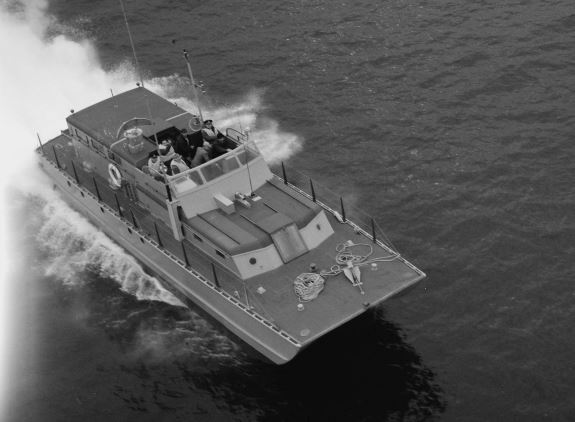
File: 55ft\close-up
Documentation on the next experimental boat is far thinner, but a handful of photographs preserved in the National Archives—and reproduced in the Photos & Missions section—confirm that the Air Force tested a very unusual craft in the mid‑1950s: R‑22‑1325, a 55‑foot experimental crash boat with a 16‑foot beam, built by the Grebe Boatyard in Chicago around 1953–54. Seen from the air, she was unmistakable—unlike any other crash boat in the inventory.
Trials in 1954 revealed just how radical she was. With two post‑war Packard engines producing roughly 2,000 brake horsepower each—likely highly supercharged 4M‑2500s or the extremely rare 1M‑3300s—she reached an astonishing 70 miles per hour. At that speed she behaved less like a rescue craft and more like an offshore racing boat, complete with a towering rooster tail. When fitted with two 750‑hp Packard 1D‑2270 diesels, she still managed 47 mph, and with two Hall‑Scott engines she ran at 40 mph. But 70 mph was simply too fast; the boat spent as much time airborne as in the water.
R‑22‑1325 remains one of the more enigmatic chapters in Air Force crash‑boat history—a bold experiment in speed and design that left behind only a few photographs, a handful of test notes, and a trail of conflicting stories.
According to the AAF–USAF Crash Rescue Boat Association newsletter, the vessel eventually found her way into civilian hands. By 1990 she was reportedly owned by Allen Valek of Delray Beach, Florida, and had been converted into a yacht. Yet the photograph accompanying that article does not match the hull seen in the National Archives images. It is far more likely that the boat pictured in the newsletter was one of the Chris‑Craft–built crash boats shown below and elsewhere on the site, rather than the unique Grebe‑built experimental craft.
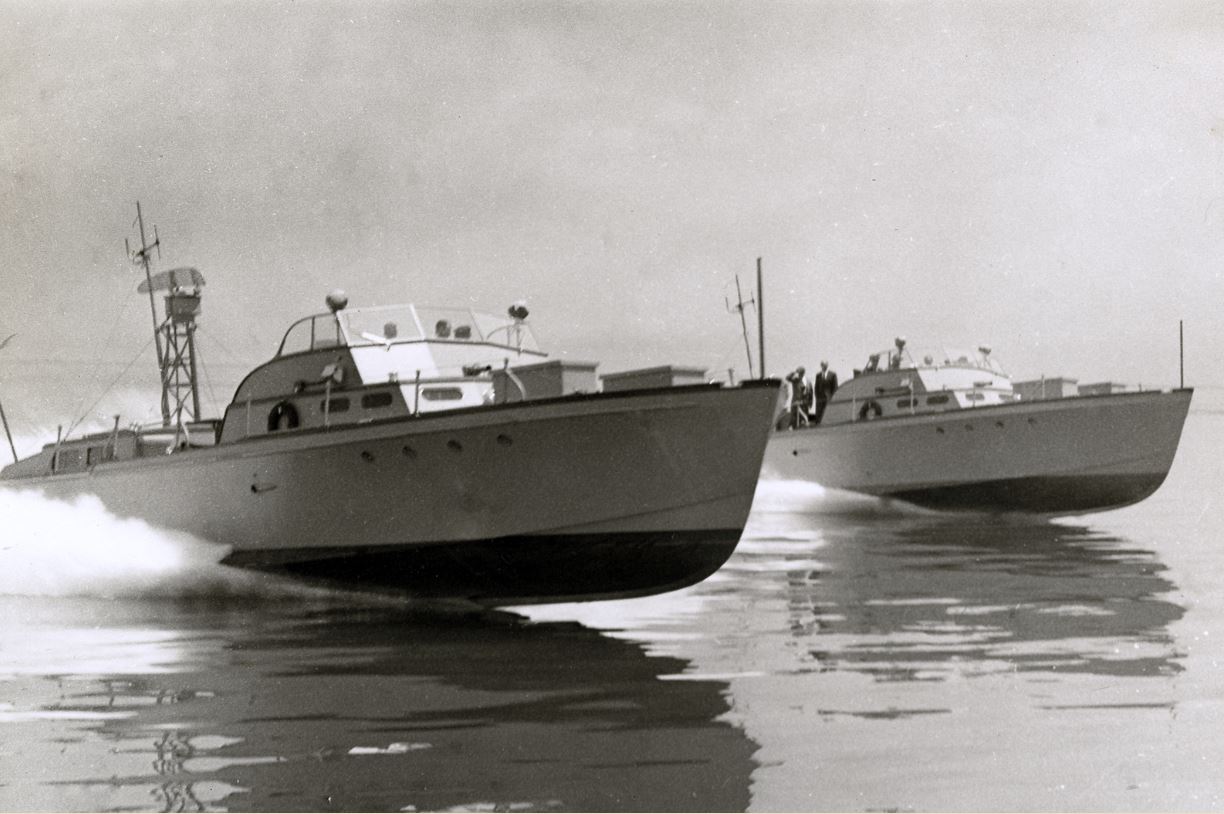
File: 52ft Chris-Craft\Photo of 2
Two prototype 52‑foot crash boats emerged from the Chris‑Craft yards at the dawn of the 1950s, each representing a slightly different approach to the same experimental design. The first, C‑7161, carried a straightforward direct‑drive arrangement. Her sister, C‑7172, was fitted with a vee‑drive system built by Western Gear Works—a mechanical choice that set the two boats apart from the moment their engines first turned over.
Although some sources have repeated earlier dates from the 1940–42 period, the Navy specifications stamped November 30, 1950 tell a more convincing story. Even the placement of the stern antenna aligns with this later date, reinforcing the conclusion that these boats belonged firmly to the postwar era of experimentation rather than the wartime production surge.
Their construction reflected Chris‑Craft’s trademark craftsmanship: double‑planked mahogany hulls sheathed in 5/8‑inch teak decking laid over a ¼‑inch plywood sub‑deck. Both prototypes carried a transom gate and propeller guards—practical features for rescue work—and were equipped with a surprisingly capable hot‑water heating system. Even in 30‑degree weather, the boats could maintain a 70‑degree interior, a 40‑degree lift that spoke to their intended all‑weather readiness. Fully loaded, each boat displaced between 48,000 and 50,000 pounds, substantial mass for their length.
Beneath the deck, the real personality of these prototypes came alive. Each boat carried a pair of Packard 4M‑2500 W‑14 engines, driving twin right‑hand 28‑inch propellers pitched at 29 inches. These engines delivered formidable power, 1350bhp each at 2,400 rpm.
Together, the hull design and the Packards made the 52‑foot prototypes fast, muscular, and unmistakably part of the Navy’s postwar search for the next generation of high‑performance rescue craft.